Take . Despite the source's terminology, is a dimensionless conditional bound-state probability at phase , not a spatially normalized probability density; the phase-average bound fraction is . The given equation has advection and binding reactions but no diffusion term. Large permits the prescribed steady approximation.
For spatially gated myosin attachment, define , , and . Continuity and periodicity give , , hence . The full periodic steady solution isThe requested limit makes , so and . The curve rises exponentially over the binding window, remains flat to , then decays over length to an exponentially small value before the next period. The piecewise expression is continuous at both switching points and at the period boundary.
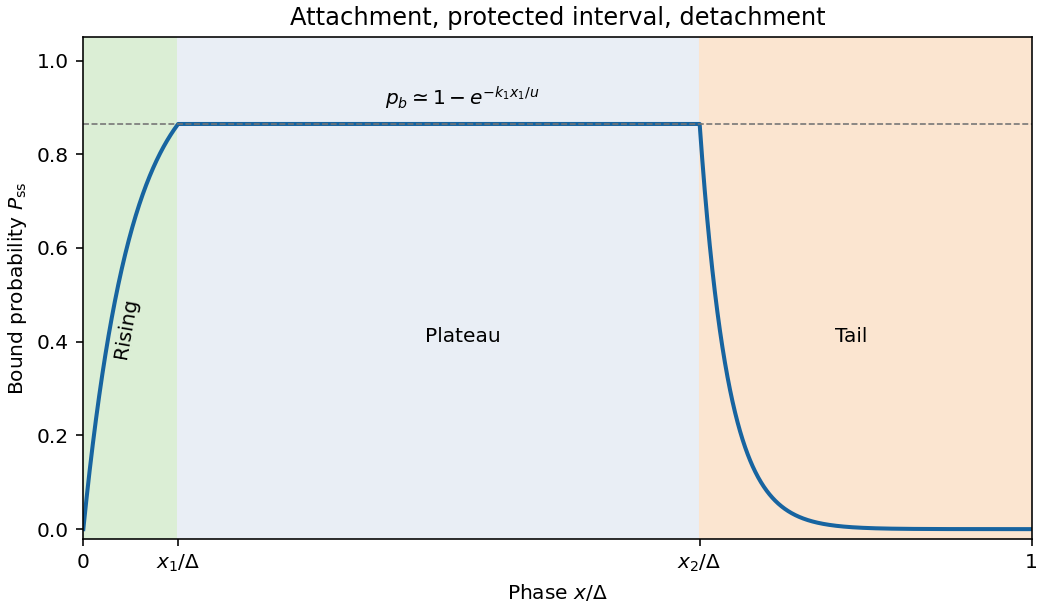
For a head sampling phases uniformly during steady sliding, its mean force is times the phase-average bound probability. In the limit of spatially gated myosin attachment, integrating the three intervals givesThe first integral is bounded by , and the last by . Relative to the plateau contribution, they are negligible when and , respectively. ThereforeThis is a constant-force spatially gated motor approximation: complete detachment between binding windows, a narrow attachment window, a short detachment tail and essentially fixed sliding velocity. In particular, need not be small.
Put and . The constant-force spatially gated motor producesThe limit is approached after the periodic steady state is established; at exactly arbitrary initially bound heads in inactive phase intervals need not equilibrate. The curve decreases from and has formal large- tail . Extrapolation of that tail beyond the small- detachment assumptions is not controlled.
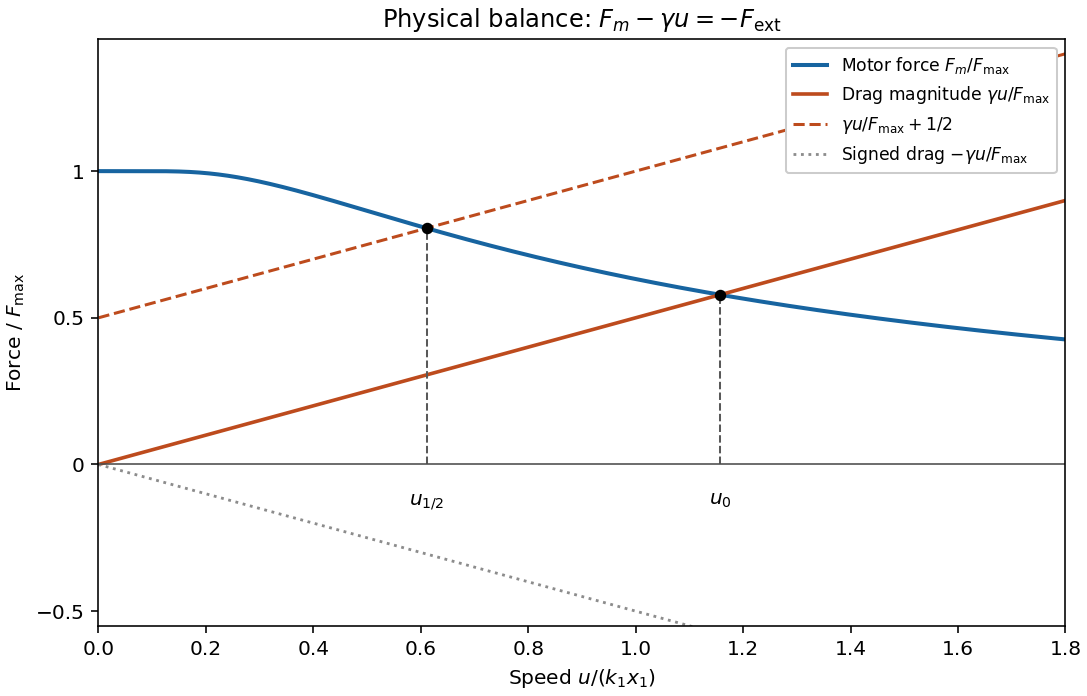
Sign inconsistency in the printed force balance. For a positive viscous drag coefficient , the signed drag force is . The printed cannot give the requested positive no-load contraction speed: both last terms are positive when . With , the left side starts at and may have zero, one or two positive roots depending on parameters; the requested usual load construction is not implied by that equation.
The physical linear-drag load curve for a spatially gated motor usesOn the same axes plot the positive drag magnitude and the decreasing motor force . The no-load speed is their intersection. For opposing load , intersect with the parallel raised line ; equivalently intersect with . Drop verticals to the speed axis. The loaded speed obeys . Each intersection is unique because decreases and increases. The signed drag is also indicated below the axis in the sketch.


Articles by others on the same topic
There are currently no matching articles.