The Milne-Thomson circle theorem constructs a circular impermeable boundary in planar potential flow. Suppose is an incident complex potential of a two-dimensional potential flow with no singularities on or inside . Thenis a complex potential of a two-dimensional potential flow outside the circle, with the same exterior singularities and their strengths as the incident flow; the added image singularities lie inside the excluded disk. On , , so is real. Its imaginary part, the streamfunction, is constant on the circle, proving the no-penetration boundary condition. The theorem gives the usual zero-circulation construction; a separately prescribed circulation can be added by its logarithmic vortex potential.
A uniform flow with physical velocity has complex velocity and incident potential . Apply the Milne-Thomson circle theorem with :Indeed, on it is , which is real, so the boundary is a streamline. At infinity, , verifying the specified incoming uniform flow.
Parameterize the unit circle by . Under the Joukowski map,Consequently its image is the ellipsewith horizontal and vertical semi-axesBoth are positive because . The horizontal axis is the major axis. The derivative is nonzero for . Also, equality of two images implies ; two distinct exterior points cannot satisfy the second factor since . Thus the exterior map is one-to-one, mapping the exterior of the unit circle conformally onto the exterior of the ellipse.
At large , , so the map tends to the identity. Its exterior inverse has the expansion . Therefore the physical complex potential of a two-dimensional potential flow is , withIts leading term is unchanged, so the far-field velocity still has magnitude and inclination .
The chain rule gives the complex velocity:The parameter denotes the unique exterior preimage of . If an expression solely in is desired, takewhere the exterior holomorphic square root is chosen so that at infinity. Its branch points lie inside the ellipse. This is uniform potential flow around an ellipse.
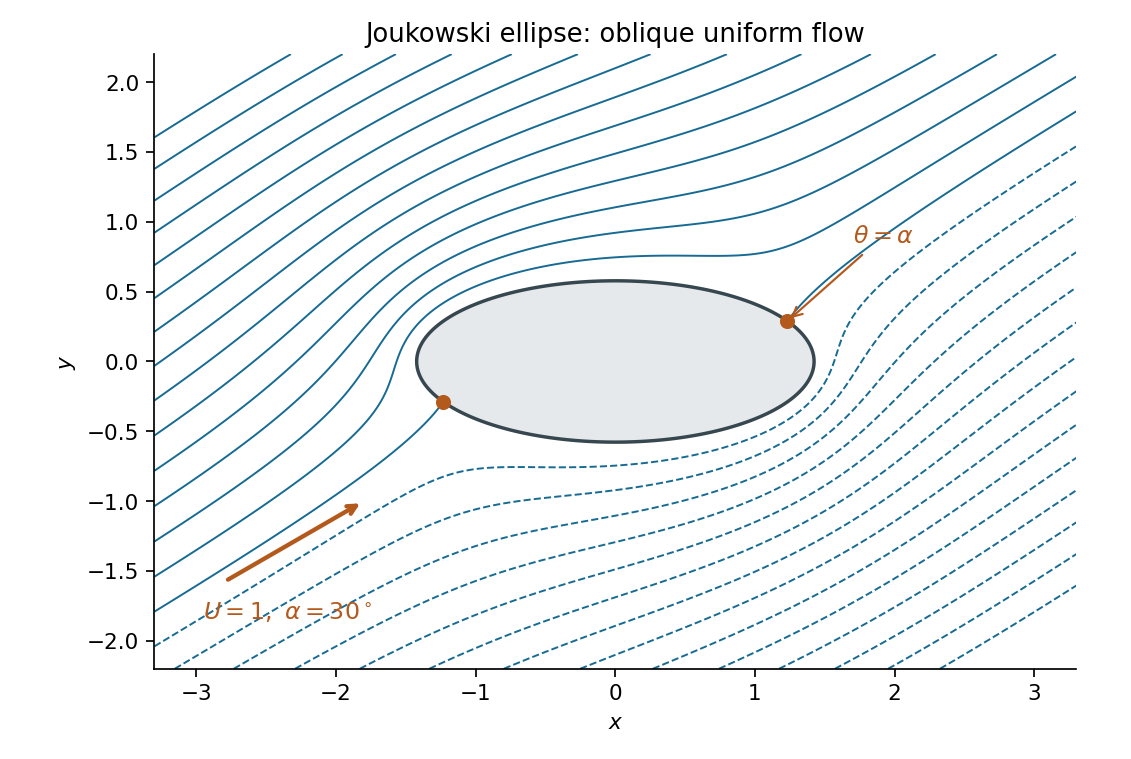
The complex velocity vanishes where , provided its denominator is nonzero. Thus . Both lie on the unit circle, and since . Mapping these points into the physical plane givesEquivalently, the two stagnation points are the opposite points and on the ellipse. The conformal map preserves the zeros of the complex velocity here because its derivative is finite and nonzero on the boundary.

Articles by others on the same topic
There are currently no matching articles.