The total velocity fields on the two sides areEach base flow is divergence-free. Incompressibility therefore makes both disturbance velocity potentials satisfy the Laplace equation:At the fixed horizontal walls, impermeability requires zero vertical velocity:The discontinuity in tangential base velocity at the interface is a vortex sheet. The assumption of irrotational flow is understood separately in each open fluid region; it cannot hold distributionally across that sheet when .
The interface is material. Applying the kinematic boundary condition to gives, exactly,The disturbance velocities and are small. Products of two disturbance quantities are second order, and a Taylor expansion moves their evaluation to at linear order. HenceThe extra upper-fluid term is advection of the displaced interface by the base uniform flow.
Use the Unsteady Bernoulli equation separately on each side, with constant mass density . There are no restoring terms specified at this internal interface, and its pressure is continuous. Choose the time-dependent potential gauges so that the undisturbed pressure is on both sides. Subtracting the base values from Bernoulli's principle gives, at linear order,The quadratic disturbance-velocity terms have been discarded, while the cross term with the base velocity is first order and must remain. Equating the perturbation pressures yields the third condition:
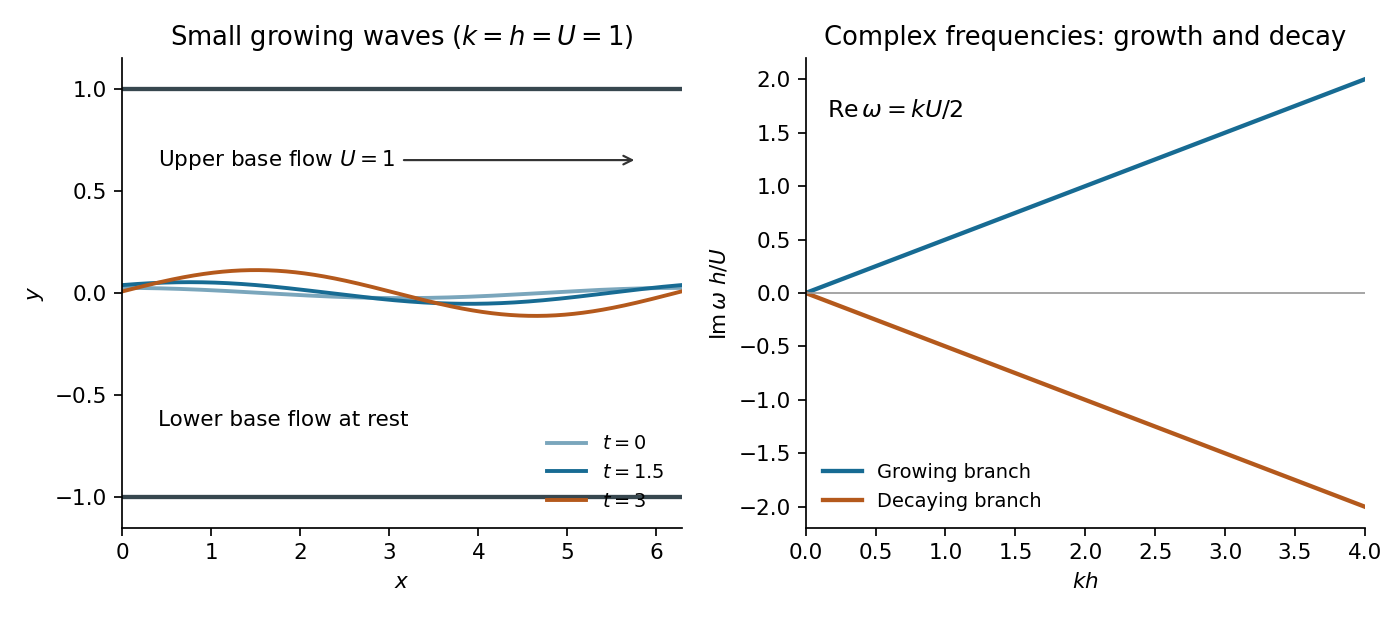
Use complex normal modes and take their real parts at the end. Write , with . The Laplace equation and the wall Neumann boundary conditions give the vertical formsAt , the two kinematic boundary conditions becomeThusThe dynamic condition isSubstituting the two amplitudes and cancelling the common nonzero depth factor gives the dispersion relation for a vortex sheet in a symmetric rigid channel:Equivalently,For the specified , the plus sign gives positive temporal growth rate in the convention . A real growing interface displacement is thereforeThe other branch decays at the same rate. Consequently the interface is linearly unstable, exhibiting Kelvin-Helmholtz instability. There is no nonzero-amplitude mode with a purely real temporal frequency for and ; the paper's sinusoidal notation must allow a complex frequency, with the physical displacement obtained by a real part.
The wave pattern is advected at speed , the mean of the two base velocities. The growth rate is independent of here because both layers have the same mass density and the same depth, making their factors cancel. In an asymmetric channel those inertia factors would differ. In the zero-shear limit , the two roots merge at zero and there is no exponential growth.

Articles by others on the same topic
There are currently no matching articles.