Work away from the line source, so . In polar coordinates, and . The supplied divergence and curl formulas giveHence the field defines an incompressible flow and an irrotational flow for . The restriction matters: the outward volume flux through any enclosing circle isThe origin is the excluded injection point. Applying the divergence theorem to a disk through that singularity would violate its smoothness hypothesis.
A velocity potential satisfies . Integration of and givesChoose the streamfunction convention , . Its streamfunction in polar coordinates satisfies and , soAdditive constants are immaterial. This complex potential of a two-dimensional potential flow is defined on a chosen logarithm branch. Its complex velocity is single-valued away from the origin. Continuing once around the line source increases by , consistently with its nonzero volume flux.
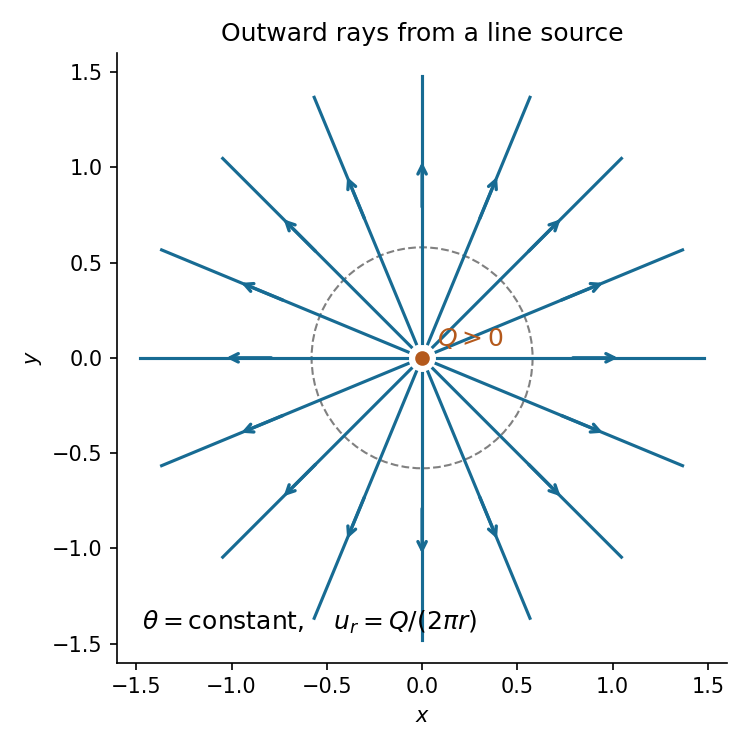
The streamlines are the level curves of the streamfunction, so is constant: radial rays directed outwards from the origin. Their arrows point outwards because . A complete straight line through the origin comprises two distinct rays separated by the excluded line source. Equivalently, and along each pathline; the steady flow makes these the same curves as the streamlines.

Articles by others on the same topic
There are currently no matching articles.