For a scalar fluid property , the Eulerian time derivative measures change at a fixed Eulerian coordinate. The material derivative, also called the Lagrangian time derivative, measures change while following one fluid element. If its Lagrangian trajectory is , where is its fixed Lagrangian coordinate, then .
The chain rule therefore givesThe last term accounts for entering a region where the property differs. For example, a spatially varying but time-independent velocity field has zero Eulerian time derivative, while a moving fluid element can have nonzero material acceleration. The same formula applies componentwise to a vector field.
Let be a smoothly moving material volume, carried by a smooth velocity field , and let be continuously differentiable. The material-volume form of the Reynolds transport theorem statesEquivalently, the divergence theorem giveswhere is the outward unit normal vector. The second integral measures the flux carried across the instantaneous boundary by its motion.
For the proof, use the particle map from , with positive Jacobian determinant . Euler's volume identity isIt is the Jacobian evolution of a smooth flow: if , differentiation gives , and differentiation of the determinant gives . The change of variables formula now moves the integral to the fixed reference volume:Finally, , giving the equivalent boundary form.
Write for the mass density. A material volume contains the same fluid elements at all times, so conservation of mass requiresby the Reynolds transport theorem. Since the initial material volume can be chosen arbitrarily, continuity of the integrand forces it to vanish pointwise. Thus the continuity equation isFor positive mass density, the incompressibility condition reduces this to . Mass conservation itself does not require incompressible flow.
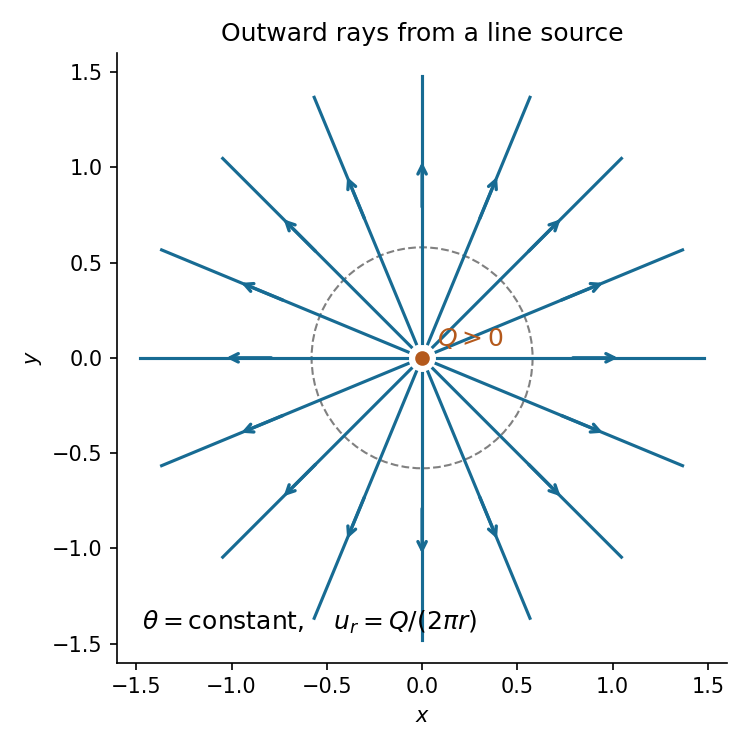
Work away from the line source, so . In polar coordinates, and . The supplied divergence and curl formulas giveHence the field defines an incompressible flow and an irrotational flow for . The restriction matters: the outward volume flux through any enclosing circle isThe origin is the excluded injection point. Applying the divergence theorem to a disk through that singularity would violate its smoothness hypothesis.
A velocity potential satisfies . Integration of and givesChoose the streamfunction convention , . Its streamfunction in polar coordinates satisfies and , soAdditive constants are immaterial. This complex potential of a two-dimensional potential flow is defined on a chosen logarithm branch. Its complex velocity is single-valued away from the origin. Continuing once around the line source increases by , consistently with its nonzero volume flux.
The streamlines are the level curves of the streamfunction, so is constant: radial rays directed outwards from the origin. Their arrows point outwards because . A complete straight line through the origin comprises two distinct rays separated by the excluded line source. Equivalently, and along each pathline; the steady flow makes these the same curves as the streamlines.

Set . The hyperbolic cosine addition formula givesFor and , both factors in the imaginary part are positive. Thus the image lies in the upper half-plane. The three walls map onto the entire real axis:Also in the interior.
To verify that this is a one-to-one conformal map onto the whole upper half-plane, factor it through . This first map is one-to-one onto , , and . Given any , the roots of have product one. Neither lies on , since that would make real. Exactly one root therefore has , andforces that root into the upper half of the exterior disk. It has a unique preimage with . This proves both surjectivity and injectivity. The construction is the hyperbolic-cosine map of a half-strip.
The source location is complex, with and . Put , so . The method of images places an equal line source at below the real axis:For real , the product of the two logarithm arguments is . Hence the streamfunction is constant along the wall, on locally consistent branches of the complex logarithm, and there is no normal velocity. Pulling back gives the requested complex potential of a two-dimensional potential flow:This is the line source in a closed-end semi-infinite strip, with no extra imposed flow. Since , near the physical source . Thus a regular term, verifying that the source strength remains under the conformal map. The image source has no preimage inside the physical strip. Finally, as , a constant, so the far-field velocity is and the channel carries exactly the injected volume flux .
Articles by others on the same topic
There are currently no matching articles.