Assume so that the Higgs potential is bounded below, and work at tree level in four spacetime dimensions with metric . For , the minimum is . The quadratic terms describe three massless gauge bosons and two complex scalars of mass , equivalently four real scalar degrees of freedom. These are the perturbative particle masses about this vacuum, without a claim about the nonperturbative asymptotic spectrum of an interacting non-Abelian theory.
Expanding the gauge covariant derivative with gives the interaction termsIn the second term, the antisymmetric part of vanishes against the symmetric gauge-field product. The corresponding Feynman diagram vertices have one vector and a scalar–antiscalar pair, two vectors and a scalar–antiscalar pair, or four scalar legs with two particles and two antiparticles. The first vertex carries a momentum difference from its derivative. The Pauli matrix in it determines which doublet components couple; the two-vector scalar vertex is proportional to . There is no cubic scalar interaction about the zero-field vacuum.
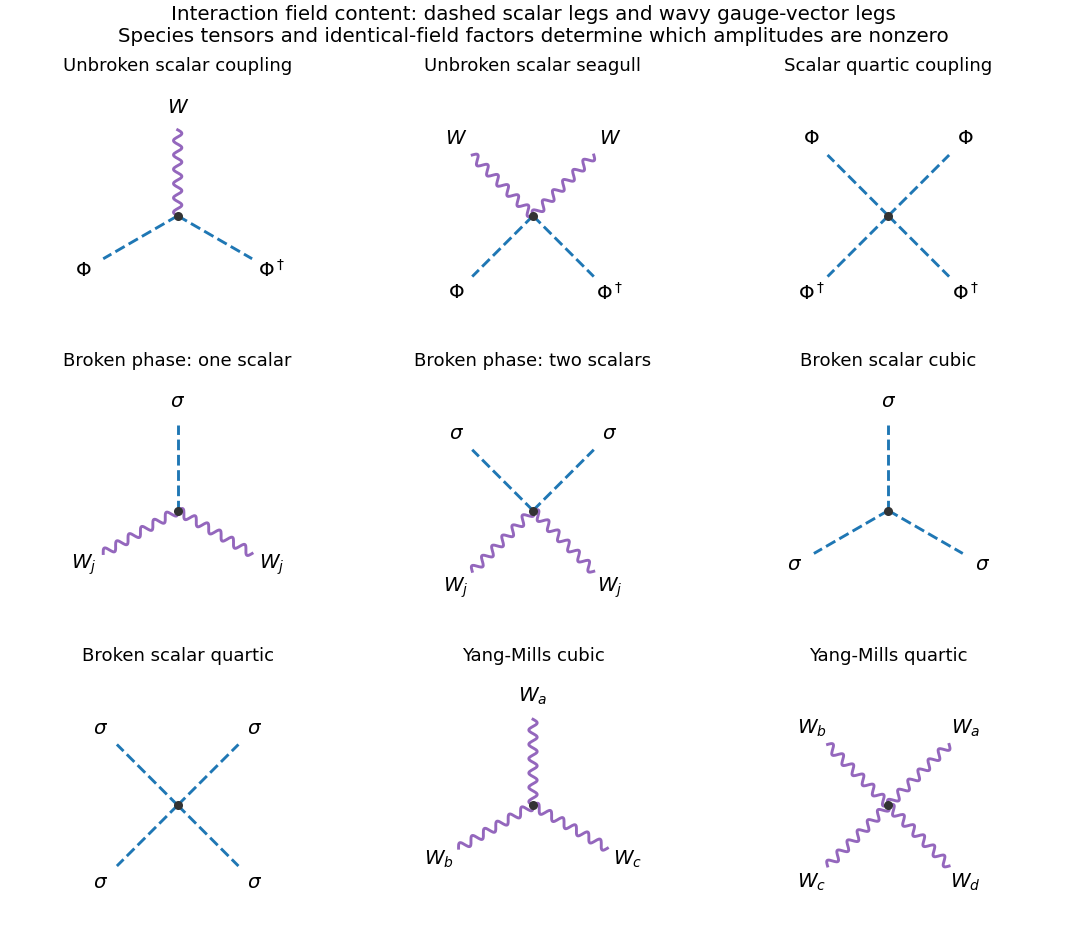

For , minimize the Higgs potential to obtain . In unitary gauge, the physical scalar fluctuation is real andComparing with and givesAll three gauge generators are broken by this complex doublet; this pure SU(2) model has no surviving massless photon. Three scalar angular degrees of freedom supply the longitudinal vector polarizations, leaving one real Higgs boson. The count is . The corresponding fundamental-doublet example also appears in Gauge Theory by David Tong.[ref]
Gauge Theory by David Tong. Section 2.7, example “SU(2) with Fundamental Matter”, Higgs-phase spectrum
The remaining interactions are , , and . They give vertices with two equal-species vector legs and one or two scalar legs, or three or four scalar legs, as drawn above. The coefficients in the Lagrangian must be differentiated with respect to identical fields when obtaining fully normalized Feynman rules; the written coefficients alone are not all the vertex factors.
The gauge fields require their own Yang-Mills Lagrangian, . The non-Abelian field strength contains a term quadratic in the gauge potentials, so squaring it produces three-vector and four-vector self-interaction vertices, with derivative momentum factors in the cubic vertex and SU(2) structure constants in both. They exist in either scalar phase and must be added to the scalar-generated vertices. A gauge-fixed quantum calculation also has gauge-fixing and, where applicable, ghost terms; those are not extra physical boson species.
For , the global phase transformation leaves both the scalar potential and the covariant kinetic term unchanged while leaving fixed. Its Noether charge counts scalar particles minus antiparticles. Thus and are compatible with this charge, whereas is forbidden: its initial charge is two and final charge zero. Charge conservation is necessary, not sufficient, for a particular amplitude to be nonzero; other quantum numbers and kinematics still apply.
After adding the hypercharge field, the neutral-vector mass term becomesIts mass matrix has zero determinant. With , the orthonormal combinations areThe unbroken generator is electric charge, , because the lower doublet component has and . The charged combinations keep mass .
The observed charged weak interaction couples left-chiral fermions within SU(2) doublets. In the Standard Model, and are doublets, while are singlets. A vectorlike assignment would also give right-handed charged weak currents, contrary to this observed chiral structure. Once the measured electric charges are specified, fixesAn optional right-handed neutrino is a singlet with . Conjugate left-chiral fields have the opposite hypercharges to these right-chiral fields. These assignments permit gauge-invariant Yukawa interactions; they are not obtained by assigning one common hypercharge to every chirality.
Articles by others on the same topic
There are currently no matching articles.