Assume so that the Higgs potential is bounded below, and work at tree level in four spacetime dimensions with metric . For , the minimum is . The quadratic terms describe three massless gauge bosons and two complex scalars of mass , equivalently four real scalar degrees of freedom. These are the perturbative particle masses about this vacuum, without a claim about the nonperturbative asymptotic spectrum of an interacting non-Abelian theory.
Expanding the gauge covariant derivative with gives the interaction termsIn the second term, the antisymmetric part of vanishes against the symmetric gauge-field product. The corresponding Feynman diagram vertices have one vector and a scalar–antiscalar pair, two vectors and a scalar–antiscalar pair, or four scalar legs with two particles and two antiparticles. The first vertex carries a momentum difference from its derivative. The Pauli matrix in it determines which doublet components couple; the two-vector scalar vertex is proportional to . There is no cubic scalar interaction about the zero-field vacuum.
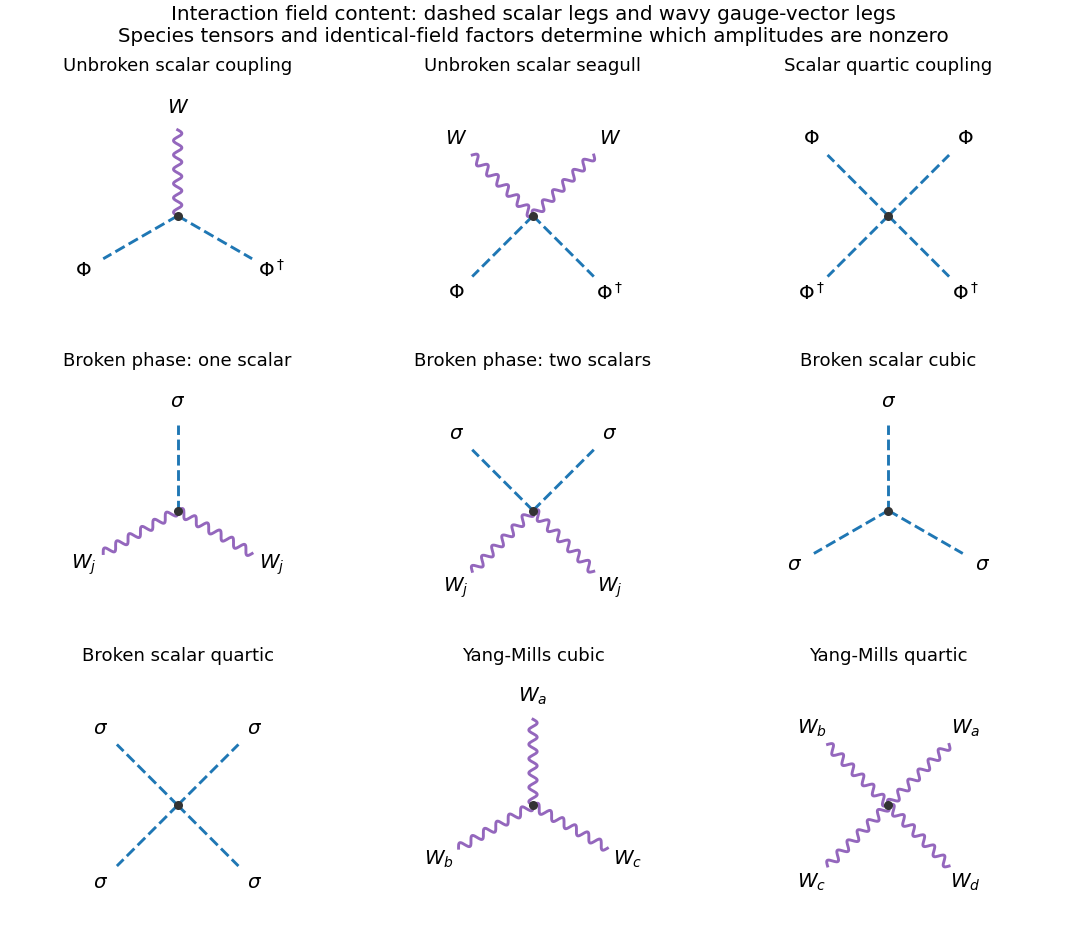

For , minimize the Higgs potential to obtain . In unitary gauge, the physical scalar fluctuation is real andComparing with and givesAll three gauge generators are broken by this complex doublet; this pure SU(2) model has no surviving massless photon. Three scalar angular degrees of freedom supply the longitudinal vector polarizations, leaving one real Higgs boson. The count is . The corresponding fundamental-doublet example also appears in Gauge Theory by David Tong.[ref]
Gauge Theory by David Tong. Section 2.7, example “SU(2) with Fundamental Matter”, Higgs-phase spectrum
The remaining interactions are , , and . They give vertices with two equal-species vector legs and one or two scalar legs, or three or four scalar legs, as drawn above. The coefficients in the Lagrangian must be differentiated with respect to identical fields when obtaining fully normalized Feynman rules; the written coefficients alone are not all the vertex factors.
The gauge fields require their own Yang-Mills Lagrangian, . The non-Abelian field strength contains a term quadratic in the gauge potentials, so squaring it produces three-vector and four-vector self-interaction vertices, with derivative momentum factors in the cubic vertex and SU(2) structure constants in both. They exist in either scalar phase and must be added to the scalar-generated vertices. A gauge-fixed quantum calculation also has gauge-fixing and, where applicable, ghost terms; those are not extra physical boson species.
For , the global phase transformation leaves both the scalar potential and the covariant kinetic term unchanged while leaving fixed. Its Noether charge counts scalar particles minus antiparticles. Thus and are compatible with this charge, whereas is forbidden: its initial charge is two and final charge zero. Charge conservation is necessary, not sufficient, for a particular amplitude to be nonzero; other quantum numbers and kinematics still apply.
After adding the hypercharge field, the neutral-vector mass term becomesIts mass matrix has zero determinant. With , the orthonormal combinations areThe unbroken generator is electric charge, , because the lower doublet component has and . The charged combinations keep mass .
The observed charged weak interaction couples left-chiral fermions within SU(2) doublets. In the Standard Model, and are doublets, while are singlets. A vectorlike assignment would also give right-handed charged weak currents, contrary to this observed chiral structure. Once the measured electric charges are specified, fixesAn optional right-handed neutrino is a singlet with . Conjugate left-chiral fields have the opposite hypercharges to these right-chiral fields. These assignments permit gauge-invariant Yukawa interactions; they are not obtained by assigning one common hypercharge to every chirality.
Write . Hermiticity converts its complex-conjugate factors into . Summing all external colors therefore givessince SU(3) has eight generators. This is a sum, before averaging the nine equally populated incoming color states.
For the spinor current, use , and the stated gamma-matrix adjoint identity:The spin sum completeness relation then closes each product of currents into a trace. Averaging two spins for each incoming quark, in addition to nine incoming colors, givesThe factor is , rather than : the latter omits the initial spin average.
To derive the four-gamma matrix trace, first anticommutation and cyclicity give , with . If , move successively through the next three matrices. The last term is by cyclicity, soSubstitution yieldsConsequently the first momentum trace is . Contracting both traces givesHere , and all external masses vanish. Thus the distinct-flavor quark scattering color factor givesWe used and . The forward divergence reflects massless -channel exchange in this parton-level tree approximation; it is not an unrestricted prediction for an experimentally resolved jet cross section.
Finally, completeness of the SU(3) generators gives the fundamental-generator Fierz identityFor each distinct pair , the allowed final colors are either , with coefficient , or , with coefficient . If , only is nonzero, with coefficient . These are 15 ordered configurations: six unchanged-color cases, six exchanged-color cases and three all-equal cases. Their squared coefficients sum to , independently checking the first result. Flavor remains tied to each external line; exchanging colors does not exchange the up and down quark species.
A bare Dirac mass couples left and right chirality, so the distinct electroweak representations prevent writing it as a gauge-invariant term before symmetry breaking. Instead the Yukawa interactions areWeak indices are contracted to singlets. Substituting the vacuum value gives mass matrices and a physical Higgs coupling plus its conjugate. Biunitary diagonalization defines mass eigenstates; a mismatch between the up- and down-quark left rotations appears in the CKM matrix. Gauge-boson masses arise from the Higgs kinetic term, whereas these fermion masses arise from the Yukawa term.
With only the minimal field content there is no right-handed neutrino, so no renormalizable neutrino Yukawa term. Adding a gauge-singlet permits both a Dirac scale and a Majorana scale . For one family the symmetric mass matrix in a left-chiral basis isIts signed eigenvalues are . Rephasing gives positive physical masses, and for the seesaw mechanism yieldsFor and , the light scale is about . Integrating out the heavy state generates the dimension-five Weinberg operator, whose Higgs vacuum insertion gives the same suppression. Alternatively a Dirac neutrino can have a very small Yukawa coupling with lepton number conserved. A tiny observed neutrino mass does not by itself distinguish these mechanisms.
In units , a dimensionless action fixes . Canonical kinetic terms then give , and . If an interaction operator has dimension , its coefficient has mass dimension . Thus scalar quartic, Yukawa and gauge couplings are dimensionless; a scalar cubic coupling has dimension one, a four-fermion coupling has dimension minus two, and the Weinberg coefficient has dimension minus one. These are engineering dimensions; anomalous scaling is an additional quantum effect.
For a connected graph with independent loop momenta, boson lines, fermion lines and derivatives at vertex , ordinary covariant-gauge ultraviolet counting gives the superficial degree of divergenceThe second form follows from and counting field ends at vertices. It presumes the canonical large-momentum propagators; unitary-gauge vector propagators can obscure the cancellations of a renormalizable gauge theory. A nonnegative signals a possible overall ultraviolet divergence, not proof of one. Symmetries can cancel it, while a graph with can still contain divergent subgraphs.
With only operators of dimension at most four, increasing the vertex count does not require counterterms of unbounded dimension. Subject to the necessary symmetry identities and absence of gauge anomalies, scalar quartic theory, Yukawa theories and the Standard Model are perturbatively renormalizable when all required interactions are included. In particular, coupling a scalar to other fields can require a scalar quartic counterterm even if its coefficient was initially set to zero. The Higgs mechanism does not destroy renormalizability of the underlying anomaly-free gauge theory.
By contrast, repeated insertions of the dimension-six Fermi interaction or a dimension-five operator allow increasingly high-dimensional counterterms. Such terms are useful in an effective field theory with a stated expansion in energy over a high scale; nonrenormalizable does not mean unpredictive at a fixed order. A scalar interaction and perturbative Einstein gravity in four dimensions provide other examples. Renormalizability also does not assert small coupling at every scale or a complete ultraviolet theory.
The SU(5) grand unified theory embeds the strong and electroweak groups in a single simple gauge group. Its 24 gauge generators contain the eight gluons, three weak generators and one hypercharge generator, plus twelve additional generators connecting color and weak directions. A common gauge coupling applies at the unification scale with the properly normalized hypercharge generator; low-energy couplings differ through their renormalization group evolution.
Using left-chiral fields throughout, one Standard Model generation fits intoThe dimensions are and , so no right-handed neutrino is required in these multiplets. A singlet neutrino can be added. A suitable adjoint scalar vacuum breaks SU(5) to the Standard Model subgroup; a fundamental scalar contains an electroweak doublet and a colored triplet. The extra heavy vector bosons can mediate transitions between quarks and leptons, hence proton decay in the minimal model. This is a proposed unification, not an experimentally established identification of new particles.
The hierarchy problem concerns keeping an elementary weak-scale scalar light in the presence of much heavier physical scales. A heavy state coupled to it generically induces a threshold correction of order , with a product of couplings. Without protection, a weak-scale result then needs cancellation against a much larger parameter. In SU(5), this is sharpened by doublet-triplet splitting: the electroweak doublet must stay light while its colored partner must be sufficiently heavy to avoid rapid proton decay. Choosing a small tree-level doublet mass is not by itself a mechanism protecting it from subsequent heavy-particle corrections. Supersymmetry and other proposals change this protection problem, but the minimal SU(5) embedding alone does not solve it.
Articles by others on the same topic
There are currently no matching articles.