Use mass density units for the appearing in the Friedmann equation; an actual energy density is . Conservation, , gives for pressureless matter and radiation in cosmology, respectively, with . The first scaling counts dilution of particle number, while the second includes the cosmological redshift of each photon's energy.
Define the present cosmological density parameters by . ThenFor , conformal time gives , so the expanding branch obeys . Set at the Big Bang. Integrating givesand hence the flat matter-radiation conformal solutionThe limiting pure-radiation and pure-matter cases follow continuously.
At matter-radiation equality, , so . Evaluating the integrated square-root relation givesThis assumes both present densities are positive and uses the same Big Bang origin for conformal time.
For dust alone, write , whereSet and . Differentiation gives once is used, verifying the Friedmann equation. Integrating the time relation from the Big Bang yields the closed matter-dominated Friedmann solutionThe Hubble parameter and the cosmological density parameter areThe first decreases from positive infinity through zero at maximum expansion to negative infinity at the Big Crunch. The second approaches one near either singular endpoint and diverges at maximum expansion. This is a density-parameter divergence at a cosmological turnaround: makes the critical density vanish even though the physical dust density there is finite.
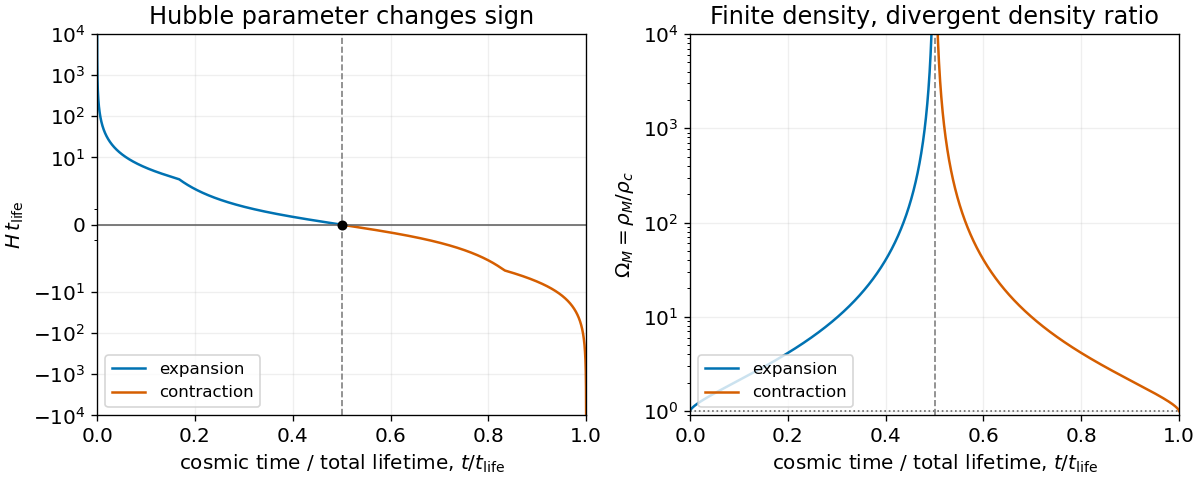
Closed dust universe: the Hubble parameter changes sign and the density parameter diverges at maximum expansion
. Details. 
At maximum expansion, . With , the present Friedmann equation gives , so positive curvature requires . Taking for the presently expanding branch givesThe lifetime of a closed dust universe follows by setting . The deceleration parameter follows from the Friedmann acceleration equation, . Thus this model always decelerates while expanding. Its total lifetime includes the elapsed age; it is not the remaining lifetime.
The supernova discovery of accelerating expansion does not support this dust-only recollapse model as a description of the observed expansion history. Already the 1998 and 1999 Type Ia supernova analyses favoured accelerating expansion, requiring ingredients beyond this zero-cosmological constant, positive-curvature dust model within the usual FLRW metric interpretation.[ref]
Observational Evidence from Supernovae for an Accelerating Universe and a Cosmological Constant by Adam Riess and others. Abstract: evidence for present acceleration
[ref] Articles by others on the same topic
There are currently no matching articles.