A photon follows a null geodesic, whose spatial path approaches straight lines far from the deflecting mass. Extend the incoming asymptote forward: this is the reference path the photon would follow if the mass were removed while its incoming direction and transverse offset were held fixed. The impact parameter is the perpendicular distance from the mass to that incoming asymptote. It is not, in general, the distance of closest approach.
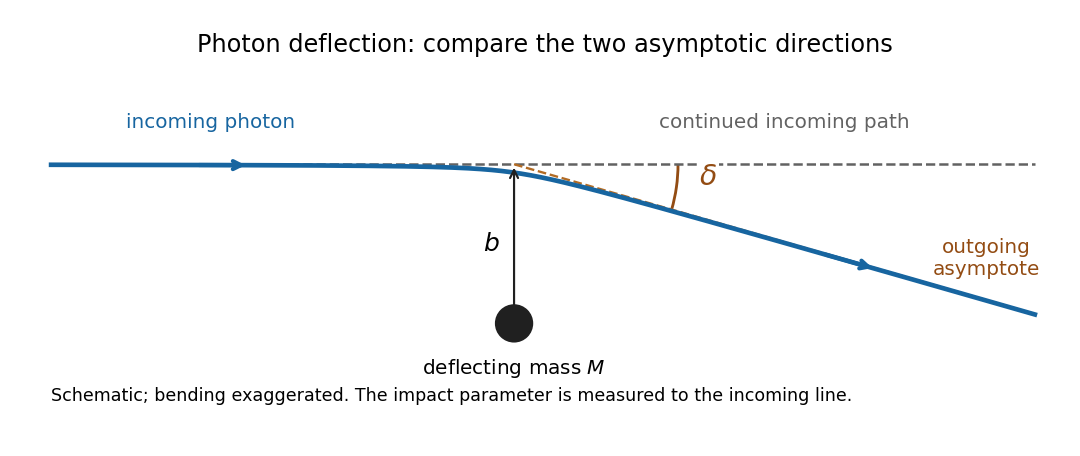
Impact parameter and deflection relative to the continued incoming photon path
. Original schematic, with bending exaggerated. The dashed horizontal line is the undeflected reference path. The outgoing dashed asymptote makes angle delta with it; b is measured to the incoming asymptote, not to the bent ray. Details.
The positive deflection angle is the angle between the outgoing propagation direction and the continued incoming direction. The photon bends toward the mass, so a ray passing above it has a downward outgoing slope in the figure. In the weak-field approximation for an isolated spherical mass, Schwarzschild light deflection gives for distant endpoints. This angle differs from the apparent image angle measured from the observer's line of sight to the mass.
By spherical symmetry, choose the orbital plane to be . The geodesic Lagrangian of the Schwarzschild metric isFor a massive test particle, dots denote proper time derivatives and . The cyclic coordinates and give, through the Euler-Lagrange equations, two constants:At infinity, is the Lorentz factor. The constant is the specific angular momentum, and the energy per unit rest mass is . The normalization of the four-velocity givesUse and define the energy-normalized angular momentum for a Schwarzschild geodesicThenFor an incoming massive test particle with impact parameter , , so . In particular, is not the same as the specific angular momentum unless .
A photon has no proper time parametrization and no finite Lorentz factor. For it, use an affine parameter in the same geodesic Lagrangian and impose . The ratio remains well defined, and the null result isEquivalently this is the ultrarelativistic limit of the massive formula at fixed , with . The printed massive formula needs this interpretation before it is applied to a photon.
Let , , and use a prime for . The null geodesic first integral obtained above becomesDifferentiating with respect to and dividing by away from a turning point givesThe same differential equation holds at the turning point by continuity. When , the general solution is . Choose the angular origin so that the incoming asymptote has and the unperturbed closest approach has . The impact parameter then fixesThis is the straight reference path, not a curved orbit.
For perturbation theory with , write , where . Inserting this into the differential equation and discarding second-order terms givesA particular solution and the complementary solution areChoosing retains reflection symmetry about and the specified impact parameter to first order. The two distant zeros of then occur at and . Their separation exceeds by , consistently giving the Schwarzschild light deflection .
In the thin-lens approximation for gravitational lensing, consider a ray crossing the lens plane at transverse distance above the aligned source-observer axis. With the observer at axial position , the black hole at and the source at , the segment joining the lens plane to the source has slope , while the segment joining the observer to the lens plane has slope . The observer sees the ray at apparent angle to the axis. When following the photon toward the observer, the two small angles to the axis have magnitudes and . The physical bend is their sum:Substitute the Schwarzschild light deflection, , and use :Every azimuth around the axis is equivalent by rotational symmetry. Isotropic emission therefore supplies rays at all these azimuths, and the ideal image is an Einstein ring centered on the black hole, with Einstein angular radius and angular diameter . A finite source size or imperfect alignment broadens or breaks the ideal ring.
The stated expression uses small angles, distant endpoints and weak-field approximation , with ordinary Euclidean distances. For cosmological gravitational lensing, use angular diameter distances in ; generally .
Articles by others on the same topic
There are currently no matching articles.