For the branching from B3 to A3, apply the supplied weight projection matrix to column vectors of Dynkin labels. It sendsIt is consistent with choosing the simple roots in the order , , . Their Dynkin diagram is the chain . Their coroot pairings are respectively , explaining the projection without confusing labels and Euclidean coordinates.
The seven weights in b project asThe six nonzero weights form the weight system of the SU(4) two-index antisymmetric representation of highest weight . The zero weight is the remaining singlet representation. ConsequentlyThe eight spinor weights project asThe four weights constitute the defining fundamental representation . The other four are their negatives, forming the dual representation of highest weight . HenceFor the Young tableaux and tensors, let be the defining SU(4) representation. The singlet representation is , with the empty Young diagram and a scalar. The other three Young diagrams are columns of one, two and three boxes, representing , and :The square brackets indicate tensor index antisymmetrization, with indices from 1 to 4. The invariant Levi-Civita symbol identifies the three-index antisymmetric tensor with a covector, , explaining .
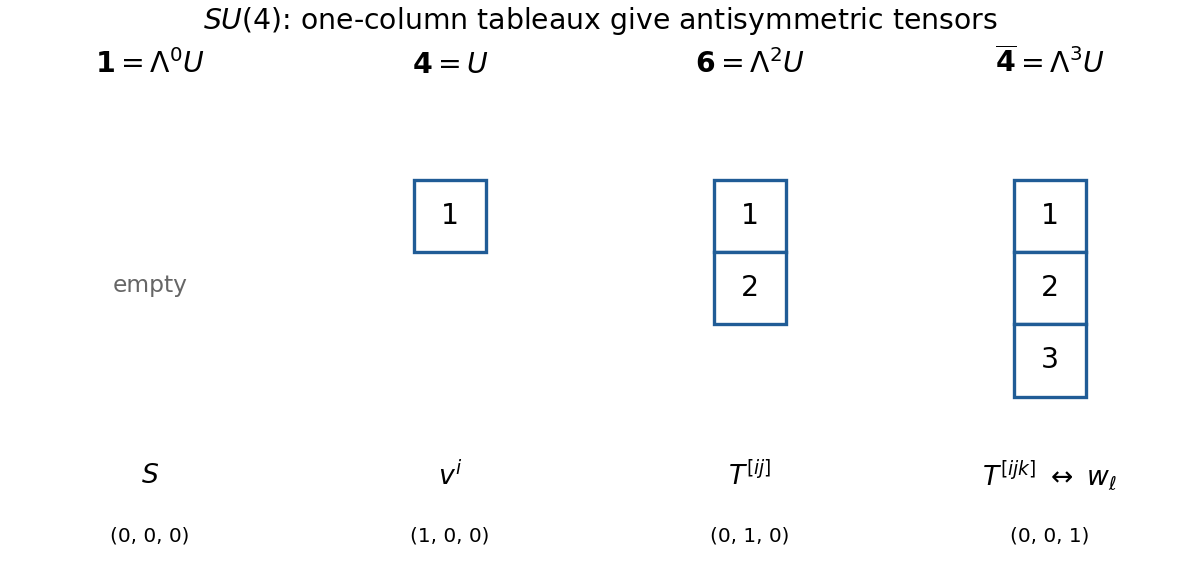
Young tableaux for the SU4 representations in the two branchings
. The empty Young diagram gives the singlet representation; columns of one, two and three boxes give , and . Increasing entries down each column display a standard Young tableau. The column determines complete tensor index antisymmetrization. Details.
Articles by others on the same topic
There are currently no matching articles.