Choose an orthonormal basis in the real Euclidean space containing the root system, and take simple rootsTheir squared lengths are . Use the Cartan matrix convention , with the denominator indexed by the column. Direct inner products giveThe Dynkin diagram of the B3 root system is a three-node chain with a single bond from node 1 to node 2 and a double bond from node 2 to the short node 3; the arrow points toward node 3. The A3 root system has a chain of three nodes joined by single bonds. A convention putting the row length in the denominator transposes the first displayed Cartan matrix.
For the Extended Dynkin diagram, the highest root is . Add . Its only nonzero off-diagonal inner product among these simple roots is . Deleting the short node 3 leaves the chain , with three equal-length roots, which is .
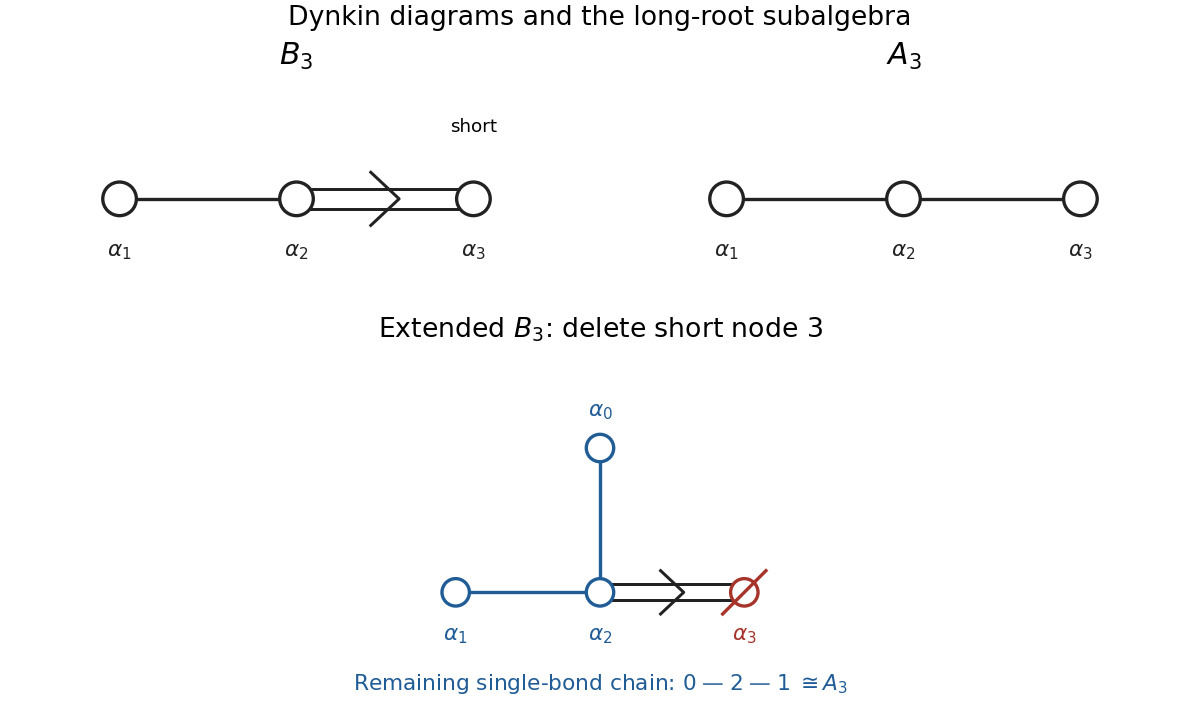

More concretely, the long roots form the D3 root system, which is isomorphic to the A3 root system. The corresponding root spaces and Cartan subalgebra generatefor the compact real forms. At the matrix level the inclusion fixes one coordinate in seven-dimensional space. This establishes the required Lie subalgebra inclusion; the associated global groups require the distinction explained in d.
In the convention of a, the fundamental weights areFor a weight in this orthonormal coordinate system, its Dynkin labels areThese labels, rather than the orthonormal coordinates, are used below and in the projection in c.
The highest weight is . Successive subtraction of the simple roots gives the complete stringThe two consecutive short-root steps are allowed because has coroot pairing two with . The weight system of this seven-dimensional vector representation is thereforeAll seven weight multiplicities are one, including the zero weight.
The highest weight is . The Weyl group of the B3 root system acts by signed coordinate permutations. Its orbit is the eight cube vertices , with independent . Starting from , lowering by , then , and then either or generates the middle branches; further lowering reaches all remaining sign choices. Thus the eight-dimensional spin representation hasThe stipulated unit weight multiplicities give dimensions seven and eight by counting these lists.
For the branching from B3 to A3, apply the supplied weight projection matrix to column vectors of Dynkin labels. It sendsIt is consistent with choosing the simple roots in the order , , . Their Dynkin diagram is the chain . Their coroot pairings are respectively , explaining the projection without confusing labels and Euclidean coordinates.
The seven weights in b project asThe six nonzero weights form the weight system of the SU(4) two-index antisymmetric representation of highest weight . The zero weight is the remaining singlet representation. ConsequentlyThe eight spinor weights project asThe four weights constitute the defining fundamental representation . The other four are their negatives, forming the dual representation of highest weight . HenceFor the Young tableaux and tensors, let be the defining SU(4) representation. The singlet representation is , with the empty Young diagram and a scalar. The other three Young diagrams are columns of one, two and three boxes, representing , and :The square brackets indicate tensor index antisymmetrization, with indices from 1 to 4. The invariant Levi-Civita symbol identifies the three-index antisymmetric tensor with a covector, , explaining .
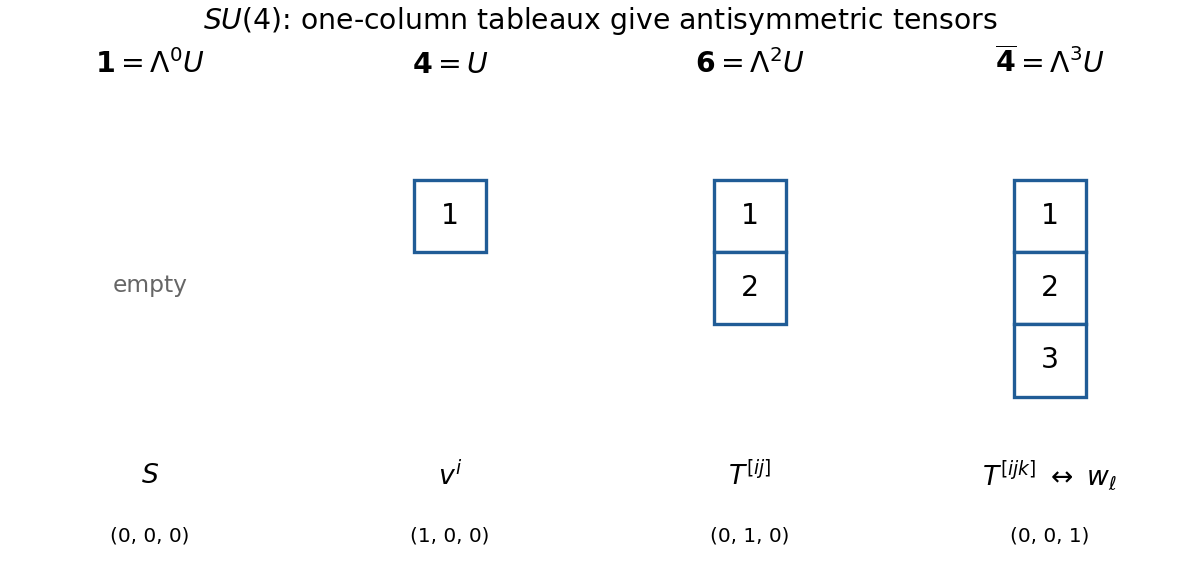
Young tableaux for the SU4 representations in the two branchings
. The empty Young diagram gives the singlet representation; columns of one, two and three boxes give , and . Increasing entries down each column display a standard Young tableau. The column determines complete tensor index antisymmetrization. Details.
For the usual colour SU(3) fixing the fourth coordinate of the SU(4) defining representation,Taking the exterior square givesThe identification follows by contracting an antisymmetric tensor with the invariant three-index Levi-Civita symbol. Combining this with c gives all colour multiplets:A colour triplet has the color charge transformation law of a quark, an antitriplet that of an antiquark, and a colour singlet is colour-neutral, as a lepton is. Thus both parent representations permit quark-like and antiquark-like colour sectors; the vector has one neutral sector and the spinor two. These are colour assignments only. They do not determine particle spin, statistics, electric charge, weak quantum numbers or a full generation of the Standard Model. In a real parent field the conjugate colour sectors may describe one complex colour field and its conjugate, rather than independent particle species.
Global group qualification. The printed chain is correct at the Lie algebra level, . Globally its simply connected form is . The standard map of SU(4) into through has a nontrivial kernel: the concrete central element acts as on and trivially on the singlet representation. Its image is , rather than an injective copy of SU(4) under this map.
The global form obstruction for the Spin7 spinor is explicit: the central element of the Spin group maps to the identity in but acts as on the eight-dimensional spin representation. Equivalently acts as on both and in its restriction. Therefore the spinor does not descend to a genuine SO(7) group representation. A theory containing that spinor needs the Spin group global form, or must understand the source's notation as specifying only its Lie algebra. The displayed colour branchings remain valid with this correction.
Articles by others on the same topic
There are currently no matching articles.