Source paper: Public Oxford source bundle, pages 104–106. The bundle filename says 2017, but this paper's cover is dated 12 January 2018. The year follows the cover. All four questions are solved, including the optional choice.
A group is a nonempty set with an operation , , satisfying associativity, an identity element with , and an inverse element with for every . These are the group axioms. An Abelian group additionally satisfies for every pair. A subgroup is a subset that is itself a group under the restricted operation; equivalently, it is nonempty and closed under .
Let be a nonzero, finite-dimensional complex irreducible representation of an Abelian group. For each fixed , commutativity givesThus is an intertwining operator from to itself. By Schur's lemma over the complex numbers, . Every line in is therefore an invariant subspace. Since is irreducible, this forcesThis is the finite-dimensional convention used throughout the paper. Without it, the literal assertion for arbitrary Abelian groups needs qualification. A concrete counterexample is acting by multiplication on the complex vector space of rational functions. Any nonzero invariant complex vector subspace containing contains for every nonzero rational , hence contains every rational function. This is an infinite-dimensional irreducible representation. The scalar conclusion of Schur's lemma used above depends on finite dimensionality.
The additive cyclic group is generated by , with . Every complex irreducible representation is one-dimensional by a. If , the defining relation requires . Conversely each such root of unity defines a group homomorphism. Hence the complete list isChanging the representative of changes the exponent by an integer multiple of , so the formula is well-defined. These representations are pairwise inequivalent because their values on the generator differ. The case is the trivial representation.
Put , so and . Since the group is Abelian, every conjugacy class is a singleton. The character table isFor the character inner product, complex conjugation givesFor , all three summands are one, giving unit norm. For the sum is ; for it is . This checks every distinct pair, proving
Use the two complementary projection operatorsThey obey , and . The given matrix is , and consequentlyIt follows that multiplication of these matrices respects addition modulo three:Thus this is a group representation. The eigenvectors and have eigenvalues and , respectively. They span invariant lines carrying and in the convention of c, soThe other nontrivial irreducible representation, , is absent.
The stated coordinate substitution splits the polynomial basis into two three-cycles:The identity fixes all six basis vectors; neither nonidentity element fixes any. A permutation representation has character equal to the number of fixed basis vectors, henceThe representation multiplicity of each irreducible character is thereforeAn explicit eigenbasis confirms the result. For , putThen and . Thus each three-cycle carries one copy of every irreducible representation. These signs use precisely the source's substitution action; taking an inverse substitution would interchange and , leaving the total decomposition unchanged.
Write and . Direct matrix multiplication givesEvery product reduces to , with and . These eight matrices are distinct and are precisely the listed elements:This is the dihedral group of group order eight. Its element commutes with both generators. Conjugation by interchanges and , while conjugation by sends to . It also interchanges and . The resulting conjugacy classes areThese are the stated in order. To see that the last two reflection classes do not merge, conjugation changes the exponent in by an even integer or changes its sign, preserving its parity. The five sets exhaust all eight elements.
Both generators are real orthogonal matrices with determinant . Hence every element obeys and . The normal-form calculation establishes closure and inverses, soIn particular the embedding in the special unitary group uses the given real matrices viewed as complex ones.
In a one-dimensional representation, the relation implies , so . Independently . These give four irreducible representationsA two-dimensional representation is obtained by restricting the given matrices to the plane:The eigenvalues of are and . Its two eigenlines are interchanged by , so neither is invariant under the whole group. Thus is a complex irreducible representation.
Taking traces gives the character table, with class sizes included for the character inner product:For example , and its inner product with each one-dimensional row is . The four one-dimensional rows are mutually orthonormal by direct weighted summation. Their squared dimensions sum to , and there are five rows for five conjugacy classes. This proves completeness of the list.
The axis is an invariant subspace on which acts as and as . The plane carries the irreducible representation from b. ThusThe character of a tensor product is the product of the characters, so . Weighted character inner products giveFor the trivial character, the multiplicity is . For any other one-dimensional character, the weighted sum over the nonidentity classes is , giving . For , it is .
Equivalently, is the sum of all four one-dimensional representations, and tensoring by gives the same two-dimensional irreducible representation. The dimensions in the boxed decomposition sum to nine, as required.
The defining SU(3) representation restricts to the given matrix representation. All its restricted matrices are real, so the conjugate representation restricts identically. Hence the first two branchings areFor the adjoint representation of SU(3), use . This follows by splitting endomorphisms into scalar and traceless matrices. Subtracting one trivial constituent from c givesAs an independent check, its restricted character is , the regular character of . Thus this is precisely the regular representation, whose representation multiplicities equal the corresponding dimensions.
Differentiate the defining relation at . The linear term gives the Lie algebraSolving this equation between matrices yieldswhere a convenient basis isThe first two generate Lorentz boosts and the last a spatial rotation. Direct commutators giveThere are three independent real coefficients, so . A Cartan subalgebra is , and the rank of a semisimple Lie algebra is one. Explicitly, if and , their commutator vanishes exactly whenFor nonzero , these equations force to be proportional to , so there is no two-dimensional commuting subalgebra. The split real rank is also one, realized by the semisimple Lorentz boost generator . ThusFor this Lorentz algebra in three spacetime dimensions, disconnected components of the full Lorentz group do not change its tangent Lie algebra at the identity.
In the complexification of a Lie algebra, defineThe relations in a becomeThe special unitary Lie algebra has real basis , where the Pauli matrices satisfy . Its commutators are the same: . The complex-linear map therefore preserves the bracket and maps a basis to a basis. ConsequentlyThe real Lie algebras are not isomorphic: multiplying the boosts by changes their real form. For example, the Adjoint representation of a Lie algebra evaluated at has real eigenvalues , whereas the corresponding nonzero compact SU(2) generators have purely imaginary adjoint eigenvalues.
Every complex Lie algebra representation of the real algebra extends uniquely by complex linearity to its complexification of a Lie algebra. The finite-dimensional complex irreducible representations are therefore classified by a nonnegative integer highest weight , just as for SU(2). There is one equivalence class for eachThese are statements about Lie algebra representations. They do not assert positive-definite unitarity for the noncompact real form, or automatic descent to the full Lorentz group. In particular, half-integer gives a sign under a spatial rotation, so its integration needs a covering group.
Choose the following Pauli matrix realization, with its spinor basis fixed for the later Dirac adjoint:The Pauli matrix multiplication rule verifiesExtending linearly therefore gives a two-dimensional Lie algebra representation. For an irreducible representation, it suffices to rule out an invariant line. Any such line would have to be an eigenline of , whose two eigenvalues are distinct. Those two coordinate lines are interchanged by , so neither is invariant. There is no proper nonzero invariant subspace.
This is a spinorial representation rather than a single-valued two-dimensional representation of the identity component of the specified orthogonal group:The mismatch explicitly exhibits the need for the spin double cover. It causes no obstruction to the requested infinitesimal construction.
The Clifford algebra condition for signature isEach Pauli matrix squares to , and distinct Pauli matrices anticommute. Therefore the given choice obeysThese check all diagonal and off-diagonal anticommutators, provingThus they are viable three-dimensional gamma matrices. Their Hermitian adjoints satisfy and for . Two components are minimal: one-dimensional nonzero scalar matrices cannot anticommute while all having nonzero squares.
The spinor basis in c is compatible with the supplied gamma matrices. The rotation generator is anti-Hermitian and commutes with . The two boost generators are Hermitian matrices and anticommute with . It follows separately for all three generators, and hence for every real , thatFor the infinitesimal Lorentz transformation, and . Hence the Dirac adjoint transforms contragrediently:The two contributions to the scalar variation cancel:This proves the spinor invariant in three spacetime dimensions has infinitesimal Lorentz invariance. Real transformation parameters matter because the Hermitian adjoint conjugates coefficients; this is not an invariance under arbitrary complexified parameters. For ordinary commuting spinor components, the bilinear is purely imaginary in this mostly-plus convention, and multiplying it by gives a real invariant. Its reality is separate from its invariance.
Choose an orthonormal basis in the real Euclidean space containing the root system, and take simple rootsTheir squared lengths are . Use the Cartan matrix convention , with the denominator indexed by the column. Direct inner products giveThe Dynkin diagram of the B3 root system is a three-node chain with a single bond from node 1 to node 2 and a double bond from node 2 to the short node 3; the arrow points toward node 3. The A3 root system has a chain of three nodes joined by single bonds. A convention putting the row length in the denominator transposes the first displayed Cartan matrix.
For the Extended Dynkin diagram, the highest root is . Add . Its only nonzero off-diagonal inner product among these simple roots is . Deleting the short node 3 leaves the chain , with three equal-length roots, which is .
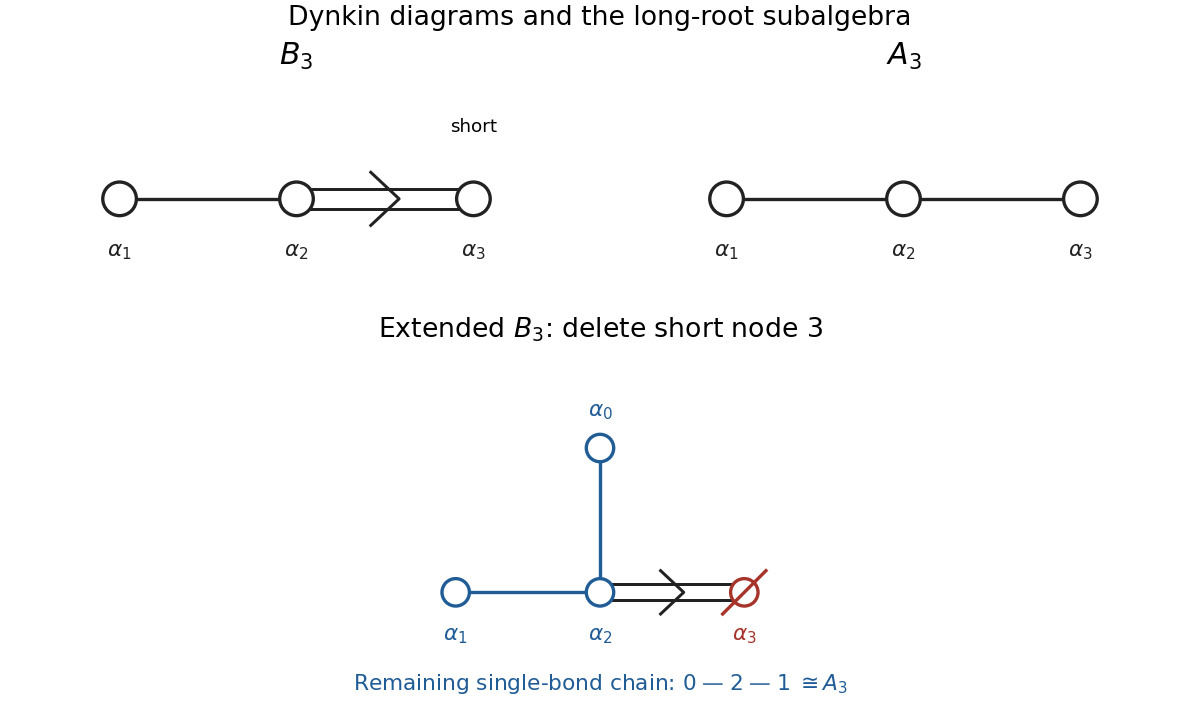

More concretely, the long roots form the D3 root system, which is isomorphic to the A3 root system. The corresponding root spaces and Cartan subalgebra generatefor the compact real forms. At the matrix level the inclusion fixes one coordinate in seven-dimensional space. This establishes the required Lie subalgebra inclusion; the associated global groups require the distinction explained in d.
In the convention of a, the fundamental weights areFor a weight in this orthonormal coordinate system, its Dynkin labels areThese labels, rather than the orthonormal coordinates, are used below and in the projection in c.
The highest weight is . Successive subtraction of the simple roots gives the complete stringThe two consecutive short-root steps are allowed because has coroot pairing two with . The weight system of this seven-dimensional vector representation is thereforeAll seven weight multiplicities are one, including the zero weight.
The highest weight is . The Weyl group of the B3 root system acts by signed coordinate permutations. Its orbit is the eight cube vertices , with independent . Starting from , lowering by , then , and then either or generates the middle branches; further lowering reaches all remaining sign choices. Thus the eight-dimensional spin representation hasThe stipulated unit weight multiplicities give dimensions seven and eight by counting these lists.
For the branching from B3 to A3, apply the supplied weight projection matrix to column vectors of Dynkin labels. It sendsIt is consistent with choosing the simple roots in the order , , . Their Dynkin diagram is the chain . Their coroot pairings are respectively , explaining the projection without confusing labels and Euclidean coordinates.
The seven weights in b project asThe six nonzero weights form the weight system of the SU(4) two-index antisymmetric representation of highest weight . The zero weight is the remaining singlet representation. ConsequentlyThe eight spinor weights project asThe four weights constitute the defining fundamental representation . The other four are their negatives, forming the dual representation of highest weight . HenceFor the Young tableaux and tensors, let be the defining SU(4) representation. The singlet representation is , with the empty Young diagram and a scalar. The other three Young diagrams are columns of one, two and three boxes, representing , and :The square brackets indicate tensor index antisymmetrization, with indices from 1 to 4. The invariant Levi-Civita symbol identifies the three-index antisymmetric tensor with a covector, , explaining .
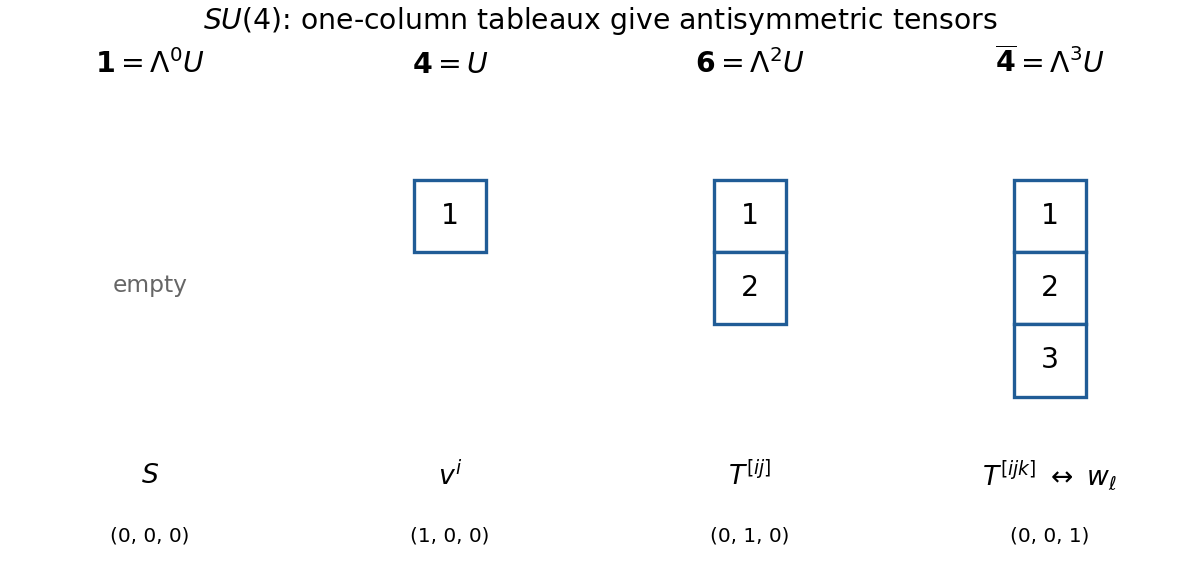
Young tableaux for the SU4 representations in the two branchings
. The empty Young diagram gives the singlet representation; columns of one, two and three boxes give , and . Increasing entries down each column display a standard Young tableau. The column determines complete tensor index antisymmetrization. Details.
For the usual colour SU(3) fixing the fourth coordinate of the SU(4) defining representation,Taking the exterior square givesThe identification follows by contracting an antisymmetric tensor with the invariant three-index Levi-Civita symbol. Combining this with c gives all colour multiplets:A colour triplet has the color charge transformation law of a quark, an antitriplet that of an antiquark, and a colour singlet is colour-neutral, as a lepton is. Thus both parent representations permit quark-like and antiquark-like colour sectors; the vector has one neutral sector and the spinor two. These are colour assignments only. They do not determine particle spin, statistics, electric charge, weak quantum numbers or a full generation of the Standard Model. In a real parent field the conjugate colour sectors may describe one complex colour field and its conjugate, rather than independent particle species.
Global group qualification. The printed chain is correct at the Lie algebra level, . Globally its simply connected form is . The standard map of SU(4) into through has a nontrivial kernel: the concrete central element acts as on and trivially on the singlet representation. Its image is , rather than an injective copy of SU(4) under this map.
The global form obstruction for the Spin7 spinor is explicit: the central element of the Spin group maps to the identity in but acts as on the eight-dimensional spin representation. Equivalently acts as on both and in its restriction. Therefore the spinor does not descend to a genuine SO(7) group representation. A theory containing that spinor needs the Spin group global form, or must understand the source's notation as specifying only its Lie algebra. The displayed colour branchings remain valid with this correction.
Articles by others on the same topic
There are currently no matching articles.