The Pauli multiplication identity gives . Its eigenvalues are therefore , and those of the density matrix areHermiticity and trace one are automatic; positive semidefiniteness holds exactly for . Thus physical qubit states form the Bloch ball, with pure states on the Bloch sphere and mixed states inside.
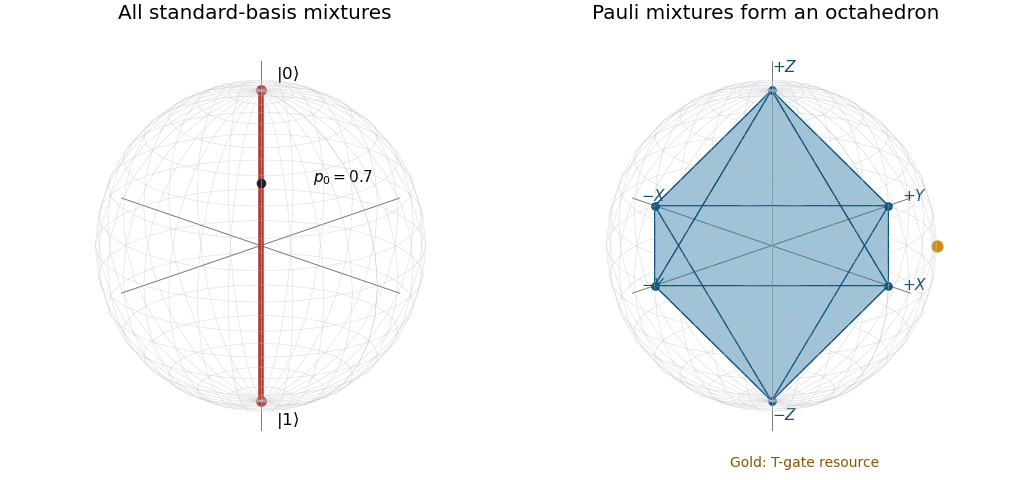
For the mixture of the two standard-basis states,These form the entire -axis diameter, shown in the left panel of the diagram in part b. Generate the state by selecting with classical probability and with probability , then discarding the classical selection record. A coherent superposition is generally a different state: the forgotten classical record removes off-diagonal coherence.
The six Pauli eigenstates have Bloch vectors , , :Classical convex combinations of density operators produce the corresponding convex combinations of their Bloch vectors. Their convex hull is the stabilizer octahedron:The six vertices are pure Pauli states; the faces and interior represent their mixtures. To verify the reverse inclusion, give the vertex in the sign of each coordinate weight and use the leftover weight at the origin, itself the equal mixture of either opposite pair.

Conjugation by the Hadamard gate sends to . Therefore its Bloch vector action isIt is a rotation through about : differs by a global phase from the corresponding spin rotation.
Direct matrix multiplication givesThus each generating Clifford gate conjugates every Pauli operator to another Pauli operator up to sign. Repeated conjugation proves the same for every product of generators and their inverses, hence for the Clifford group. For Hermitian Pauli observables the possible phases here are signs; arbitrary Pauli-group elements also include their conventional phases.
If , then . Therefore is another Pauli eigenstate. Every single-qubit Clifford circuit consequently permutes the six Pauli vertices of the stabilizer octahedron.
While the sequence is remembered, the conditional quantum state is the known pure endpoint , so its Bloch vector is one of the six Pauli vertices. Partial forgetting leaves a probability distribution over possible endpoints, givingHence the vector lies in the stabilizer octahedron. The mixing describes lost classical information, not a different unitary evolution of the physical qubit.
Under complete unbiased uncertainty over the six endpoints, , the opposite vectors cancel andThis is the maximally mixed state at the center. Mere loss of the particular sequence does not mathematically force uniform probabilities: a known biased distribution of endpoint states would leave its corresponding noncentral mixture. The central conclusion uses the unbiased randomization implicit in complete forgetting in this setting.
Write and . After the controlled-NOT gate, the joint state isAn ancilla measurement outcome zero leaves the unnormalized data state . Outcome one leaves . Both outcomes have probability . The correction for outcome one is , and , so after correction the data is always , up to an irrelevant global phase. This proves magic-state injection of a T gate.
The resource state's Bloch vector is , outside the stabilizer octahedron. Clifford gates alone preserve stabilizer structure and, with standard-basis preparation and measurement, admit efficient classical simulation by the Gottesman--Knill theorem. Adding the non-Clifford T gate supplies a universal quantum gate set together with Clifford gates: arbitrary finite-qubit unitaries can be approximated to arbitrary precision. The assertion is approximate universality, not exact representation of every unitary by a finite circuit.
Articles by others on the same topic
There are currently no matching articles.