Let be the number of stock units and the number of bank-account units, with predictable holdings satisfying the integrability conditions for the price integrals. The portfolio value is . It is self-financing ifThus changes in value come only from gains on the assets held. Rebalancing transfers money between the stock and bank account; it does not inject or withdraw cash. The definition is an identity of stochastic integrals and automatically includes the bookkeeping needed when holdings themselves vary randomly.
Write the smooth claim value as . Itô's formula givesA replicating self-financing strategy with stock holding and bank value has gainsThe Brownian terms then agree. Equating the drift terms cancels and givesThe terminal condition enforces replication of the contingent claim payoff. Subject to the usual admissibility and growth conditions for the replicating price, this is the Black-Scholes equation. Its independence of the physical drift is a consequence of hedge cancellation, not an assumption that the drift equals the risk-free rate.
For deterministic square-integrable volatility, apply Itô's formula to the exponential to obtainThe stochastic integral is centered Gaussian with variance .
Under the risk-neutral measure the drift is . Conditional on , put and . ThenIntegrating the discounted call option against this normal distribution yieldsThus the total remaining variance replaces throughout the ordinary formula; the corresponding effective constant volatility is . If , use the limiting deterministic value .
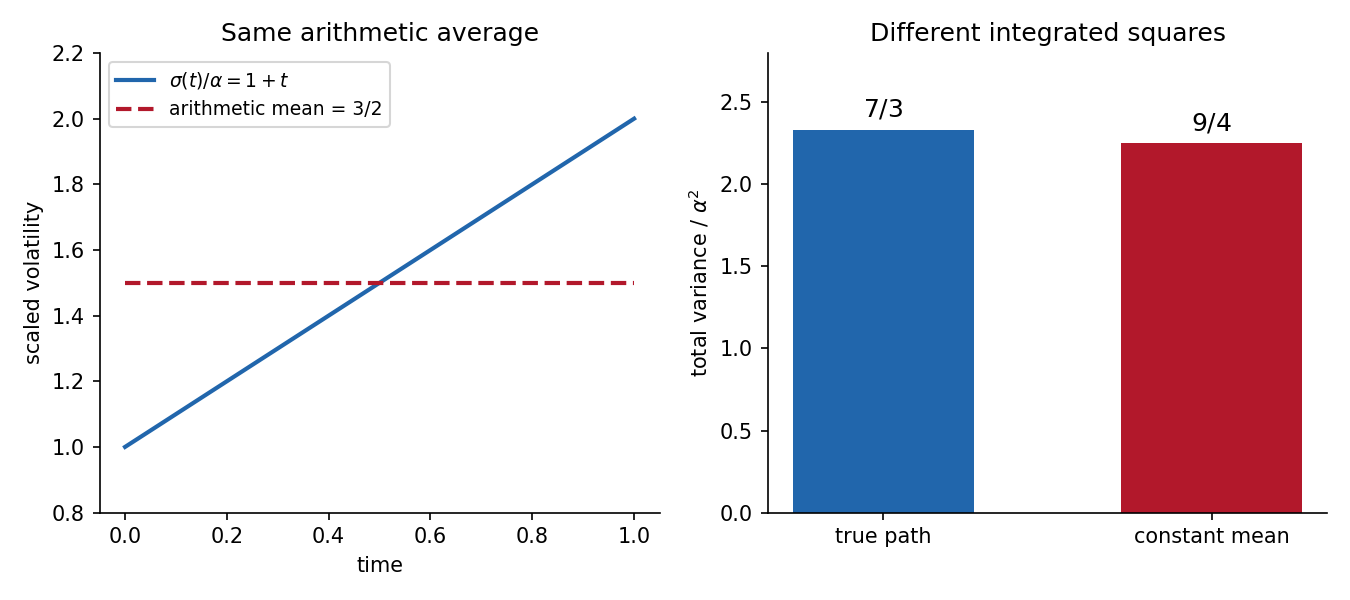
Over the stated year, the true total variance isThe second trader uses . Their difference iswhen . A nondegenerate European call option has positive option vega, equivalently a price strictly increasing in total variance. The offered price is therefore below the model value, so buy the option in the stated comparison.
If the deterministic volatility path is indeed the true one and the frictionless Black-Scholes trading assumptions apply, buy the cheap option and short its replicating portfolio computed with that true path. The initial cash received is the positive price difference, while the two terminal payoffs cancel exactly. Investing the initial surplus yields a strictly positive terminal gain with no net claim liability, an arbitrage within this model. A mere uncertain volatility belief would not by itself provide that replication guarantee. At both variances coincide and this price difference disappears.

Articles by others on the same topic
There are currently no matching articles.