Short one share at time zero and invest the one hundred pounds received in the bank asset. The initial net investment is zero. After one period, repurchasing the share leaves . Since and , this payoff is strictly positive in both states. Hence this is an arbitrage opportunity.
The risk-neutral probability must make the expected stock multiplier equal the bank multiplier:Both up and down paths have positive probability under this measure. A self-financing portfolio's discounted value is then a Q-martingale, since the discounted bank asset is constant and the discounted stock is a martingale. An arbitrage with zero initial wealth would have nonnegative terminal value and positive value in some possible state, giving a strictly positive Q-expectation and contradicting its zero discounted initial value. Thus the market with is arbitrage free.
Retain the whole price history when calculating the arithmetic average. The Asian option payoffs at expiry areIn particular and have the same terminal stock price but different averages and payoffs. The average is an additional state variable; the terminal stock nodes cannot be merged for this claim.
Use and discount one step by . At the up node, and immediate exercise pays . Continuation is worth . At the down node, and immediate exercise pays , while continuation is . Thus the American put option should be exercised at either time-one node, and
At time zero, exercise pays , while continuation is worthTherefore exercise at time zero is optimal, and pounds.
The discounted unexercised option-value process is not a Q-martingale: already . It is the Snell envelope of the discounted exercise payoff, hence a supermartingale in general, with strict decrease of expected value when immediate exercise beats continuation. Stopping at an optimal exercise time restores the stopped martingale property; that is a different assertion from the unexercised price being a martingale.
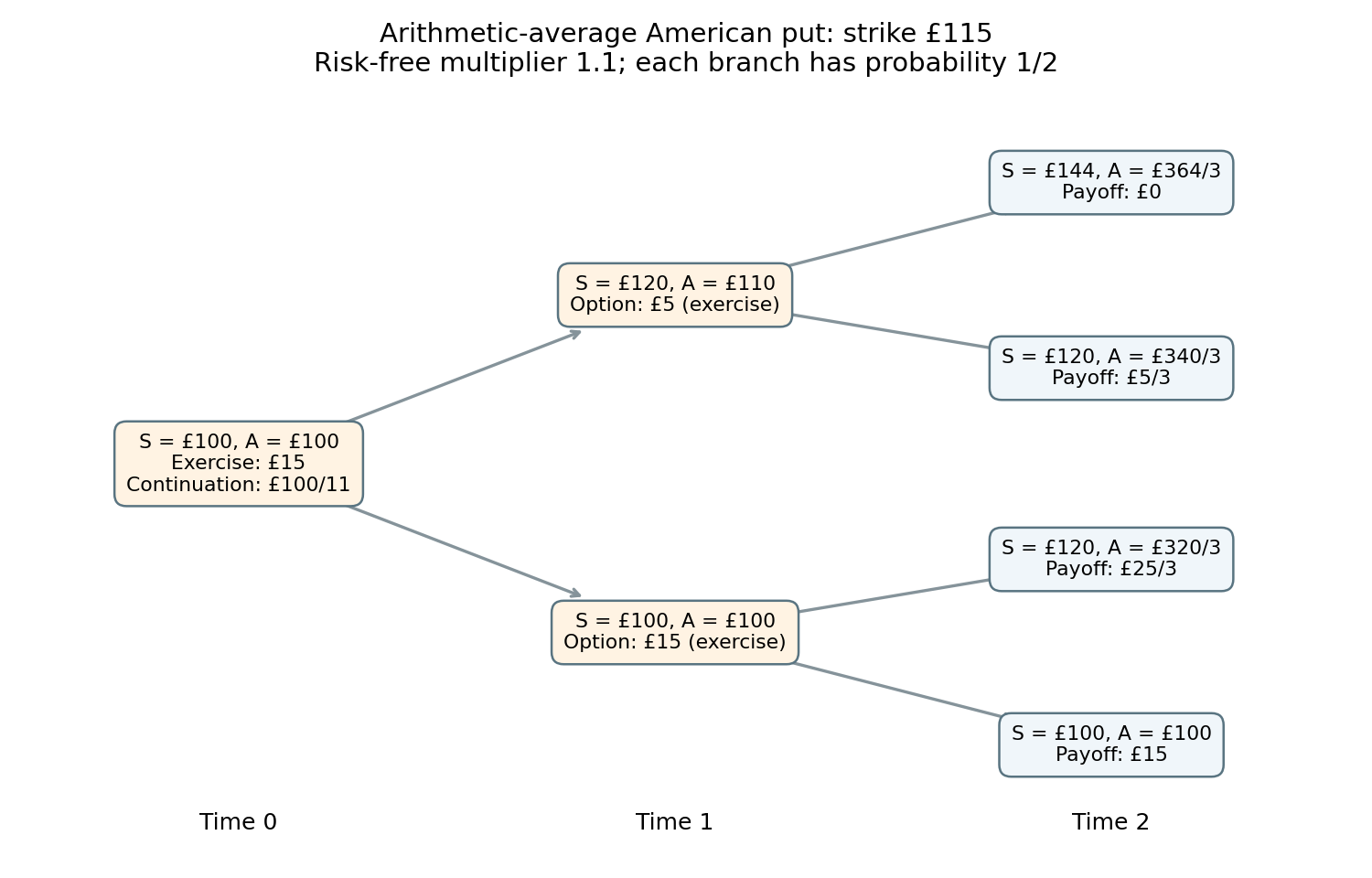
The American arithmetic-average put: four terminal histories are retained because ud and du have different average prices. Backward induction selects immediate exercise at both time-one nodes and at time zero.
Details. 
For geometric Brownian motion, . Averaging in time givesThus is normal with mean and variance . The moment-generating function of a normal distribution gives
For , the two stock paths agree, so their geometric averages agree. For , the future log-price isSplit the average's log-integral into and . The first part is , while integration of the displayed formula givesDividing by and exponentiating proves
Put . Conditional on present information, is independent of the past and is normal with mean zero and variance . Part (c) givesThe future drift in this auxiliary stock is precisely the risk-neutral drift. Discounting the conditional expectation and applying the normal exponential-moment formula yieldsAt expiry this reduces to ; at time zero it gives . This is a special case of conditional power moments of a continuous geometric Asian average.
The commodity's total gain from holding one unit is , because the storage cost is a fixed cash rate, not a proportional dividend yield. Form a locally self-financing delta hedge long the derivative and short units of the commodity. Itô's formula eliminates Brownian risk and leaves driftIts value is , so absence of arbitrage makes that drift equal to . Therefore the Black-Scholes equation with constant cash storage costs isThe cash cost enters as , rather than as , because one unit costs per unit time regardless of its current price.
Use the auxiliary diffusion with generator . Applying Itô's formula to makes its drift zero by part (a), leaving only . Under the usual integrability conditions, localization and expectation give the Feynman-Kac formulaFor polynomial-growth payoffs, the linear diffusion has the finite moments needed for this martingale argument. Its pricing drift includes the cash storage cost as an additive term.
The conditional mean solves with . Hence, for ,The forward contract's terminal payoff is , so discounting this expectation gives its current valueFor , the continuous limits are for the mean and for the contract value. A fair delivery price, as distinct from the current contract value, is the strike making this value zero: .
At expiry, the difference of a European call and put with matching strike is . Linearity of pricing therefore makes their difference equal the forward-contract value from part (c):A direct put-call parity replication gives the same result. Buy one unit of the commodity and deposit in the bank. Withdraw the fixed cash storage payments from this reserve; the reserve is exhausted at expiry, leaving one commodity unit. Its initial cost is . Borrow as well, leaving terminal value . The law of one price proves the parity identity. If , replace the storage reserve by .
Articles by others on the same topic
There are currently no matching articles.