Source: released examination bundle,
Part B 2007 11.pdf, pages 237–243. All six questions in both sections are covered. No mark allocations are printed.A measurable space is a set together with a sigma-algebra of its subsets: it contains and is closed under complements relative to and countable unions. A measure is a map with and countable additivity on disjoint measurable sets:A finite measure additionally satisfies .
For , define the measurable decreasing tail eventsIf almost everywhere, every point outside its null exceptional set eventually leaves each such tail event, so . Continuity from above of a measure applies because , giving .
Conversely, assume these measures tend to zero. For each positive integer , the intersection has measure zero. Outside the union of these countably many null sets, every has an index after which for all later . Hence there. This proves the desired equivalence. The argument uses all positive thresholds; replacing the intersection of tail events by a single strict limsup inequality at the same threshold would mishandle equality cases.
The triangle inequality gives the event inclusionCountable subadditivity of a measure bounds its measure by the sum of the two terms on the right. Both tend to zero as by convergence in measure. Thus convergence in measure implies the Cauchy property in measure.
The Cauchy assumption lets us choose recursively, increasing strictly, so that for all . In particular the measurable eventshave summable measures. The measure of is at most , so is a null set. Outside it, the successive differences are eventually bounded by a summable geometric series. Hence is pointwise Cauchy and has a finite real limit.
Define to be that limit wherever the sequence converges, and zero elsewhere. The convergence set is measurable by the countable Cauchy criterion, and the limit is measurable as a limit of measurable functions on that set. Thus there is no need to assume the measure is complete. Part (a)(ii), or the corresponding finite-measure implication, gives in measure.
For the full sequence useChoose a sufficiently late subsequence index so the second term is small; the Cauchy property then bounds the first uniformly for all large . Therefore in measure. This proves completeness of convergence in measure on a finite measure space.
Kolmogorov zero-one law states that every event in the tail sigma-algebra of an independent sequence has probability zero or one. Removing any fixed number of summands changes by a finite random constant divided by , so does not change its extended-real limsup. Therefore is measurable with respect to the tail sigma-algebra. Each event for rational has probability zero or one. Monotonicity of these events forces the distribution to be concentrated at one extended-real value, allowing either infinity.
The strong law of large numbers says that for independent identically distributed variables with ,
Pointwise, the positive integers with are exactly . Thus . The monotone convergence theorem gives . Since ,These inequalities also hold for infinite expectations. This is the tail-sum formula comparison for a nonnegative real variable.
For any , the variable has infinite expectation. Part (a)(ii) therefore forces . Identical distributions give
For each positive integer , the events are independent and have divergent total probability by part (i). The Borel-Cantelli second lemma makes them occur infinitely often. Taking the countable intersection over givesIf were finite along any such sample path, then for some finite path-dependent , eventually. But would give eventually, a contradiction. ThereforeThis is the divergence of normalized iid partial sums without a first absolute moment.
The Borel-Cantelli second lemma says that independent events whose probabilities have divergent sum occur infinitely often almost surely. The events here are independent and have probabilities . Their sum diverges by the harmonic series, so
The printed update needs a one-step index correction to match its filtration: the draw for the transition from to must be the fresh variable . Also the trivial initial sigma-algebra is , rather than the printed . With literal , the next increment is already known at time , so ; the nontrivial update differs from . Thus the stated martingale claim is false with that indexing. The following uses the standard Pólya urn described in words.
Put , so the total count is . Conditional on , the next blue indicator has expectation . HenceAdaptedness and integrability follow from the recursive construction and . Thus is a bounded martingale. The martingale convergence theorem gives an almost-sure limit . Boundedness and the dominated convergence theorem then give , establishing convergence in .
The blue count never decreases, so . For all sufficiently large , this is at least . Whenever the fresh draw satisfies , a blue ball is added. Part (a), with , says that such events occur infinitely often almost surely. Therefore . Consequently
Since , the pointwise inequalityholds: on that event both sides equal one, and elsewhere the left side is zero. Take conditional expectation and pull out the positive -measurable denominator to obtain the requested bound. The supplied variance estimate improves it toalmost surely, by part (ii). These conditional probabilities are bounded by one. The dominated convergence theorem and tower property of conditional expectation giveThis proves Positivity of the limiting Pólya urn proportion without needing its explicit beta distribution.
Short one share at time zero and invest the one hundred pounds received in the bank asset. The initial net investment is zero. After one period, repurchasing the share leaves . Since and , this payoff is strictly positive in both states. Hence this is an arbitrage opportunity.
The risk-neutral probability must make the expected stock multiplier equal the bank multiplier:Both up and down paths have positive probability under this measure. A self-financing portfolio's discounted value is then a Q-martingale, since the discounted bank asset is constant and the discounted stock is a martingale. An arbitrage with zero initial wealth would have nonnegative terminal value and positive value in some possible state, giving a strictly positive Q-expectation and contradicting its zero discounted initial value. Thus the market with is arbitrage free.
Retain the whole price history when calculating the arithmetic average. The Asian option payoffs at expiry areIn particular and have the same terminal stock price but different averages and payoffs. The average is an additional state variable; the terminal stock nodes cannot be merged for this claim.
Use and discount one step by . At the up node, and immediate exercise pays . Continuation is worth . At the down node, and immediate exercise pays , while continuation is . Thus the American put option should be exercised at either time-one node, and
At time zero, exercise pays , while continuation is worthTherefore exercise at time zero is optimal, and pounds.
The discounted unexercised option-value process is not a Q-martingale: already . It is the Snell envelope of the discounted exercise payoff, hence a supermartingale in general, with strict decrease of expected value when immediate exercise beats continuation. Stopping at an optimal exercise time restores the stopped martingale property; that is a different assertion from the unexercised price being a martingale.
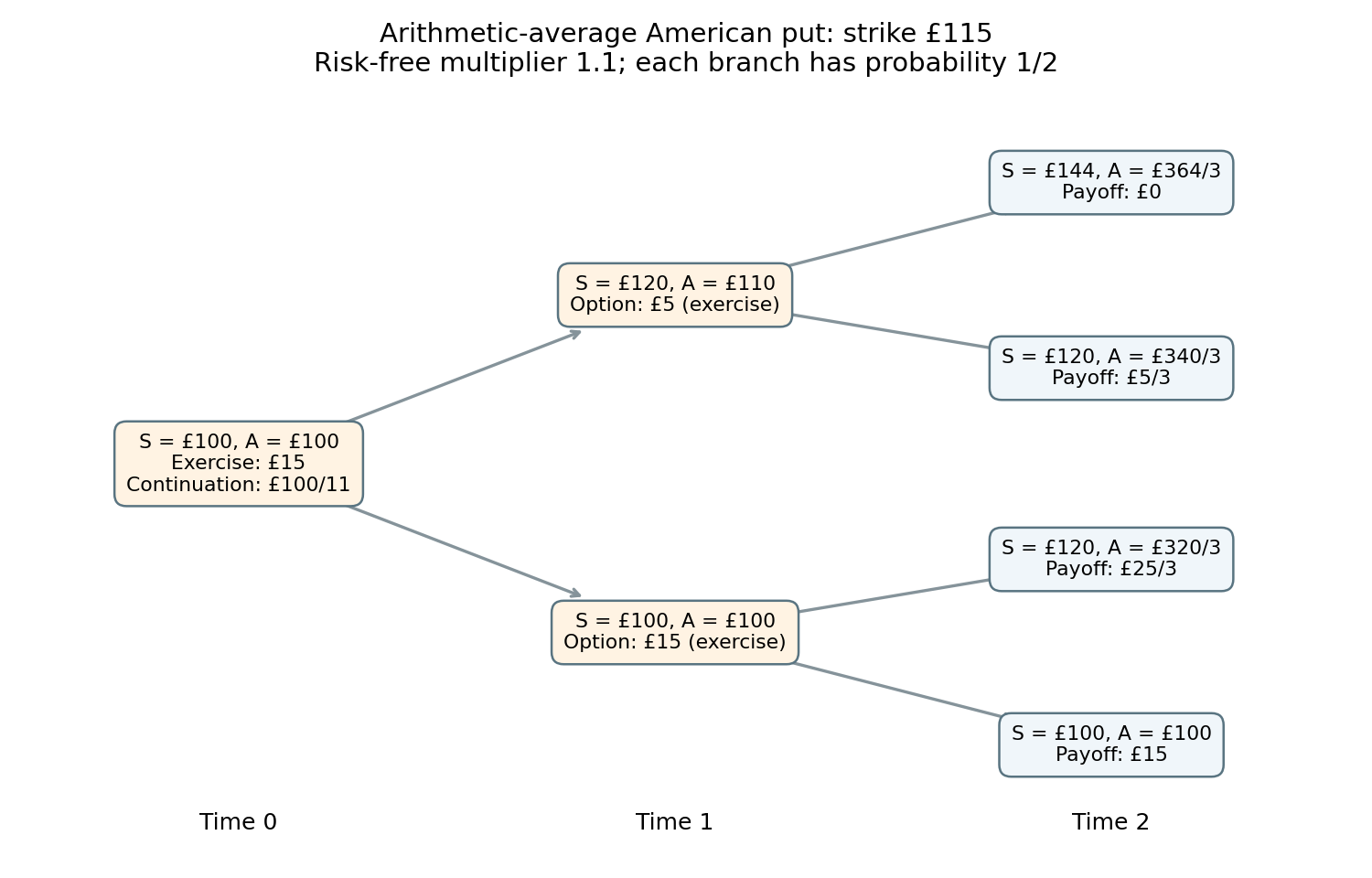
The American arithmetic-average put: four terminal histories are retained because ud and du have different average prices. Backward induction selects immediate exercise at both time-one nodes and at time zero.
Details. 
For geometric Brownian motion, . Averaging in time givesThus is normal with mean and variance . The moment-generating function of a normal distribution gives
For , the two stock paths agree, so their geometric averages agree. For , the future log-price isSplit the average's log-integral into and . The first part is , while integration of the displayed formula givesDividing by and exponentiating proves
Put . Conditional on present information, is independent of the past and is normal with mean zero and variance . Part (c) givesThe future drift in this auxiliary stock is precisely the risk-neutral drift. Discounting the conditional expectation and applying the normal exponential-moment formula yieldsAt expiry this reduces to ; at time zero it gives . This is a special case of conditional power moments of a continuous geometric Asian average.
The commodity's total gain from holding one unit is , because the storage cost is a fixed cash rate, not a proportional dividend yield. Form a locally self-financing delta hedge long the derivative and short units of the commodity. Itô's formula eliminates Brownian risk and leaves driftIts value is , so absence of arbitrage makes that drift equal to . Therefore the Black-Scholes equation with constant cash storage costs isThe cash cost enters as , rather than as , because one unit costs per unit time regardless of its current price.
Use the auxiliary diffusion with generator . Applying Itô's formula to makes its drift zero by part (a), leaving only . Under the usual integrability conditions, localization and expectation give the Feynman-Kac formulaFor polynomial-growth payoffs, the linear diffusion has the finite moments needed for this martingale argument. Its pricing drift includes the cash storage cost as an additive term.
The conditional mean solves with . Hence, for ,The forward contract's terminal payoff is , so discounting this expectation gives its current valueFor , the continuous limits are for the mean and for the contract value. A fair delivery price, as distinct from the current contract value, is the strike making this value zero: .
At expiry, the difference of a European call and put with matching strike is . Linearity of pricing therefore makes their difference equal the forward-contract value from part (c):A direct put-call parity replication gives the same result. Buy one unit of the commodity and deposit in the bank. Withdraw the fixed cash storage payments from this reserve; the reserve is exhausted at expiry, leaving one commodity unit. Its initial cost is . Borrow as well, leaving terminal value . The law of one price proves the parity identity. If , replace the storage reserve by .
Articles by others on the same topic
There are currently no matching articles.