Write , and . In a one-step binomial options pricing model, absence of arbitrage requires . If , borrowing to buy the stock gives a nonnegative gain in either state and a positive gain in at least one. If , shorting the stock and investing the proceeds does the same. Conversely, strict inequalities give the risk-neutral probability , under which the discounted stock is a martingale; this excludes arbitrage at each node. Hence
Under a risk-neutral measure, the expected stock multiplier is the bank multiplier. With ,Thus , and the one-period effective return is also zero.
The terminal stock prices and European put option payoffs areLet be the risk-neutral up probability. Risk-neutral pricing and the supplied discounted-price condition giveso . Its roots are and ; only the first is a probability. ThereforeThe current put price is pounds. This interest rate is specific to part (c), and differs from the zero rate in part (b).
For matching European strike and expiry with no dividends, put-call parity gives . Using the rate and put price from part (c),As a check, only the call payoff is positive, at . Its risk-neutral expectation is , and discounting by gives the same value.
Return to and from part (b). An American put option is valued by the larger of immediate exercise and discounted continuation at each node. At time one with stock price , exercise gives zero, while continuation gives . With stock price , exercise gives , and continuation gives ; the holder is indifferent.
At time zero, exercise gives , while continuation gives . ConsequentlyIt is optimal to wait initially and at the up node; at the down node either exercise or waiting is optimal. At this zero interest rate, the European put also costs twenty pounds.
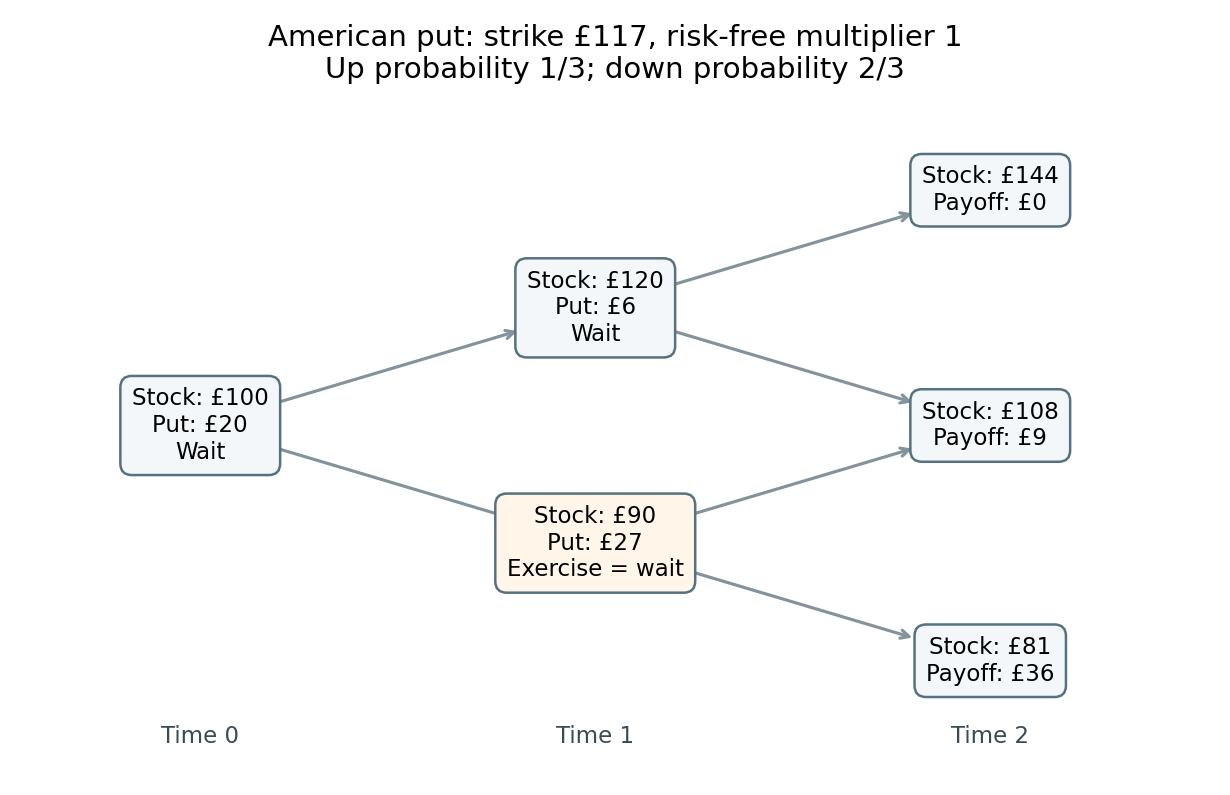
Backward induction for the American put when the risk-free multiplier is one and the up probability is one third. Each node shows the stock price and option value.
Details. 
Articles by others on the same topic
There are currently no matching articles.