Write , and . In a one-step binomial options pricing model, absence of arbitrage requires . If , borrowing to buy the stock gives a nonnegative gain in either state and a positive gain in at least one. If , shorting the stock and investing the proceeds does the same. Conversely, strict inequalities give the risk-neutral probability , under which the discounted stock is a martingale; this excludes arbitrage at each node. Hence
Under a risk-neutral measure, the expected stock multiplier is the bank multiplier. With ,Thus , and the one-period effective return is also zero.
The terminal stock prices and European put option payoffs areLet be the risk-neutral up probability. Risk-neutral pricing and the supplied discounted-price condition giveso . Its roots are and ; only the first is a probability. ThereforeThe current put price is pounds. This interest rate is specific to part (c), and differs from the zero rate in part (b).
For matching European strike and expiry with no dividends, put-call parity gives . Using the rate and put price from part (c),As a check, only the call payoff is positive, at . Its risk-neutral expectation is , and discounting by gives the same value.
Return to and from part (b). An American put option is valued by the larger of immediate exercise and discounted continuation at each node. At time one with stock price , exercise gives zero, while continuation gives . With stock price , exercise gives , and continuation gives ; the holder is indifferent.
At time zero, exercise gives , while continuation gives . ConsequentlyIt is optimal to wait initially and at the up node; at the down node either exercise or waiting is optimal. At this zero interest rate, the European put also costs twenty pounds.
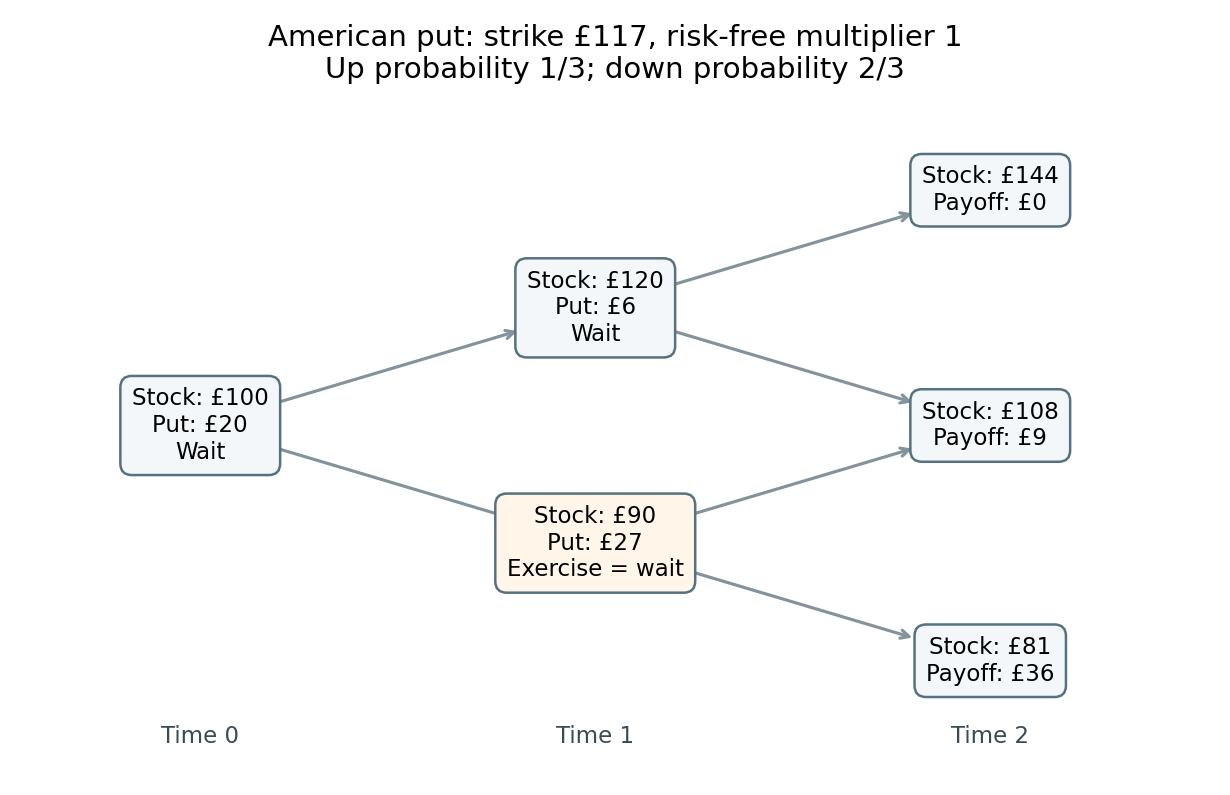
Backward induction for the American put when the risk-free multiplier is one and the up probability is one third. Each node shows the stock price and option value.
Details. 
Put . The linear combination starts at zero and has continuous paths. An increment over an interval of length is a linear combination of independent centred normal random variables, so is centred normal with varianceIncrements on disjoint intervals are independent, since they depend on disjoint increments of the two independent Brownian motions. These are the defining properties, so is a standard Brownian motion.
Cubing the supplied geometric Brownian motion solution gives . The moment-generating function of a normal distribution yields . Therefore
For this stock-dependent payoff, replace the stock drift by under a risk-neutral measure. Conditional lognormal moments then give, with ,This is the Power payoff in the Black-Scholes model. The delta hedge is shares, so the stock holding is worth . The rest is a bank position worth , or units of the bank asset. This gives a replicating portfolio; its self-financing identity follows from Itô's formula and the Black-Scholes pricing equation, and its terminal value is .
The full two-Brownian filtration contains an additional orthogonal noise direction, but this particular payoff is replicated using the traded stock and bank asset, so that extra noise does not affect its price.
Apply Itô's formula to , where . Since , the drift and diffusion areThusUnder the risk-neutral measure its drift becomes , as required for a traded, non-dividend-paying replicating asset.
For a call option on a power payoff, the replicating asset from part (c) has , volatility , and risk-neutral drift . The new payoff is therefore a European call option on , with strike . Applying the given Black-Scholes formula givesHere . Equivalently . It is the price process , rather than the raw power , that serves as the self-financing underlying for this application.
Under the physical probability, the stock has mean . Nonnegativity permits interchanging expectation and integration in the accumulated dividends. HenceTherefore
Let the accumulated bank account from past dividends beHolding one stock share and banking its dividends is a self-financing portfolio with wealth and . Doubling that strategy replicates the specified terminal payoff. Its price is thereforeIn particular its initial price is one hundred pounds. This illustrates banking stock dividends versus reinvesting them. The accrued-dividend term is known at time and belongs to the payoff defined from time zero; it cannot be discarded when .
For an ex-dividend stock, holding shares earns both and the dividend gain . Freeze locally in a self-financing hedge that is long the claim and short these shares. Itô's formula cancels its Brownian exposure, leaving drift . Its value is , so absence of arbitrage requires this drift to equal . Rearrangement gives the Black-Scholes equation with continuous stock dividends:With the given parameters,The physical drift cancels because the hedge removes the stock-price risk; the dividend payment remains in the stock's total gain.
The diffusion associated with the displayed pricing equation is . For , Itô's formula givesThe drift vanishes by the PDE. Under the usual integrability conditions for the payoff and solution, localization and conditional expectation make a true martingale; for polynomial-growth data the lognormal moment bounds provide the needed integrability. Applying the terminal condition yields the Feynman-Kac formulaThe printed diffusion contains an additional undefined factor multiplying . If literally retained, its second-order generator coefficient would be , so the requested representation would correspond to that different PDE unless . The formula above uses the volatility specified by the stock model and by part (c).
Under the pricing measure, the ex-dividend stock drift is . ThusA direct replication holds shares and reinvests every dividend into more shares. The share count grows at rate , reaching two shares at expiry, with no external cash input. This payoff contains only the terminal ex-dividend stock value, unlike part (b), which also includes the separately accumulated dividends.
Articles by others on the same topic
There are currently no matching articles.