At equilibrium between two thermodynamic phases of a pure substance, their molar Gibbs free energies are equal. Along a coexistence line,Subtracting the two differentials givesFor a nonzero volume change,The second equality uses on coexistence. Total entropy and volume changes may be used instead if they refer to the same amount of material. The ratio must use one consistent transformation direction, so reversing the labels changes both signs and leaves the slope unchanged. This is the general Clapeyron equation; the ideal-vapour approximation often called Clausius-Clapeyron makes further assumptions not needed for two solids.
A multi-anvil press transmits a large external load through several hard anvils onto a confined pressure medium surrounding the sample. Reducing the loaded area raises pressure, while the surrounding medium and gasket limit lateral escape. A resistive heater within the assembly can heat the sample, with insulation and temperature sensing arranged around it. It provides relatively large sample volumes and useful bulk, high-temperature experimental conditions, but access to the sample and optical paths is restricted, pressure gradients and calibration matter, and the maximum pressure is constrained by anvil strength and geometry.
A diamond anvil cell squeezes a very small sample and pressure medium in a gasket hole between opposed diamond culets. Diamond combines high strength with useful optical transparency, permitting spectroscopy and optical pressure calibration as well as suitable X-ray access. Heating can be external or laser-based. The very small contact area permits high pressure from a modest total force, but gives a tiny sample volume. Nonhydrostatic stress, pressure gradients, gasket deformation, heating gradients, chemical compatibility and diamond failure are important limitations.
Neither device generates pressure by force alone independent of area and confinement. Nor does a nominal force-to-area ratio guarantee a known hydrostatic sample pressure; experimental pressure and temperature must be calibrated. The two assemblies trade sample volume and access against pressure reach rather than one being universally preferable.
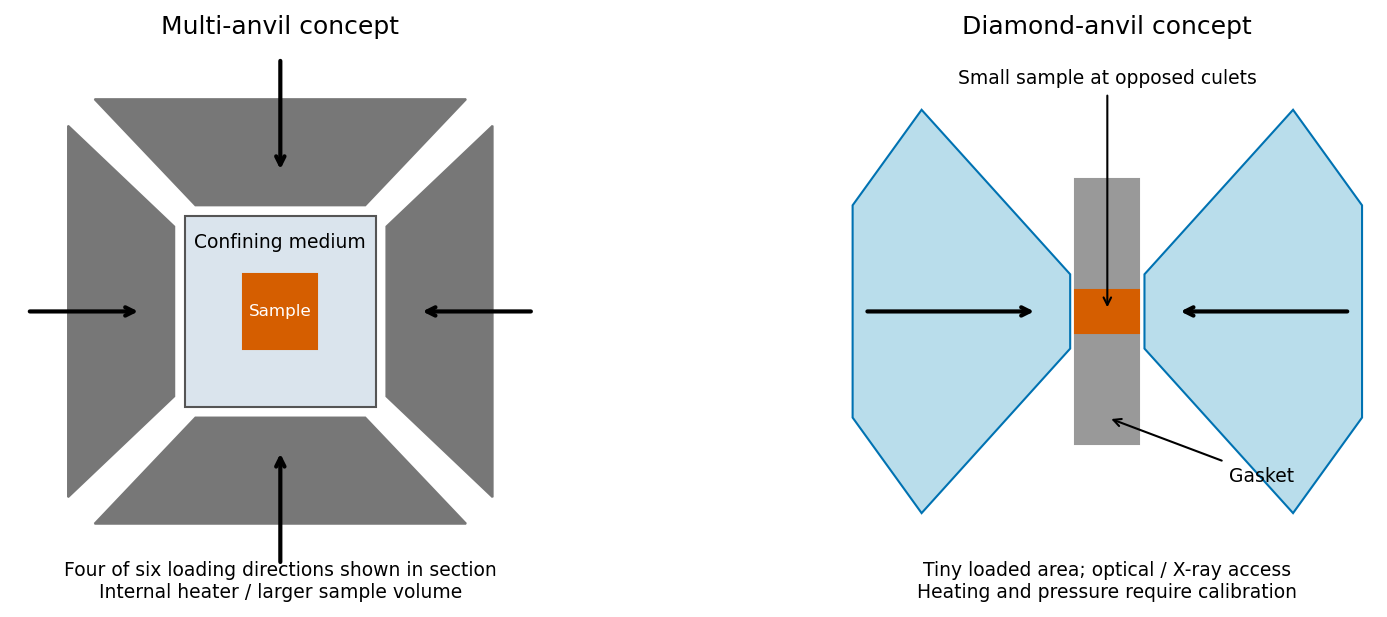
Original conceptual comparison of multi-anvil load transmission and opposed diamond culets, showing confinement and qualitative heating/access tradeoffs
. Details. 
Diamond can be metastable: its Gibbs free energy is higher than graphite's under ambient conditions, but transformation is kinetically inhibited. Conversion requires substantial rearrangement of the strong carbon-bond network and the formation and growth of a new thermodynamic phase, with an activation and nucleation barrier.
At room temperature the rate can be extremely small even though the free-energy change favors graphite. Thermodynamic stability specifies the preferred equilibrium state, not the time needed to reach it. Persistence of diamond therefore does not contradict graphite's ambient equilibrium stability.
Use the same molar amount for both thermodynamic phases. A hexagonal cell built from two basal lattice vectors at120degrees has volume , not the volume of a three-times-larger full hexagonal prism. With four atoms per stated graphite cell,Diamond has eight atoms per conventional cubic cell, soFor graphite transforming to diamond,ThereforeThe positive slope reflects diamond's smaller entropy and volume. Higher temperature favors the higher-entropy graphite thermodynamic phase, requiring greater pressure to compensate in favor of the smaller-volume diamond thermodynamic phase.
This estimate treats the supplied ambient molar entropies and volumes as applicable near coexistence and neglects their changes through thermal expansion, compressibility and heat capacity. It gives an approximate gradient, not the transition pressure or a complete high-pressure thermodynamic phase boundary; an intercept would require an additional free-energy datum.
Articles by others on the same topic
There are currently no matching articles.