A diamond anvil cell concentrates force onto tiny opposing culets, reaching very high pressure with small samples and useful optical access through diamond; its small volume, pressure gradients, alignment demands and difficulties with some heating or sample environments can limit experiments. A multi-anvil press supports a much larger sample and is useful for high-temperature synthesis and bulk measurements, but usually reaches lower ultimate pressures and has more restricted optical access. Hydrostaticity, attainable temperature and calibration depend on the actual apparatus and pressure medium; neither design guarantees uniform pressure.
Use mass density , with . The rock salt structure has formula units per conventional cell; the CsCl structure has . In pressure order the densities are approximatelyThe increase across the transition is approximately , much greater than the smooth compression within either branch. Comparing directly without correcting the different would create a fictitious volume discontinuity.
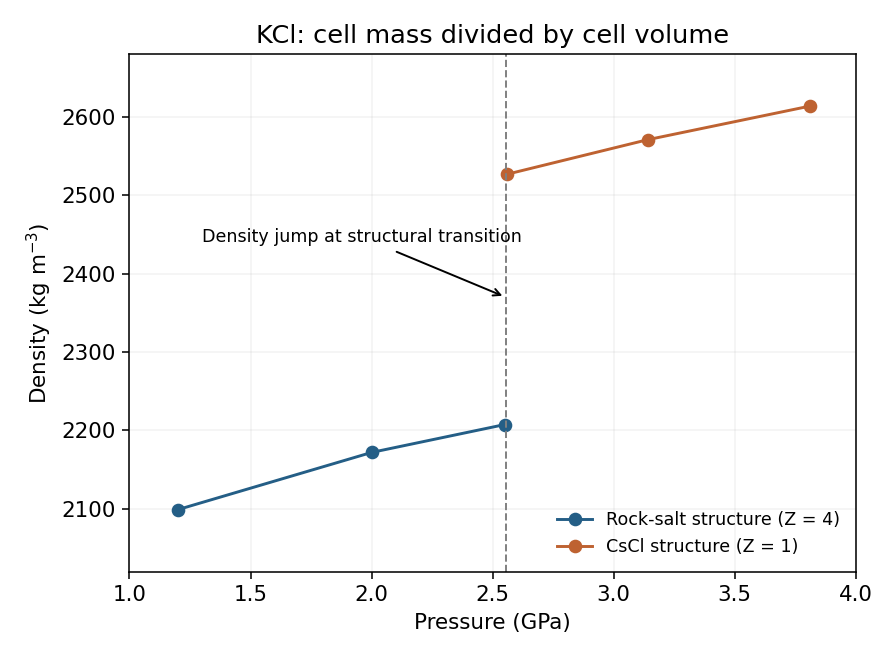
KCl density calculated separately for the two crystal structures
. Original calculation from cell mass and volume. The narrow gap brackets the transition; separate lines avoid implying a continuous single-phase density through the jump. Details.
Within each cubic phase, increasing pressure decreases , so decreases and Bragg's law moves a given reflection to higher . Near , peaks of the rock salt structure disappear as those of the CsCl structure appear, potentially with a coexistence interval. The former has an FCC translation selection rule, with all even or all odd; mixed-parity reflections vanish kinematically. The latter has primitive-cubic translations and basis factor , so it has no FCC extinction rule. Odd-sum reflections may nevertheless be weak because the two ionic scattering factors are similar. Peak spacings, relative intensities and the cell volume per formula unit change discontinuously. A simple uniform shift of the entire original pattern cannot describe the structural transition.
Use only the high-pressure CsCl structure branch to extrapolate its volume per formula unit . A straight-line least-squares fit to those three measurements gives approximatelywith in GPa. Thus , and . Taking Cu K wavelength in Bragg's law givesThe estimate is model-dependent: a straight-line extrapolation of instead gives . The data stop at , so the absence of further phase transitions does not by itself determine an exact equation of state to . The peak can also be weak because its basis factor is .
The coordination number rises from six in the rock salt structure to eight in the CsCl structure. In the elementary hard-sphere ionic bonding model, accommodating eight opposite neighbours favours a larger cation/anion radius ratio: the geometrical limiting ratios are for sixfold and for eightfold coordination. The high-pressure change is therefore consistent with increasing under compression. Sincethe chloride ion is inferred to be more compressible than the potassium ion in this radius-ratio interpretation. This is a qualitative structural argument; real ionic radii depend on coordination and electronic structure, and the transition does not uniquely determine separate microscopic compressibilities.
Articles by others on the same topic
There are currently no matching articles.