Reading the coefficients in the ordered concentration vector gives the linear system of ordinary differential equationsIts columns sum to zero, so . This three-state cyclic conversion model conserves total concentration.
Put and . Direct expansion gives the characteristic polynomialThe quadratic formula therefore givesSince , both nonzero eigenvalues have negative real part. They need not be real; equal rates give a complex-conjugate pair.
The remaining eigenvalue is . At a steady state, the three cyclic fluxes agree: . A corresponding nonzero eigenvector is thereforeor its scalar multiple . Its positive components express a possible equilibrium concentration ratio.
If , the three eigenvalues are distinct, so a basis of eigenvectors givesThe transformed coordinates then have the displayed exponential form. If , this is a complex eigenbasis; real concentrations are recovered by conjugate-paired coefficients. A real basis instead gives a decaying two-dimensional rotation block with decay rate and angular frequency .
The proposed diagonalization is not valid for every positive choice of rates. For example , gives , , with repeated eigenvalue and only one corresponding eigenvector. More generally the defective repeated eigenvalue in a cyclic conversion model occurs when . A Jordan basis then givesThe extra factor cannot be represented by two independent pure exponential coordinates in a diagonal basis.
All nonzero eigenmodes decay, including the term in the repeated-root case. Total concentration is conserved and initially equals . Combining with the equal-flux ratios givesThese are the unique steady state concentrations with this total. The formula remains valid when the transient eigenvalues are complex or repeated.
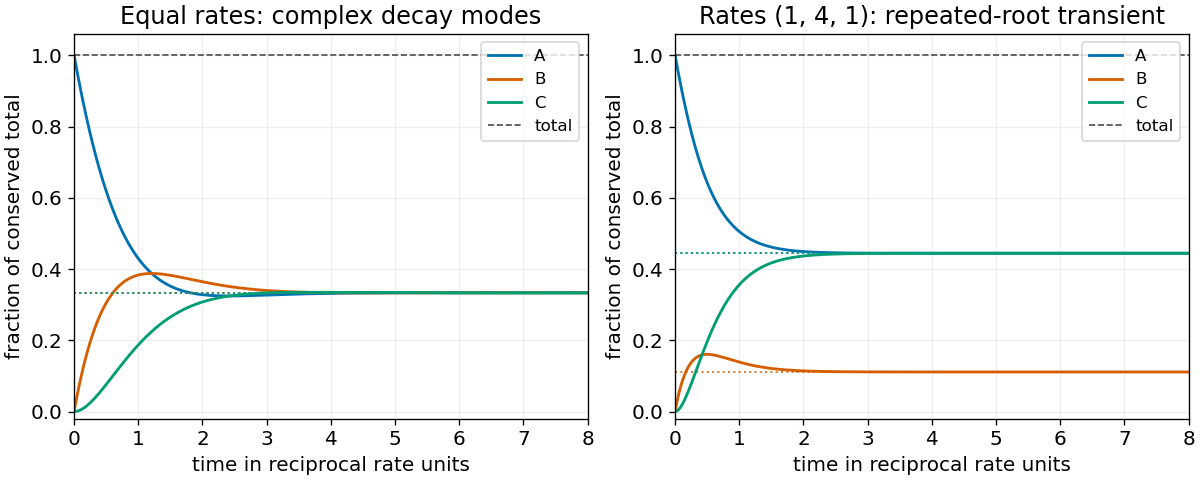
Three-state conversion conserves total concentration; equal rates give damped oscillations and repeated roots give a Jordan transient
. Details. 
Articles by others on the same topic
There are currently no matching articles.