Source paper: www.whatdotheyknow.com/request/physics_preliminary_examinations/response/1162943/attach/3/Twain.7z?cookie_passthrough=1
Multiply numerator and denominator by the denominator's complex conjugate:Thus the real part is and the imaginary part is .
The determinant is . The adjugate matrix formula givesWhen or we have a singular matrix, so no inverse matrix exists. This criterion holds for real or complex .
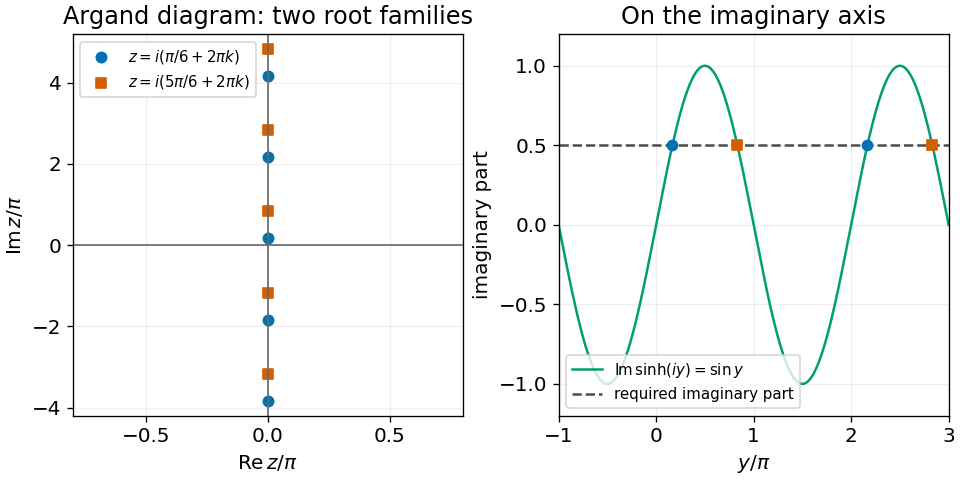
Write with real . The complex hyperbolic sine is . Its zero real part requires . If , the magnitude of the imaginary part would be , which cannot equal . Therefore and . All solutions areOn the Argand diagram these are two interlaced arithmetic sequences on the imaginary axis; both repeat with imaginary period .

The elementary row operation givesThe nonzero rows here have distinct pivots. Therefore the matrix rank isThere is always at least one nonzero row, so rank zero is impossible.
Rearrange as . The characteristic polynomial factors as , giving the homogeneous solutions . A particular polynomial solution obeys and . HenceThis is the full two-constant solution of the second-order linear differential equation.
Let , a primitive fourteenth root of unity. The geometric series gives . Taking the real part and adding the remaining fifteenth term therefore yieldsThe upper summation limit matters: the first fourteen terms complete one full cycle, and the fifteenth supplies one additional term.
The finite-dimensional spectral theorem diagonalizes the Hermitian matrix in its orthonormal eigenbasis. The determinant is the product of the eigenvalues:
Distinct eigenvalues of a Hermitian matrix have orthogonal eigenvectors, since . The given normalization then gives
Here , so its even powers alternate between and its odd powers between . Collecting even and odd terms of the matrix exponential yieldsThus , , and . It is the rotation matrix for a counterclockwise rotation through angle , preserving lengths and orientation.
The substitution turns the equation into . Separating and integrating gives , henceEach real solution is defined on an interval containing no pole of the tangent. There is no real constant- solution discarded by division, since .
The first-order linear differential equation has integrating factor . Multiplying through givesWith , the right side integrates to . ConsequentlyAll coefficients are smooth, so these real solutions extend over the whole real axis.
Put , so . On an interval with , the resulting first-order linear differential equation is . Its integrating factor gives , henceFor real differentiable graphs one needs and , with either fixed sign on a connected interval. The points are outside the original equation's domain. At , would make the left side zero while the right side is , so those endpoints are also excluded. The identically zero function is not an additional solution.
One scalar initial condition is needed in each case, because each equation is first order and each regular solution has one integration constant. The usual Picard-Lindelöf theorem applies locally at a regular initial point. For part (c), this requires and ; a condition at an excluded singular endpoint cannot specify a classical solution there. Arbitrary distant boundary data also need not be compatible with one common interval of existence.
A direction of the intersection line must be orthogonal to both normal vectors. Their cross product isThus a convenient parallel vector is .
Eliminating from the two plane equations gives , followed by . Taking gives the point . The entire intersection line is , where .
The orthogonal projection of the origin onto the line occurs at , giving closest point . Hence the distance from a point to a line in three dimensions is
For , the norm equation requires . Thus the locus isThis includes , when the first condition imposes no restriction.
First assume . The first equation is a plane, and the second is a sphere centred at . Define its signed normal separation and projected centre byThe intersection of a plane and a sphere isThe circle lies in the given plane. Its radius follows from the Pythagorean theorem, splitting into orthogonal components. If , the first equation is the identity , so the locus is the entire sphere, rather than a planar section.
Reading the coefficients in the ordered concentration vector gives the linear system of ordinary differential equationsIts columns sum to zero, so . This three-state cyclic conversion model conserves total concentration.
Put and . Direct expansion gives the characteristic polynomialThe quadratic formula therefore givesSince , both nonzero eigenvalues have negative real part. They need not be real; equal rates give a complex-conjugate pair.
The remaining eigenvalue is . At a steady state, the three cyclic fluxes agree: . A corresponding nonzero eigenvector is thereforeor its scalar multiple . Its positive components express a possible equilibrium concentration ratio.
If , the three eigenvalues are distinct, so a basis of eigenvectors givesThe transformed coordinates then have the displayed exponential form. If , this is a complex eigenbasis; real concentrations are recovered by conjugate-paired coefficients. A real basis instead gives a decaying two-dimensional rotation block with decay rate and angular frequency .
The proposed diagonalization is not valid for every positive choice of rates. For example , gives , , with repeated eigenvalue and only one corresponding eigenvector. More generally the defective repeated eigenvalue in a cyclic conversion model occurs when . A Jordan basis then givesThe extra factor cannot be represented by two independent pure exponential coordinates in a diagonal basis.
All nonzero eigenmodes decay, including the term in the repeated-root case. Total concentration is conserved and initially equals . Combining with the equal-flux ratios givesThese are the unique steady state concentrations with this total. The formula remains valid when the transient eigenvalues are complex or repeated.
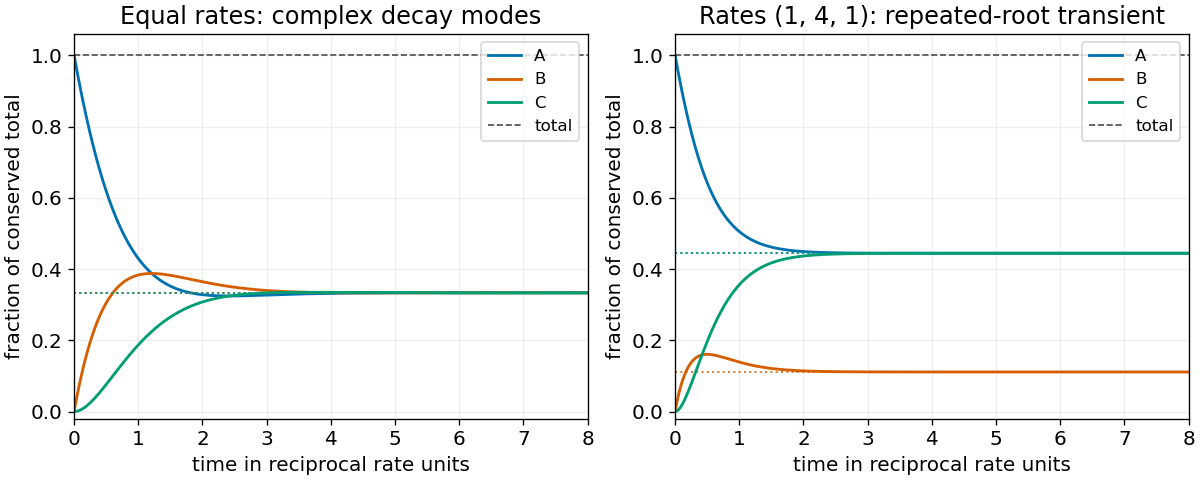
Three-state conversion conserves total concentration; equal rates give damped oscillations and repeated roots give a Jordan transient
. Details. 
A real symmetric matrix has freely chosen diagonal entries and freely chosen entries above the diagonal. The entries below are then fixed by symmetry. Consequently
The cyclic property of the trace gives , which is C1. The linearity of trace and matrix multiplication gives C2 and C3. Finally symmetry of giveswith equality exactly when every entry is zero. Thus C4 also holds. This is the Frobenius inner product restricted to the real vector space of symmetric matrices.
Apply the cyclic property of the trace and :This proves similarity invariance of trace without requiring or to be symmetric.
Taking the trace of the proposed commutator identity would givea contradiction for positive integer over the real numbers. No such finite real matrices exist. This is the trace of a commutator obstruction; it also applies to complex finite matrices.
Multiplicativity of the determinant gives . Thus C1 holds. For , C2 fails: choosing and gives . The same choice disproves C3, since . The nonnegativity portion of C4 holds, because , but its positive-definiteness clause fails: a nonzero singular matrix that is symmetric, such as , has zero self-pairing.
Therefore this is not an inner product for . For the exceptional case , the determinant is the scalar entry and the pairing is ordinary multiplication of real numbers, so all four conditions hold. The determinant pairing is not an inner product in higher dimension because it measures volume scaling rather than a bilinear length geometry.
Articles by others on the same topic
There are currently no matching articles.