Interpret “held” and then “released” as zero initial velocity. In the small-slope wave equation on a string model, the elastic energy is and the initial kinetic energy is zero. The given profile hasThe two cosine functions are orthogonal on and each has squared integral . ThusThe implicit leading displacement amplitude is one in the source's chosen length units. If that amplitude is written explicitly as , all energies here and below acquire a factor .
For a short string element , small slope makes its tension magnitude approximately constant and its vertical component approximately . The net vertical force is . Its mass is . Newton's second law givesThis assumes uniform equilibrium tension, small slopes, negligible bending stiffness and dissipation. The symbol is linear mass density here, not volume density.
Fixed endpoints select the spatial normal modes , with angular frequencies . Zero initial velocity selects cosine time dependence. Matching the two nonzero initial amplitudes givesEach term separately satisfies the wave equation and fixed-end boundary conditions. At the prescribed profile is recovered, and differentiating in time gives zero initial velocity.
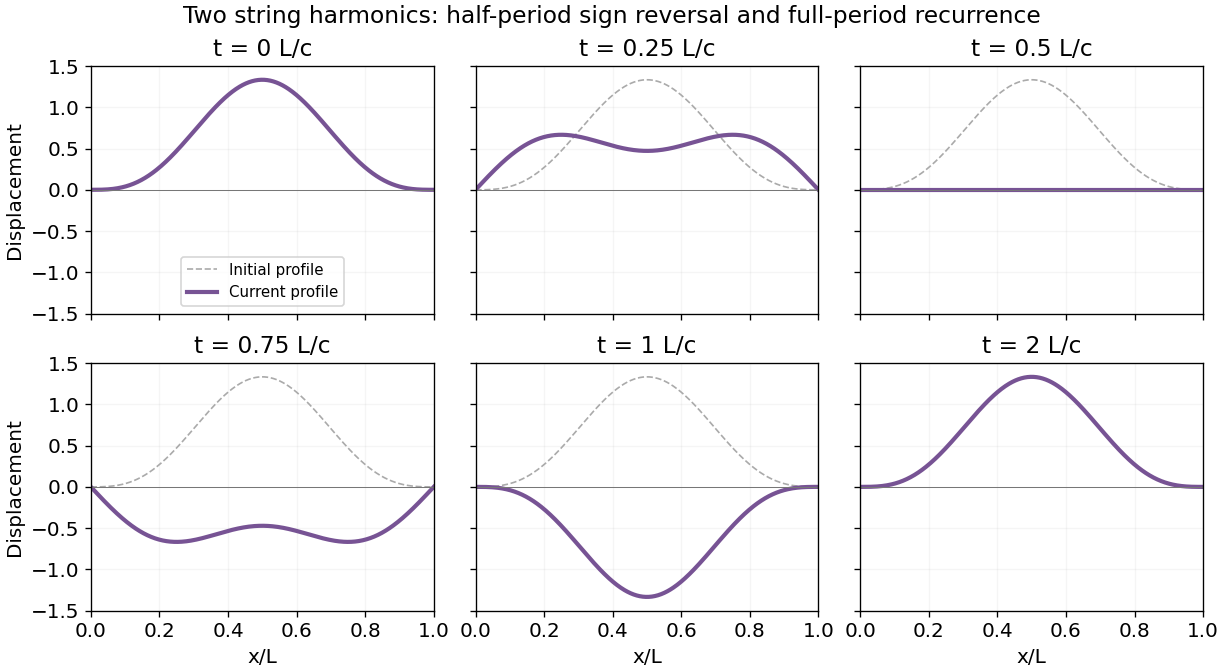

To recover the original signed displacement profile, orthogonality requires both cosine time factors to equal one. Since , the smallest positive time isAt both factors are , giving the negative of the initial profile, rather than the same profile. More generally, simultaneous recurrence requires commensurate excited-mode frequencies and undiminished amplitudes. The ideal nondispersive, fixed-end string has integer-multiple frequencies, whereas damping or a dispersive correction can destroy exact recurrence.
For a mode , integrate the kinetic-energy density:Here , and , soAll other modes have zero energy. The equal modal energies for inverse-harmonic string amplitudes give each excited mode total energy , even though their displacement amplitudes differ. The corresponding potential energy replaces sine squared by cosine squared, so their sum recovers the constant total energy from part (a).
Articles by others on the same topic
There are currently no matching articles.