Source: public Oxford archive. The held cover dates this sitting to 11 September 2014, despite its retained Trinity Term heading. Unlettered marked blocks are indexed a and b; all Section B options are answered.
For a continuously differentiable vector field on a bounded region with suitably piecewise smooth boundary, the divergence theorem giveswhere the normal vector points outward. In three dimensions, the position vector is and . ThereforeThe result depends only on the enclosed volume, not on the shape or its location relative to the origin. Reversing the surface orientation reverses the sign.
Multiply the convergent Taylor series and . Keeping all terms through total degree five givesThere are six nonzero monomials displayed, so the answer does not select only part of the tied total-degree-five terms when asking for at least four terms. Both original series converge for every finite real .
Use the Maclaurin series and the geometric series . Multiplication, grouped by total degree, givesThe six displayed nonzero terms include every contribution through total degree three. A sufficient open region for the convergent product expansion is , .
Stokes theorem equates the circulation of a continuously differentiable vector field around an oriented boundary to the flux of its curl across a spanning oriented surface:The boundary direction follows the right-hand rule relative to the normal vector. For the polynomial vector field, only the component of the curl can be nonzero, and
Orient the rectangle with normal vector . The surface integral of the curl is an ordinary planar integral:If the opposite orientation is chosen, both this flux and the corresponding boundary line integral change sign.
For positive and upward orientation, traverse the four edges counterclockwise. The bottom edge contributes . The right edge contributes . On the top edge decreases, giving . The left edge has and zero tangential component. HenceThis agrees with the surface integral and explicitly verifies Stokes theorem, including the direction of the top-edge traversal.
The cancellation of the quadratic terms makes the fourth-order terms decisive. The Taylor expansions giveCanceling for and taking the limit yields
On bounded intervals the exponential series converges uniformly, allowing termwise integration. Since ,The requested first two nonzero terms are thereforeThe function is the error function, with and derivative .
The proposed change of variables gives , , with inverse , . The Jacobian determinant isThe two lines of slope become , while the two lines of slope become . Thus the parallelogram becomes , . Since stays positive, the transformed integrand has no singularity there. The double integral is
For a differentiable function at an interior stationary point, both first partial derivatives vanish. If the second derivatives are continuous, form the symmetric Hessian matrixThe second-derivative test gives a strict local minimum if and , a strict local maximum if and , and a saddle point if . If , higher-order terms must be examined. For example, , and all have zero Hessian matrix at the origin but respectively a minimum, maximum and saddle. These are local interior criteria; boundary extrema require separate treatment.
The gradient is , so the only stationary point is . Its Hessian matrix is and its determinant is . ThusCompleting squares confirms the classification directly: . Arbitrarily close to the point, moving in the direction increases the value and moving in the direction decreases it.
Choose both waves as sinusoids with a common zero phase and amplitude . The trigonometric sum identity givesThe slowly varying wave envelope has constant phase when is constant. Its speed is , and in the close-frequency limit the group velocity isIt describes the motion of a narrow-band envelope in a medium where the constituent waves retain a coherent packet interpretation; it is not an unconditional signal-speed theorem in strongly absorbing or anomalously dispersive media. The carrier phase velocity is . In a nondispersive medium, with constant , so .
Measure each rod angle from the downward vertical, as in the held diagram. The upper mass rises by ; the lower mass rises by . With the hanging equilibrium as the zero of gravitational potential energy,The retained expression is quadratic in the small displacements. Both masses contribute to the upper rod's gravitational term.
The two positions are and . Differentiating and summing their kinetic energies gives the exact expressionIn the linear small-oscillation approximation, set the cosine to one in this quadratic velocity expression:The cross term arises because the lower mass participates in motion generated by both rods.
A symmetric quadratic form has twice its off-diagonal entry as the coefficient of the mixed product. Comparing with the preceding potential energy and kinetic energy expressions givesHere is the stiffness matrix and the mass matrix in angular coordinates; their units differ accordingly. The dimensionless mass-matrix determinant is and its first diagonal entry is positive, so the kinetic energy is positive for every nonzero angular velocity.
The quadratic total mechanical energy isFor this frictionless conservative double pendulum, the Euler-Lagrange equations for giveor and . Substitution immediately verifies energy conservation.
Logical qualification. Energy conservation does not uniquely determine equations of motion: the scalar equation alone does not determine both equations. For example, replacing their right side by with any nonzero antisymmetric matrix preserves the same energy because , while changing the dynamics. Such a gyroscopic force is absent from the specified pendulum. The conservative-force structure, supplied here by the Lagrangian, is the additional information needed to justify the displayed equations rather than infer two independent equations from one scalar identity.
For the normal modes of a double pendulum with a two-to-one length ratio, seek . The generalized eigenvalue problem is . Put . A nonzero mode requiresThus the two angular frequencies areBoth squared frequencies are positive. The slower mode has and is in phase; the faster mode has and is out of phase. These mode ratios also check the off-diagonal terms in the mass matrix.
Assume . In cylindrical coordinates, the sphere imposes , and the volume element is . The required triple integral isHenceIt tends to zero as and to the full sphere volume as , checking both limits.
For the specified change of variables,Thus the inverse-coordinate Jacobian determinant is where , and the area element uses the absolute value .
Now , and . The positive quadrant maps to the half-strip , . The original origin corresponds to the collapsed boundary , where is not unique; this measure-zero degeneracy does not affect the integral. ThereforeThe second factor is the area of a unit semicircle. Independently, the original integrand factors into two identical gamma integrals, giving .
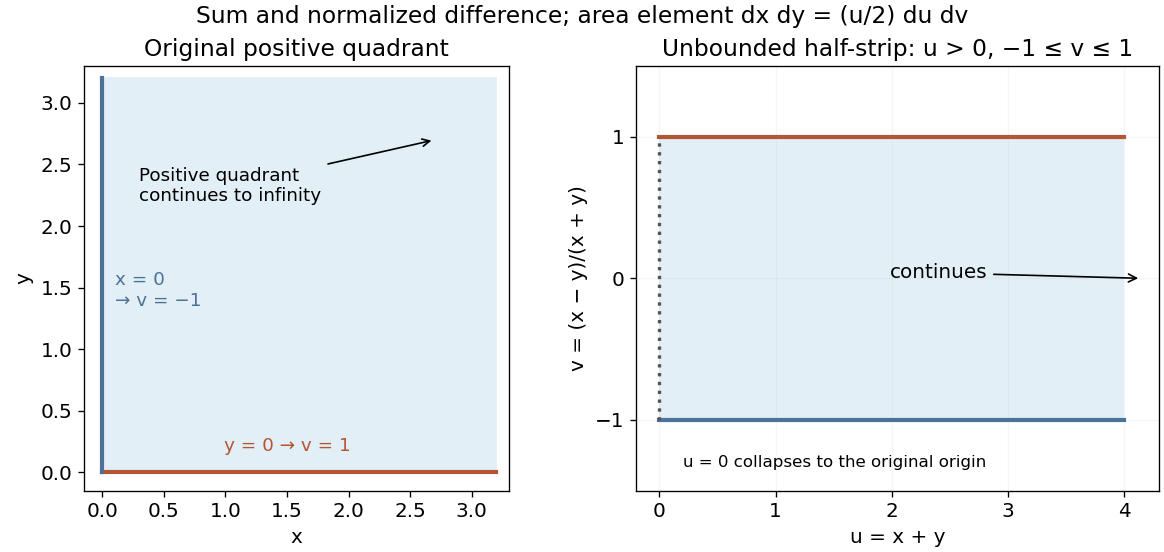
Positive-quadrant coordinates mapped to an unbounded half-strip
. Details. Interpret “held” and then “released” as zero initial velocity. In the small-slope wave equation on a string model, the elastic energy is and the initial kinetic energy is zero. The given profile hasThe two cosine functions are orthogonal on and each has squared integral . ThusThe implicit leading displacement amplitude is one in the source's chosen length units. If that amplitude is written explicitly as , all energies here and below acquire a factor .
For a short string element , small slope makes its tension magnitude approximately constant and its vertical component approximately . The net vertical force is . Its mass is . Newton's second law givesThis assumes uniform equilibrium tension, small slopes, negligible bending stiffness and dissipation. The symbol is linear mass density here, not volume density.
Fixed endpoints select the spatial normal modes , with angular frequencies . Zero initial velocity selects cosine time dependence. Matching the two nonzero initial amplitudes givesEach term separately satisfies the wave equation and fixed-end boundary conditions. At the prescribed profile is recovered, and differentiating in time gives zero initial velocity.
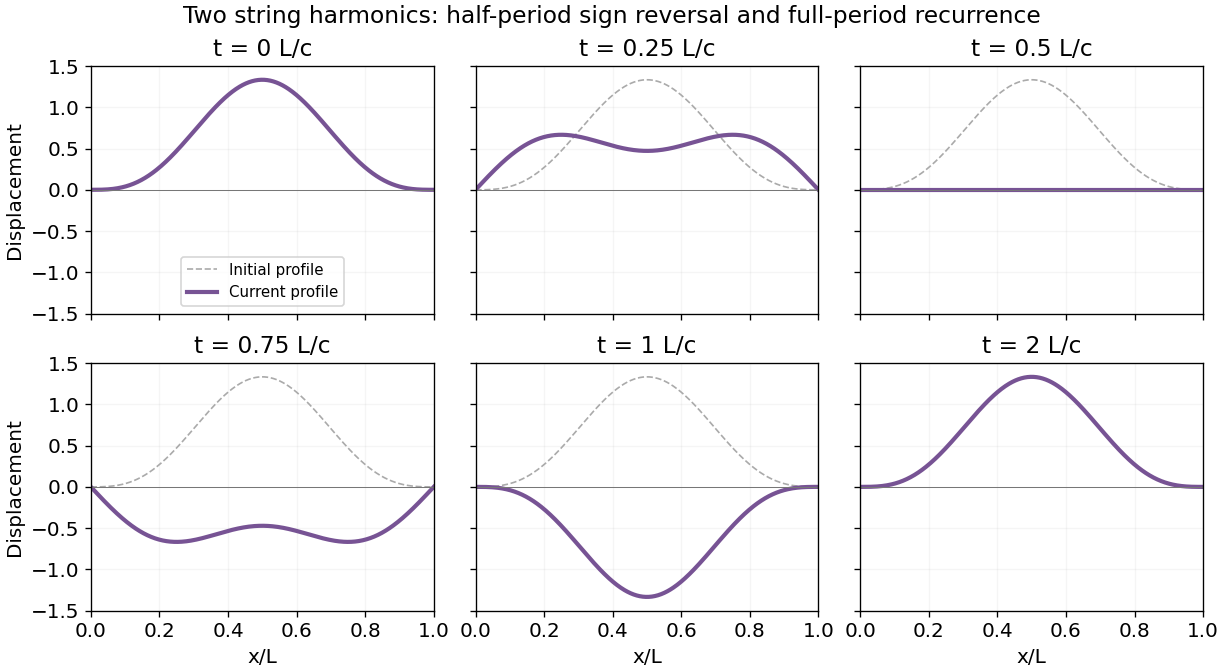


To recover the original signed displacement profile, orthogonality requires both cosine time factors to equal one. Since , the smallest positive time isAt both factors are , giving the negative of the initial profile, rather than the same profile. More generally, simultaneous recurrence requires commensurate excited-mode frequencies and undiminished amplitudes. The ideal nondispersive, fixed-end string has integer-multiple frequencies, whereas damping or a dispersive correction can destroy exact recurrence.
For a mode , integrate the kinetic-energy density:Here , and , soAll other modes have zero energy. The equal modal energies for inverse-harmonic string amplitudes give each excited mode total energy , even though their displacement amplitudes differ. The corresponding potential energy replaces sine squared by cosine squared, so their sum recovers the constant total energy from part (a).
Write . The cross product gives . Since the components of are constant, direct partial differentiation givesThusThe vorticity is twice the local angular velocity of this rigid-body rotation.
This is the velocity field of solid-body rotation about the axis parallel to through the origin. A fluid-following body's centre moves around that axis at angular speed , keeping its axial coordinate and perpendicular distance fixed. Its orientation rotates at the same angular velocity. The symmetric part of the velocity-gradient tensor is zero, so the prescribed flow produces no local strain or change of shape. Indeed, the separation between two fluid points obeys .
This is a kinematic prediction for an entrained body or material object. A finite inertial body initially at rest cannot instantaneously acquire the prescribed velocity and rotation without forces and torques; its transient after placement would also require density, drag and coupling data. Neglecting gravity alone does not specify that transient. On the rotation axis its centre can remain fixed while its orientation still rotates.
Take the curl component by component:The field is irrotational exactly when all three constant components vanish:
With those constants, integrate with respect to to obtain . Matching gives . Finally, matching gives . Thus a potential of a conservative vector field isThis explicit polynomial establishes a global potential on all of ; no topological obstruction is present. Its additive constant is arbitrary.
The only contributions to the Laplacian come from the pure quadratic terms. HenceThe scalar potential is therefore a harmonic function. Since ,Thus this field is both irrotational and divergence-free. By the divergence theorem, its net flux through every sufficiently regular closed surface is zero.
Articles by others on the same topic
There are currently no matching articles.