Embed the planar vector field as , independent of . Applying the Cartesian curl formula givesConsequently, for continuously differentiable components,This is the local closedness condition for the one-form . To infer global path independence from this condition alone, the domain also matters: it suffices that the planar domain is a simply connected space. The polynomial field in the next calculation is defined on the whole plane, so there is no missing-hole obstruction.
Set and . Their mixed derivatives agree: . Both components are smooth on all of , a simply connected space, so the line integral is path independent.
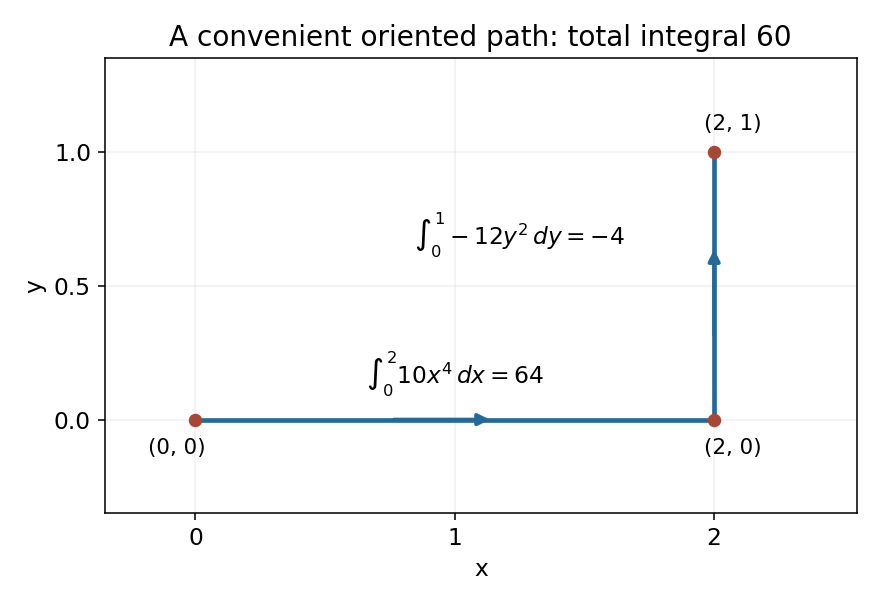
Choose a horizontal segment from to followed by a vertical segment to . On the first, and ; on the second, and . ThusThe selected path and its orientation are shown below. No contribution comes from a differential whose coordinate is held constant on a segment.

A one-form is an exact differential if a single-valued differentiable potential of a conservative vector field satisfies and on the domain. Then it equals , and its integral along a path is the endpoint difference of .
Integrate with respect to :Its derivative is . Matching the required second component forces , so the additive constant is arbitrary andThe fundamental theorem for line integrals now givesindependently of the convenient segmented path used before. Merely checking equality of mixed partial derivatives on an unspecified domain would not by itself construct this globally defined potential.
Take to be a simple closed, piecewise smooth curve oriented counterclockwise around its interior . Green's theorem applied to and givesThe orientation is essential: a clockwise unit circle gives , whereas twice its ordinary unsigned area is . For a nonsimple curve, the corresponding formula concerns signed area with winding multiplicity rather than one unsigned enclosed area.
Articles by others on the same topic
There are currently no matching articles.