For with continuous second partial derivatives near , its multivariable Taylor expansion iswhere all displayed derivatives are evaluated at . Continuity of the second derivatives justifies equality of the mixed partials and the stated remainder. A cubic-order remainder requires additional regularity.
The notation means the derivative with respect to while is held fixed:For a differentiable function, its first-order height change is . If both coefficients vanish, the tangent plane is horizontal and every directional derivative vanishes: the surface is flat to first order at that point. It need not be constant in a neighbourhood; at the origin is a counterexample. Existence of coordinate partials alone, without differentiability, would not justify this tangent-plane conclusion.
At a stationary point, the linear terms vanish, so , with , , . Let be the Hessian determinant. For , completing the square givesThe second-derivative test therefore yieldsWhen the quadratic form is indefinite, including the case , . When , the quadratic approximation is degenerate and the test is inconclusive: higher-order terms may produce a minimum, maximum or saddle. For nondegenerate cases the quadratic term dominates the Taylor remainder sufficiently close to the point.
The gradient components are and . Their real simultaneous zeros are and . The Hessian matrix is diagonal:At the origin it is positive definite; at each other critical point it is and indefinite. HenceThere are no local maxima. The contours are symmetric under either coordinate reflection. Small positive levels have a closed component surrounding the minimum; these meet the saddle-level separatrices at level . That critical contour has the useful exact form . Other components extend toward large , where the term makes the function unbounded below.
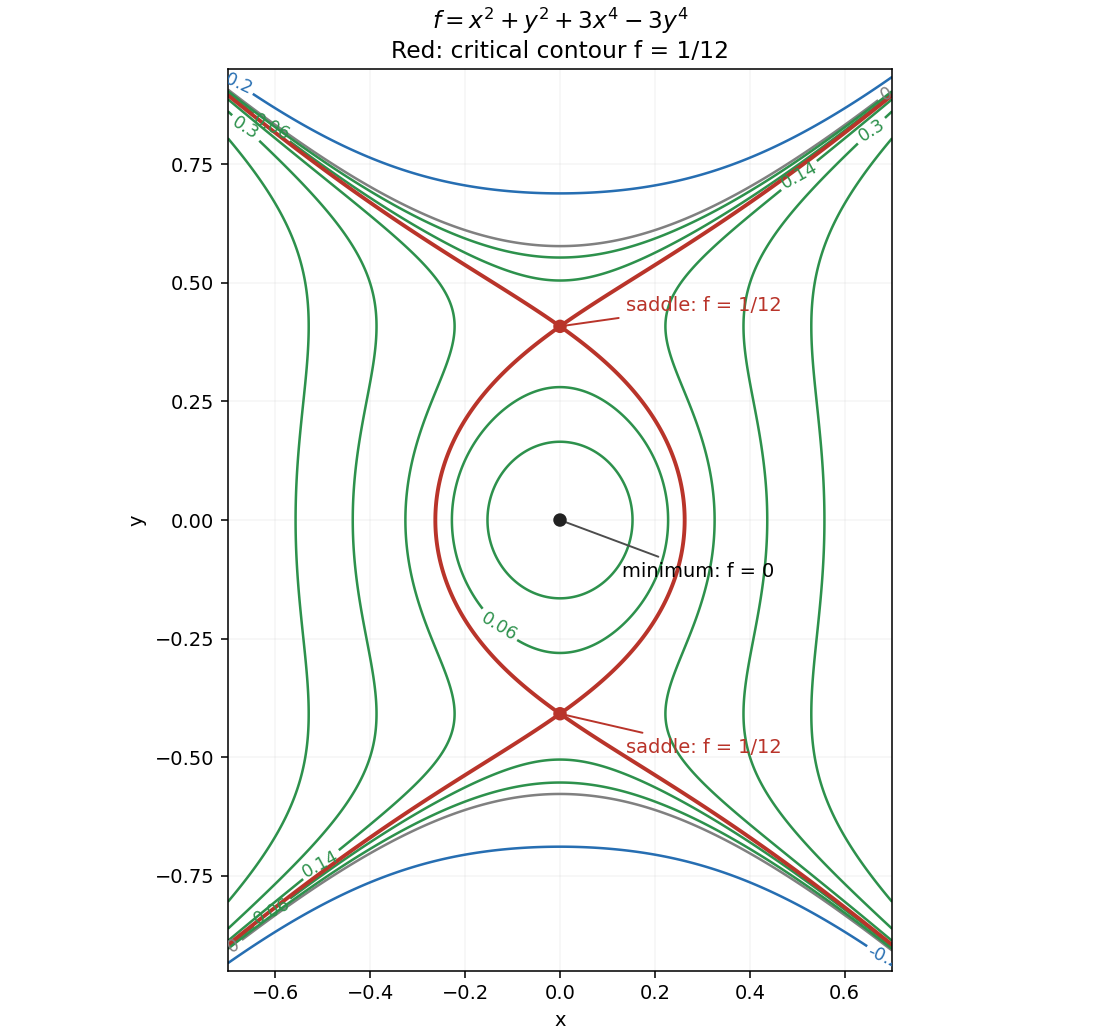
Contours near a minimum and two saddle points, including the critical level one twelfth
. Details. 
Articles by others on the same topic
There are currently no matching articles.