For small horizontal displacement , the gravitational restoring force is . A spring between adjacent bobs has extension equal to their displacement difference; Hooke's law pulls each bob towards its neighbour's displaced position. Thus comparison with the stated equations givesThe small-angle approximation makes the bob motion horizontal to first order; its vertical shift changes spring geometry only at higher order. Multiplying all force equations by minus one puts the positive restoring coefficients on the displayed right-hand side.
In one normal mode, all moving bobs share the same frequency and fixed amplitude ratios. A real mode vector allows their phases to be chosen equal or differing by , according to the signs of its components. A component equal to zero means that bob remains at rest in that mode and has no oscillation phase to assign.
The squared-frequency matrix isThe dimensionless spring matrix has an orthonormal eigenbasiswith eigenvalues . Adding the gravitational term therefore givesThe uniform mode leaves both springs unstretched. The other two modes deform the springs and so have higher frequencies.
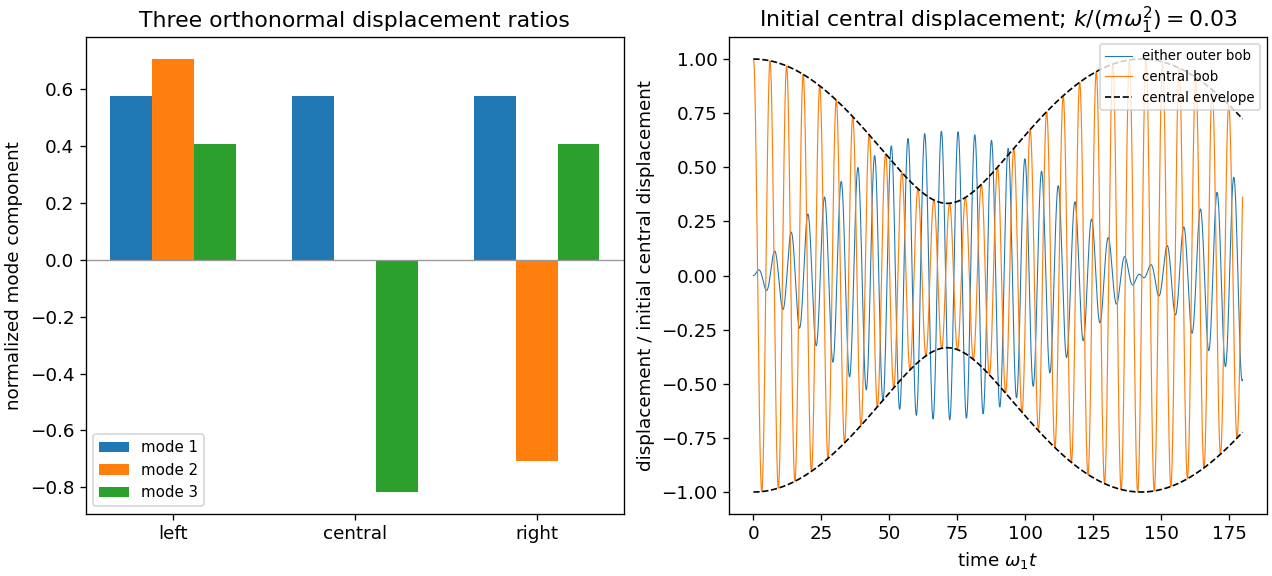
With zero initial velocities, choosing the initial displacement proportional to one eigenvector excites only its normal mode. Suitable ratios areThe overall scale must remain small compared with . Release each configuration from rest; its subsequent vector is its initial displacement multiplied by . The middle bob is stationary in the second mode, while it moves oppositely with twice either outer amplitude in the third.
For a central displacement in three freely ended coupled pendulums, the initial vector decomposes as . The antisymmetric second mode is absent. HenceLet and . The outer displacement is , explicitly exhibiting an amplitude modulation. The middle displacement is , whose modulation envelope isIt ranges from to , so it does not vanish completely. These are beats between the two excited frequencies. A slow envelope well separated from the carrier requires ; in that limit . The exact two-mode formulas remain valid without that additional weak-coupling assumption.

Articles by others on the same topic
There are currently no matching articles.