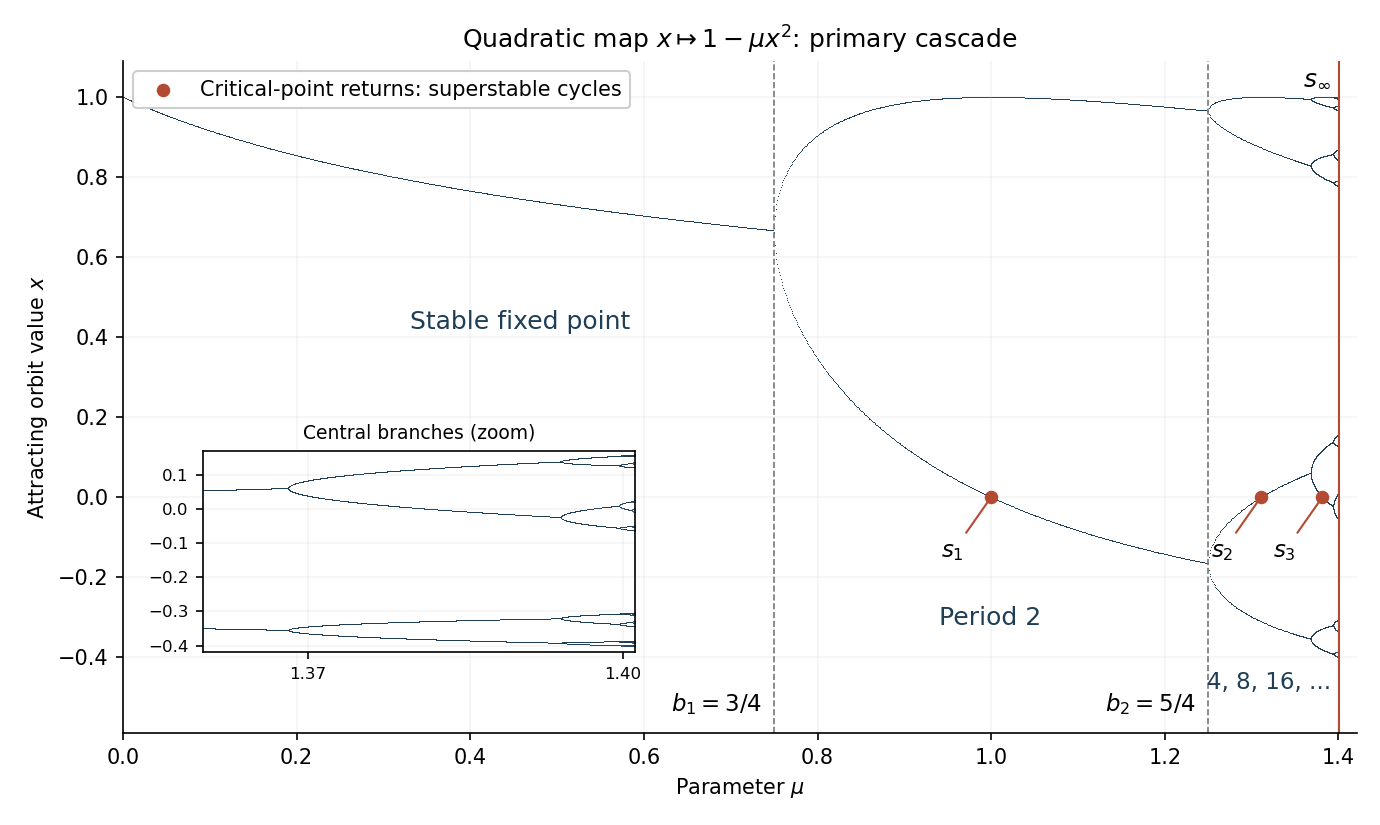
For the quadratic unimodal map, an attracting fixed point lies on the positive branchIts multiplier has modulus less than one for and reaches at the first period-doubling bifurcation . The resulting two-cycle has pointsIts periodic-orbit multiplier is , so it is attracting for and doubles at . Successive attracting periods are , with their parameter intervals shrinking toward .
A superstable periodic orbit contains the critical point zero, so its derivative product vanishes. Along the first period-doubling cascade, is the first-cascade parameter with a critical orbit of exact period , satisfying . For example, , , and . These are interior points of stability intervals, distinct from the bifurcation parameters .
The following bifurcation diagram shows attracting orbit values, including the first bifurcations and superstable points. At the accumulation parameter the limiting critical orbit is not a finite attracting cycle; its closure is the period-doubling limit set.

The Feigenbaum constants use the positive spatial-scaling convention. Their parameter definition isThe same limit is obtained from successive bifurcation parameters. To define spatial scaling without ambiguity about signs, letThis is the signed central return separation in the superstable orbit; its sign alternates between successive levels of the primary cascade. ThenEquivalently, the ratio of the corresponding unsigned separations tends to . Some conventions call the signed ratio itself ; here the spatial scale of the Feigenbaum renormalization fixed point is , matching the orientation reversal in the doubling operator.
The normalization fixes the critical point at zero and its image at one. It removes arbitrary height and spatial scales, so successive renormalized return maps can be compared in one function space rather than drifting through rescaled copies of the same dynamics. The second iterate near the critical point has a minimum; a negative rescaling reverses it back to a maximum.
Because , the period-doubling renormalization operator satisfiesPreservation of normalization therefore forcesThe scale is a functional of , not an independently adjustable constant. In the renormalizable regime it lies in . If , then on the central restrictive interval. Thus topological conjugacy relates one iteration of the renormalized map to two iterations of the original map, and the new critical value is again one. For , , so this regime starts beyond the superstable two-cycle at .
Normalization alone does not make every normalized unimodal map renormalizable: the central interval and its image must form the appropriate period-two restrictive pair, so that the rescaled second iterate is again an even unimodal map into . The operator is considered on the neighbourhood where these additional conditions hold.
Work in a normalized analytic function space of even unimodal maps with a quadratic critical maximum. The relevant fixed-point and spectral conjectures are that the period-doubling renormalization operator has a nontrivial universal Feigenbaum renormalization fixed point , and that its linearization at is hyperbolic with precisely one expanding eigenvalue . Its remaining spectral directions contract. The associated local stable manifold has finite codimension one; maps on it are indefinitely renormalizable and their normalized central return maps converge to . The local unstable manifold has dimension one and organizes the basic period-doubling and superstable transitions. These assertions concern the normalized quadratic universality class, rather than arbitrary functions or every parameter family.
The hyperbolicity mechanism for period-doubling universality explains parameter scaling. Let a typical one-parameter family cross the stable manifold transversely at . In local stable and unstable coordinates, write its unstable coordinate asRepeated renormalization multiplies this coordinate to leading order by while damping stable components. A superstable orbit of period becomes a superstable two-cycle after renormalizations. Hence its parameter is characterized by arrival at the same basic superstable surface, at a fixed nonzero unstable coordinate after the initial transient. This yieldsand thereforeThe family-dependent coefficient changes with parametrization, but the ratio does not. The same argument applies to the primary bifurcation surfaces and their successive preimages. Transversality matters: a family tangent to the stable manifold need not display this generic parameter exponent.
Spatial universality follows from the fixed point's scale . As renormalized maps approach , their successive central restrictive intervals shrink by factors approaching , with orientation alternating. Thus the signed central spacings have asymptotic ratio , andStable directions remove the original family's detailed shape; the limiting profile is , the parameter expansion rate is , and the spatial contraction rate is . Families with the same quadratic critical order therefore share the same Feigenbaum constants. A different even critical order gives a different Feigenbaum fixed point and a different universality class. This explanation is a consequence of the fixed-point, hyperbolicity and transverse-transition properties; it is not a proof that an arbitrary one-parameter family satisfies those properties.
Write the local Taylor series at the critical point aswhere is even, and put . The fixed-point equation first gives , consistently with normalization. Expanding the inner function at zero and the outer one at one,The quadratic remainder in the outer expansion is of order , at least because . Comparing the nonzero coefficients proves the exact identityTo obtain the requested first-order relation, use the leading polynomial approximation to a renormalization fixed point: retain only . Then , while , giving the truncated equationThe equality belongs to this truncation; higher analytic coefficients generally change and , so it is not an additional exact equation for the full fixed point.
For , solve . The root compatible with is ; the other root is inadmissible. ThusThis is a coarse leading approximation, not the more accurate universal value obtained after retaining higher coefficients.
Articles by others on the same topic
There are currently no matching articles.