Take the causally unwrapped universal cover of Anti-de Sitter spacetime, with curvature radius . In global coordinates,The ordinary radial Penrose diagram is a half-strip: the left edge is a regular center and the right edge is a timelike conformal boundary. For displaying signed spatial motion, the figure doubles the radial diameter to . Its two ends represent antipodal spatial directions of the higher-dimensional boundary; they are not a claim that the full AdS boundary has two disconnected components.
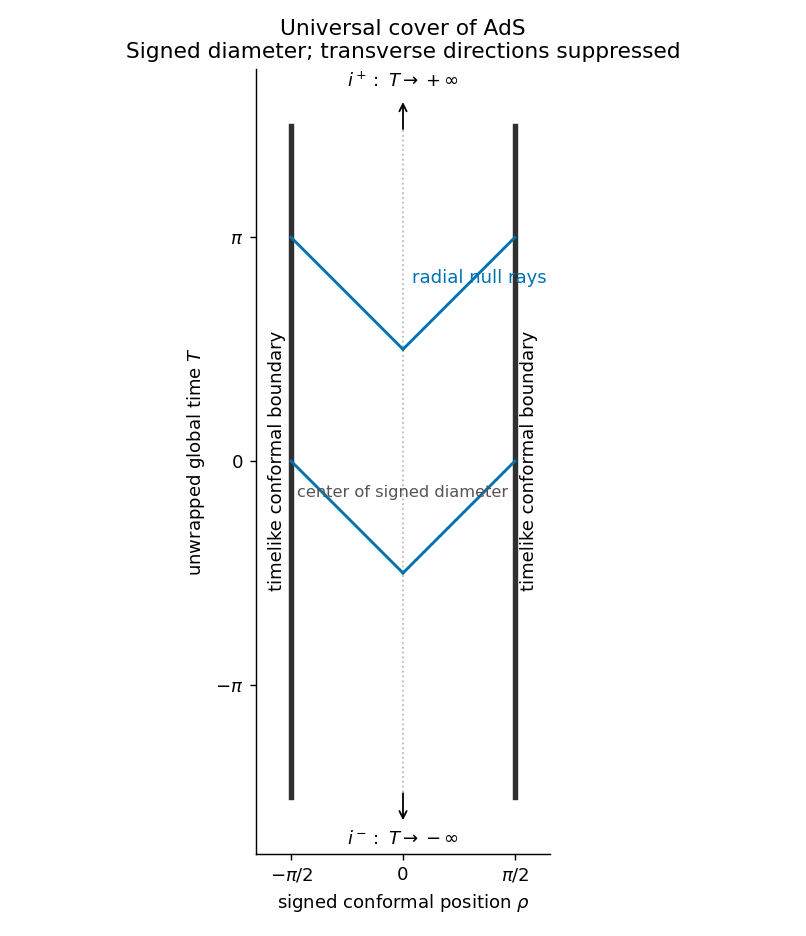
Conformal strip of the universal cover of anti-de Sitter spacetime, with timelike conformal boundaries and past/future timelike ends
. Details. 
The vertical edges are spatial infinity at every finite global time, forming the timelike boundary . The arrows mark the future and past timelike ends , conventionally and . There are no separate null-infinity edges like Minkowski : radial null rays satisfy and reach the timelike boundary in finite global time. Their physical affine parameter is nevertheless infinite there. The drawing is a finite excerpt of an infinitely tall strip, not an identification of its top and bottom. On the original hyperboloid global time is periodic and there are closed timelike curves; unwrapping it is essential to the usual physical maximally extended AdS spacetime.
A globally hyperbolic spacetime admits a Cauchy surface: every inextendible causal trajectory meets this spacelike initial-data surface exactly once. Physically, suitable field data on it determine evolution everywhere in its domain without additional data arriving from an unprescribed external boundary. This includes absence of causal loops and pathological almost-loops. An equivalent standard characterization is strong causality together with compact causal diamonds . The Cauchy condition concerns all causal curves, not merely the timelike geodesics that happen to remain in a bounded spatial region.
The universal cover of maximally extended AdS is not globally hyperbolic. Its timelike conformal boundary can send signals into the interior after any chosen initial slice, so bulk initial data alone do not determine evolution. In the conformal strip, a null ray can run from to the center in global time ; it need not meet a sufficiently earlier constant-time slice within the interior spacetime.
The compact-diamond test makes the obstruction explicit. Choose two central events with times and in units . Events at , lie between them causally, because their radial coordinate separation is less than2. They form a sequence in the causal diamond with no limit in the AdS interior. The diamond is therefore noncompact. Boundary conditions, such as reflecting conditions on the conformal boundary, can supply a well-posed initial-boundary-value problem; they do not turn the boundary-free interior into a globally hyperbolic spacetime in the usual definition. The periodic-time hyperboloid is also non-globally-hyperbolic, already because it has closed timelike curves.
In the ambient space of signature , AdS is . Let an arbitrary event have embedding vector , and let be any future unit timelike tangent, soThe complete family through that event isDirect substitution gives and . Its ambient acceleration is , normal to the hyperboloid, so its tangential covariant acceleration vanishes. This proves that is proper time and that each curve is a timelike geodesic, rather than just guessing sinusoidal tracks from the diagram.
An AdS isometry can place any chosen at . Rotate the spatial direction into the displayed signed diameter. Write the initial local velocity as , with . Then , and . Eliminating using the global coordinates givesVarying the speed gives the drawn family; suppressed spatial directions can be restored by varying the tangent direction. It represents all timelike initial directions after the isometry and spatial rotations.
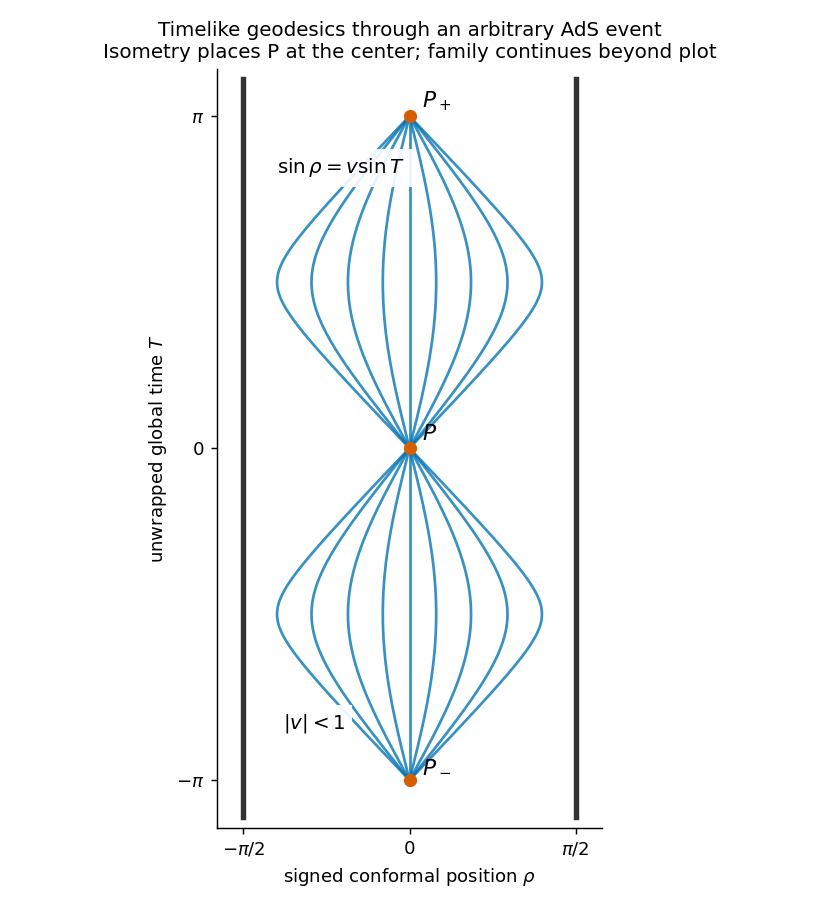
Timelike geodesics through an arbitrary AdS event, placed at the center by an isometry, refocusing at later antipodal events
. Details. 
Every finite-speed curve turns before the conformal boundary. At proper time , all reach ; at their ambient coordinates return to . This is Anti-de Sitter timelike geodesic refocusing. On the universal cover the global time has advanced by and , respectively, so these are later events. They are not closed timelike curves. The limits approach the null directions and are not timelike members of the family.
Set . The metric becomesso these are Poincare coordinates on anti-de Sitter spacetime with unit curvature radius. They cover one patch, not the whole global extension.
On the two-dimensional section with the three transverse suppressed, choose embedding coordinates , , . The Poincaré transformation isChoose the connected component containing . Its denominator is positive, givingIts two sloping edges are Poincaré horizons, null coordinate boundaries at . The right vertical edge is the timelike conformal boundary. Substituting the transformation into gives , verifying the chart and its null edges.
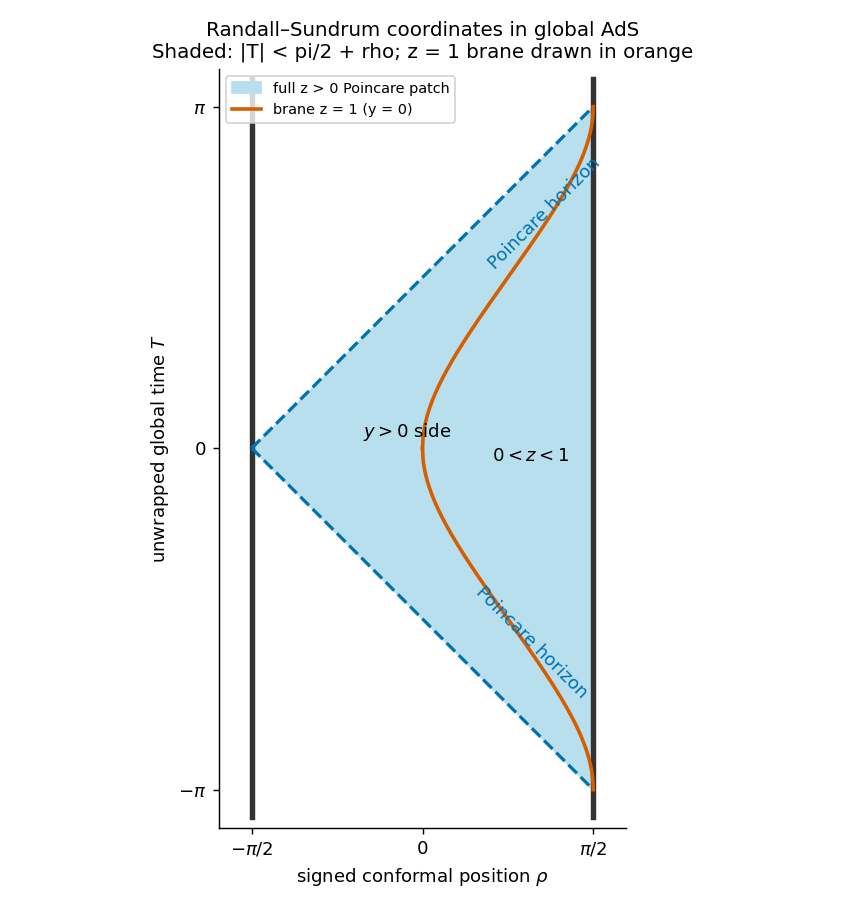
The Randall-Sundrum Poincaré patch inside global AdS, with null patch horizons and the reference brane z=1
. Details. 
The full coordinates in this part have , hence the whole shaded patch. If one additionally retains only the Randall–Sundrum bulk as in Question4, keep . The brane , or , has and is drawn in orange; the retained side contains , . A patch horizon is not a curvature singularity or the timelike conformal boundary. A geodesic can cross it in finite proper time while the patch coordinate diverges.
Use dots for derivatives with respect to proper time and the given unit curvature radius. Translation symmetry in the four brane coordinates gives constantsFor a future-directed timelike curve . The unit-tangent constraint isIt follows that and . Set . Thenwith solution on an interval where the cosine is positive. A phase shift includes either sign of the initial radial velocity. Integrating the four conserved-momentum equations gives the most general trajectory within this patch:The arbitrary constants encode the initial location and every unit timelike initial velocity. For the past-directed orientation reverse the tangent. The radial turning point is ; the two limits are patch horizons, not the endpoints of the complete globally extended geodesic. This is the timelike geodesics in a warped Poincaré patch solution. As a check, and , which are the explicit geodesic equations.
To measure the acceleration of the surface, take an observer at rest in its flat coordinates: there. The relevant Christoffel coefficient isThereforeIt points toward decreasing . More generally any observer moving inertially within the brane satisfies , and gives the same normal acceleration. The brane's extrinsic curvature for normal is , consistent with this result. Restoring curvature radius gives warped-brane proper acceleration . Intrinsically the induced brane metric is Minkowski and these observers have zero four-dimensional proper acceleration; the nonzero acceleration is relative to the bulk.
Articles by others on the same topic
There are currently no matching articles.