Efficient convection keeps the interior at nearly uniform specific entropy. For the fully ionized monatomic gas, the heat capacity ratio is , so the adiabatic process gives , with spatially constant. The ideal gas relation then impliesThe constant is spatial, not temporal: loss of specific entropy during contraction changes it. This is a stellar polytrope with polytropic index . We neglect radiation pressure and take the thin photosphere as an atmospheric matching layer rather than a significant fraction of the stellar mass.
For a fixed dimensionless profile of the Lane-Emden equation, the stellar homology relations have the formwhere are positive dimensionless structure constants. More explicitly, write and with and fixed dimensionless profiles. Mass conservation gives . Integrating the hydrostatic pressure support equation, with negligible surface pressure on the interior scale, gives . Both integrals are fixed positive numbers, proving the two central scalings. Substituting these relations into givesThus the same polytropic index fixes throughout this homologous sequence, while the dimensional stellar polytrope constant changes.
At the photosphere, whose optical depth is , identify the temperature with the effective temperature . The ideal gas relation and the interior adiabat give . With the prescribed opacity and stellar surface boundary condition,Eliminating therefore provesUsing the Stefan–Boltzmann law, with , gives the luminosity
The gravitational energy of a stellar polytrope is for . The stellar virial theorem for a monatomic gas gives , and hence the total energy is . With no appreciable stellar nuclear fusion or accretion, energy conservation givesCombining the two expressions for yieldsMultiplication by and integration proves the contraction law with density-linear fourth-power stellar opacity:When the accumulated contraction term dominates the initial-radius term, . Substitution into the central ideal gas relation giveswhich has the stated behavior when the time origin is negligible. This late-time approximation still requires the assumed fully convective star, fixed composition and opacity law to remain applicable.
For fully ionized hydrogen and helium with mass fractions and , the inverse mean molecular weight counts nuclei plus free electrons:Thus for , for , and . Keep the same and dimensionless structure constants when comparing these toy sequences. From part (a),Eliminating gives the composition shift of a convective pre-main-sequence track:Consequently the tracks in a Hertzsprung-Russell diagram are almost vertical, with . At equal luminosity, : the track lies to the hotter, left-hand side of the track. Since contraction decreases , both and decrease in this particular opacity model. Both arrows therefore point downward and slightly rightward on the conventional hot-left diagram.
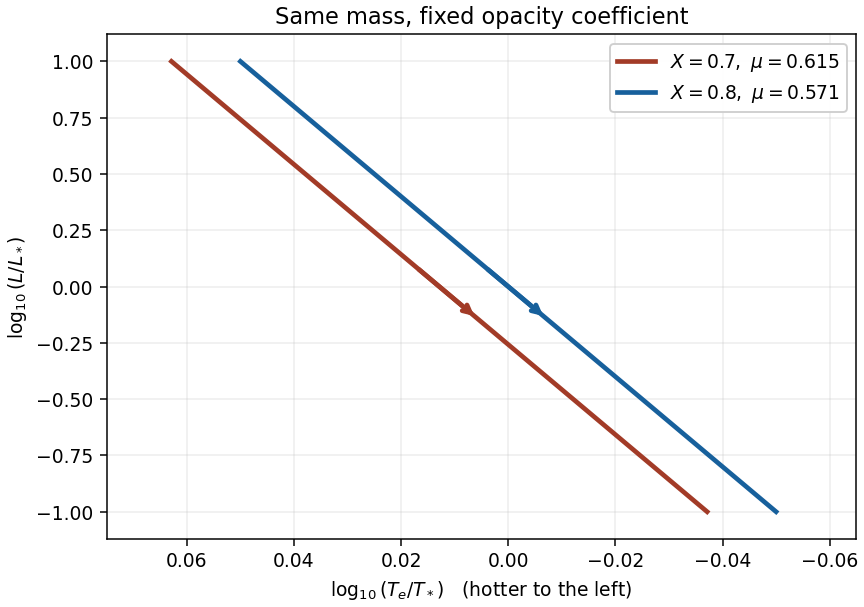

The plotted reference scales are arbitrary; the horizontal separation is the predicted . They are schematic Hayashi tracks under the specified atmospheric opacity law, rather than calibrated stellar models.
A protostar leaves this contraction sequence when its assumptions fail. Increasing central stellar temperature makes stellar nuclear fusion significant: burning of deuterium can temporarily slow contraction, and sustained hydrogen burning brings the star to the main sequence. In a sufficiently massive pre-main-sequence star, a radiative core develops, the interior ceases to share one adiabat, and evolution can proceed along a hotter Henyey track. Changing atmospheric opacity, partial ionization, or substantial continuing accretion also changes the predicted path. For sufficiently low mass, electron degeneracy pressure instead limits the increase of central temperature, as in part (c).
Retain fixed dimensionless structure constants and fixed . Write the assumed stellar homology relations as and . The equation of state giveswhere and . The first term is the temperature required for ordinary thermal pressure support; the second subtracts the support supplied by nonrelativistic electron degeneracy pressure.
As a function of , this is a concave quadratic polynomial. Differentiation givesand substitution provesThe scaling holds at fixed and homologous profile; changing the mean molecular weight per electron also changes . At the maximum the ion thermal pressure and electron degeneracy pressure contribute equally. Subsequent contraction lets electron degeneracy pressure carry more of the load without raising the temperature; eventually the assumed positive-temperature branch approaches a cold, degenerate configuration.
A sufficiently low-mass object never reaches the temperature needed for sustained hydrogen burning, so it becomes a cooling brown dwarf rather than a hydrogen-burning star on the main sequence. The scaling explains a hydrogen-burning minimum mass; its numerical value additionally requires the composition, detailed structure and nuclear ignition conditions, which are not specified here.
Articles by others on the same topic
There are currently no matching articles.