Efficient convection keeps the interior at nearly uniform specific entropy. For the fully ionized monatomic gas, the heat capacity ratio is , so the adiabatic process gives , with spatially constant. The ideal gas relation then impliesThe constant is spatial, not temporal: loss of specific entropy during contraction changes it. This is a stellar polytrope with polytropic index . We neglect radiation pressure and take the thin photosphere as an atmospheric matching layer rather than a significant fraction of the stellar mass.
For a fixed dimensionless profile of the Lane-Emden equation, the stellar homology relations have the formwhere are positive dimensionless structure constants. More explicitly, write and with and fixed dimensionless profiles. Mass conservation gives . Integrating the hydrostatic pressure support equation, with negligible surface pressure on the interior scale, gives . Both integrals are fixed positive numbers, proving the two central scalings. Substituting these relations into givesThus the same polytropic index fixes throughout this homologous sequence, while the dimensional stellar polytrope constant changes.
At the photosphere, whose optical depth is , identify the temperature with the effective temperature . The ideal gas relation and the interior adiabat give . With the prescribed opacity and stellar surface boundary condition,Eliminating therefore provesUsing the Stefan–Boltzmann law, with , gives the luminosity
The gravitational energy of a stellar polytrope is for . The stellar virial theorem for a monatomic gas gives , and hence the total energy is . With no appreciable stellar nuclear fusion or accretion, energy conservation givesCombining the two expressions for yieldsMultiplication by and integration proves the contraction law with density-linear fourth-power stellar opacity:When the accumulated contraction term dominates the initial-radius term, . Substitution into the central ideal gas relation giveswhich has the stated behavior when the time origin is negligible. This late-time approximation still requires the assumed fully convective star, fixed composition and opacity law to remain applicable.
For fully ionized hydrogen and helium with mass fractions and , the inverse mean molecular weight counts nuclei plus free electrons:Thus for , for , and . Keep the same and dimensionless structure constants when comparing these toy sequences. From part (a),Eliminating gives the composition shift of a convective pre-main-sequence track:Consequently the tracks in a Hertzsprung-Russell diagram are almost vertical, with . At equal luminosity, : the track lies to the hotter, left-hand side of the track. Since contraction decreases , both and decrease in this particular opacity model. Both arrows therefore point downward and slightly rightward on the conventional hot-left diagram.
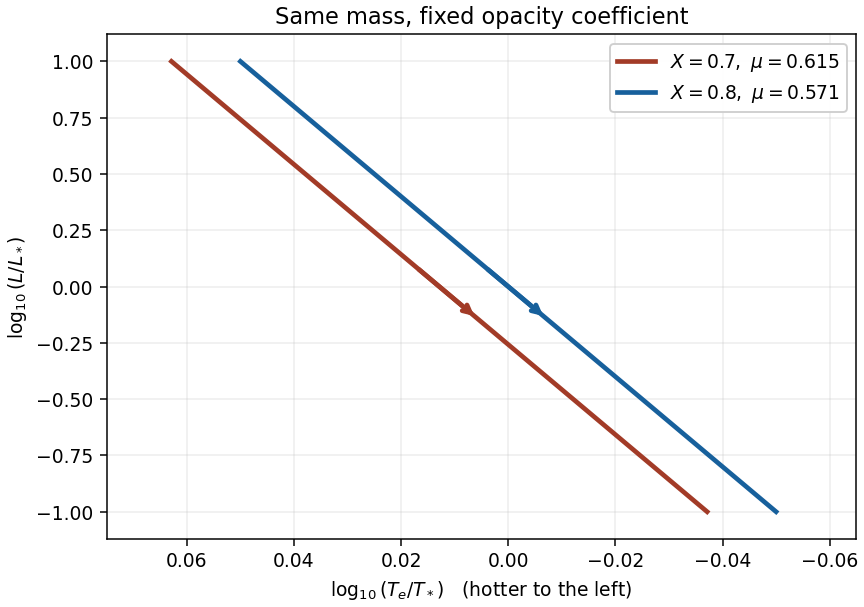
The plotted reference scales are arbitrary; the horizontal separation is the predicted . They are schematic Hayashi tracks under the specified atmospheric opacity law, rather than calibrated stellar models.
A protostar leaves this contraction sequence when its assumptions fail. Increasing central stellar temperature makes stellar nuclear fusion significant: burning of deuterium can temporarily slow contraction, and sustained hydrogen burning brings the star to the main sequence. In a sufficiently massive pre-main-sequence star, a radiative core develops, the interior ceases to share one adiabat, and evolution can proceed along a hotter Henyey track. Changing atmospheric opacity, partial ionization, or substantial continuing accretion also changes the predicted path. For sufficiently low mass, electron degeneracy pressure instead limits the increase of central temperature, as in part (c).
Retain fixed dimensionless structure constants and fixed . Write the assumed stellar homology relations as and . The equation of state giveswhere and . The first term is the temperature required for ordinary thermal pressure support; the second subtracts the support supplied by nonrelativistic electron degeneracy pressure.
As a function of , this is a concave quadratic polynomial. Differentiation givesand substitution provesThe scaling holds at fixed and homologous profile; changing the mean molecular weight per electron also changes . At the maximum the ion thermal pressure and electron degeneracy pressure contribute equally. Subsequent contraction lets electron degeneracy pressure carry more of the load without raising the temperature; eventually the assumed positive-temperature branch approaches a cold, degenerate configuration.
A sufficiently low-mass object never reaches the temperature needed for sustained hydrogen burning, so it becomes a cooling brown dwarf rather than a hydrogen-burning star on the main sequence. The scaling explains a hydrogen-burning minimum mass; its numerical value additionally requires the composition, detailed structure and nuclear ignition conditions, which are not specified here.
The event rate counts unordered pairs of reacting nuclei. For unlike species there are pairs per unit-volume normalization; for identical species there are approximately pairs, since counting ordered pairs counts each collision twice. The Kronecker delta therefore supplies exactly the required divisor . It is the event rate, not the destruction rate of identical nuclei: one identical-pair reaction destroys two nuclei.
The temperature dependence combines the high-energy tail of the Maxwell-Boltzmann distribution with quantum tunnelling through the Coulomb barrier. The principal exponential factor in the energy integral is . Its stationary point, the Gamow peak, has and exponent . Integrating around this peak gives a prefactor proportional to , or , when the nuclear factor varies slowly. Thus the supplied thermonuclear reaction rate is locally proportional to . The slow weak interaction in the proton-proton reaction also makes its overall coefficient very small; its local thermal slope follows the supplied formula.
At fixed number densities, define the local temperature exponent of a thermonuclear reaction by a logarithmic derivative. Since ,For proton-proton reactions, and . At , and . For two helium-3 nuclei, and , giving and . For helium-3 with helium-4, and the same charge product gives and . HenceThese are local powers near the specified temperature, not constant exponents over an arbitrarily large range. The greater reduced nuclear mass in the reaction increases its tunnelling exponent and its thermal sensitivity.
For the effective proton-proton reaction network, denote the event rates byThe short-lived beryllium intermediate can be eliminated, so production through feeds , representing predominantly lithium-7. This rapid conversion is electron capture. Count the nuclei consumed and produced in each reaction: consumes two protons and makes one deuterium; consumes a proton and a deuterium and makes one helium-3; consumes two helium-3 and makes one helium-4 and two protons; consumes one of each helium isotope; consumes a proton and lithium-7 and makes two helium-4. It follows thatFor closure, . These nuclear terms conserve , providing an independent stoichiometric check. They describe a fixed local volume; compression or mixing would add transport terms.
The roughly one-second destruction time of deuterium is negligible compared with the proton-burning and helium-3 evolution times. Its abundance rapidly adjusts to the slowly evolving production rate. Set , giving the deuterium quasi-equilibrium in proton-proton burningSubstitution, without setting , givesThe helium-3 relaxation time of about years is likewise short compared with the central proton-burning time and the age of the Sun. On this relaxation time the proton and helium-4 abundances, and the background temperature, can be treated as fixed. Put , , . Then , and its nonnegative equilibrium isThe other root is negative and unphysical. Write and subtract the equilibrium equation. Exactly, for a fixed background,Dropping the quadratic displacement givesThus small displacements decay exponentially. A slowly moving equilibrium introduces an additional term, negligible to leading order when is short compared with background evolution.
To estimate the temperature for helium-3 freeze-out, use the cooler pp-I-dominated region and neglect compared with . Then and . With the local powers just obtained and fixed proton number density, and . Adopting givesThis is an order-of-magnitude extrapolation of local exponents. Keeping the supplied exponential factors gives the helium-3 freeze-out estimate with Gamow factorswhich yields about with the same normalization and fixed-density approximation. Thus the robust estimate is several million kelvin. The supplied data do not fix the local density, composition or pp-II fraction away from the centre, so they cannot determine an exact transition temperature or radius. In particular, using alone would omit the temperature dependence of the equilibrium helium-3 abundance.
The solar hydrogen and helium-3 abundance profiles follow from burning, finite equilibration time and convection. Central hydrogen has been consumed, so is lowest in the centre and increases toward its much less processed outer value. In the hot centre, rapid destruction keeps helium-3 small. Moving outward initially raises its equilibrium abundance because rises strongly as temperature falls. Further out, equilibration is no longer reached within the solar age, and still farther out even production is slow. Hence has an off-centre maximum and then declines toward its small outer abundance. The outer convective envelope mixes each abundance toward a constant value.
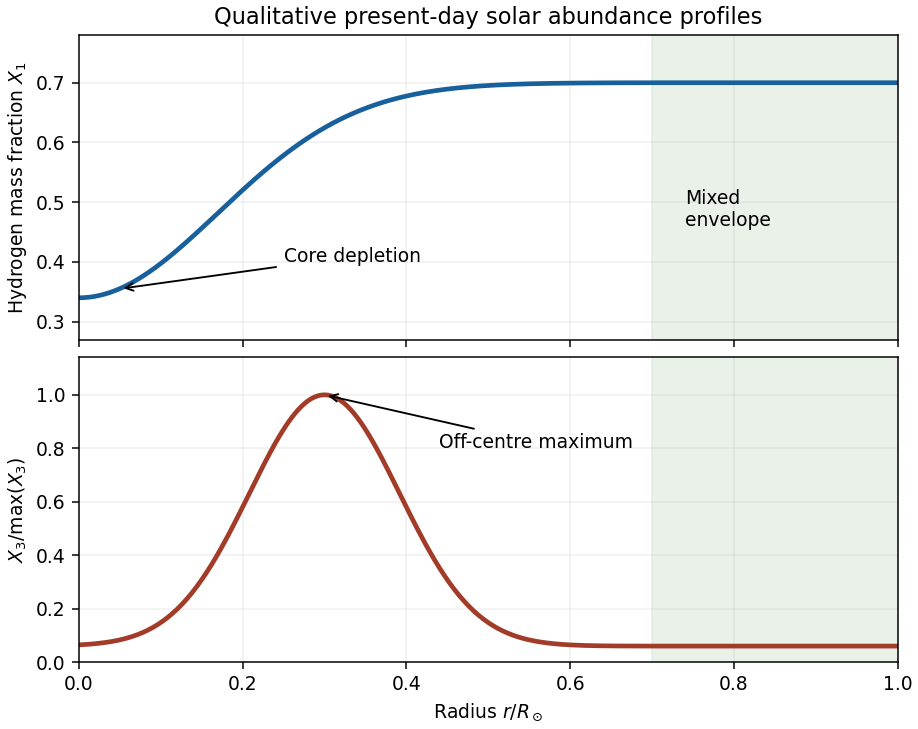


The sketch shows these qualitative shapes; the helium-3 ordinate is scaled to its own maximum. The illustrated amplitudes, peak radius and envelope boundary are schematic, not a numerical solar-model solution.
Use the secular, circular-orbit approximation: the wind escapes fast enough to avoid appreciable interaction with the companion, while the stellar masses change slowly enough that orbital elements describe the evolving binary star. Neglect spin angular momentum. Let be the orbital angular speed. The donor's distance from the centre of mass is , and the circular-binary orbital angular momentum isA spherically symmetric wind in the donor frame has zero mean additional angular momentum about the donor. Averaging its angular momentum about the binary centre of mass therefore gives the donor's orbital specific angular momentum, . Since denotes mass removed from the system, , andThis is donor-wind angular-momentum loss in the Jeans-mode mass loss approximation.
First allow only wind loss, so and . The logarithmic derivative of givesSolving yields . By Kepler's third law, , so . Integrating givesWind loss thus expands the separation and lengthens the orbital period. These are secular relations; an impulsive loss on an orbital time could instead generate eccentricity and would need a different analysis.
To test contact, put . The given short-time stellar radius response exponent gives . Differentiating the Roche lobe approximation givesFor wind alone this becomes . Hence, with the binary mass ratio ,Because is negative, increasing overfill, , occurs precisely whenThis is wind-driven Roche-lobe overflow. For the reverse strict inequality, and the donor star retreats inside its Roche lobe, producing a detached binary. At equality the wind is neutral to contact at this order.
Now permit an additional conservative binary mass transfer rate to the mass-gaining star. The total escaping wind remains , while . Transfer retains orbital angular momentum within the binary under the assumed neglect of spins, so the same wind-loss formula for applies. Logarithmic differentiation now givesSubstituting this and into the two radius derivatives givesSteady contact requires . If the wind is driving overflow and , the transfer contribution reduces overfill and a positive contact rate exists:The numerator and denominator are positive in this regime, making . This explicitly establishes both the contact transfer rate with Jeans-mode wind loss and its stabilizing sign.
If the wind drives overflow but , positive transfer instead increases : the mass loss required to relieve overfill makes the overfill worse. The formal contact formula would require , which is not donor-to-companion transfer. There is no stabilizing positive contact rate; overflow runs away. For a red giant this can lead to a common envelope, followed by envelope ejection into a tighter binary or a merger. The criterion concerns the supplied short-time radius response; the actual runaway timescale and outcome require the donor's dynamical and thermal response. At transfer is neutral to contact at this order, so it cannot balance a nonzero wind driver. If the wind already causes detachment, the transfer instability condition alone does not initiate overflow.
A stellar polytrope replaces a detailed equation of state and thermal structure by for , with spatially constant and polytropic index . Together with spherical hydrostatic equilibrium and mass conservation, it gives a tractable family of stellar density profiles. Introduce the Lane-Emden variables for a stellar polytropeCombining with eliminates to give . Substitution of the pressure law and the dimensionless variables gives the Lane-Emden equationA regular finite-radius model for ends at the first zero . Its radius and mass areThese formulas supply central-to-mean density ratios and stellar homology scalings without solving a full evolutionary model. Eliminating , for and , gives the polytropic mass-radius relation
An efficient-convection monatomic gas has . The same index describes a cold, nonrelativistic electron degeneracy pressure law; at fixed composition it gives for a white dwarf. Ultrarelativistic electron degeneracy pressure has , for which the mass is independent of and scales as . This is the origin of the Chandrasekhar limit. A radiation-dominated, approximately constant-entropy interior also approaches and . The polytrope of index zero is an incompressible comparison model, useful for illustrating the role of central concentration.
The gravitational energy of a stellar polytrope, , and the stellar virial theorem make polytropes useful for contraction-energy estimates. They also provide structural models for perturbation and stability calculations. A polytrope is a structural approximation, not a complete stellar evolution calculation. One must still specify stellar nuclear fusion, opacity, energy transport, composition and boundary conditions to determine the luminosity and history. Moreover, the structural exponent need not equal the adiabatic exponent relevant to a rapid perturbation. Real stars can have different effective indices in their cores and envelopes, as well as ionization zones or varying electron degeneracy pressure.
The first argument is the energy budget. The gravitational energy reservoir is of order , so the Kelvin-Helmholtz cooling time is . For the Sun, , and give years. This is much shorter than the approximately -year solar-system age. Chemical binding energies are only of order electronvolts per atom and provide an even smaller reservoir. Thus neither ordinary chemical energy nor continuing gravitational contraction can supply the long-term solar luminosity.
Stellar nuclear fusion provides an adequate reservoir. Conversion of four hydrogen atoms into one helium-4 atom releases about , corresponding to a mass defect of about of the initial mass; some energy leaves as neutrinos. If a fraction of stellar mass with hydrogen fraction is available for core burning, the energy scale is . Taking and supplies roughly , enough for several billion years at the solar luminosity, consistent with a stellar nuclear timescale of order years. The core temperature and density inferred from stellar structure permit the proton–proton chain; hotter stellar cores favor the CNO cycle.
The most direct evidence is the detection of solar neutrinos. They are created in the weak reactions of the proton–proton chain and can escape from the core, unlike the photons whose transport through the interior is slow. Measurements accounting for neutrino oscillation recover a total neutrino flux consistent with nuclear-powered solar models. Their spectra and reaction-dependent fluxes test the core reactions rather than merely the surface effective temperature.
There is also independent evidence from stellar evolution: the main sequence is a long-lived core-hydrogen-burning phase, more massive luminous stars consume fuel more quickly, and the main-sequence turnoff of a star cluster records its age. Subsequent evolution and the production of heavier elements fit further nuclear reactions. Agreement among these observations, nuclear energy release and stellar-model lifetimes is much stronger than the energy-budget argument alone. The combination of a sufficient nuclear reservoir, measured core neutrinos and the observed evolutionary sequence identifies nuclear reactions as the main long-term power source of ordinary stars.
A Type Ia supernova is a thermonuclear disruption associated with a carbon-oxygen white dwarf in a binary system. Electron degeneracy pressure supports the dense star, and initially depends much less on temperature than an ideal gas pressure does. Once carbon burning heats degenerate material, the immediate pressure response is insufficient to produce the usual expansion-and-cooling thermostat. The strongly temperature-sensitive nuclear reactions can therefore undergo a thermonuclear runaway.
One channel involves accretion toward the Chandrasekhar limit, about solar masses for a typical electron composition. Other proposed channels involve merging white dwarfs or an initial helium-layer detonation that triggers carbon burning below that mass. Thus the Chandrasekhar limit motivates an important model, but it is not an assumption that every Type Ia supernova has exactly the same progenitor mass or ignition history. Burning carbon and oxygen into more tightly bound nuclei releases enough nuclear binding energy to overcome the stellar gravitational binding energy. An ordinary successful event ejects the star rather than leaving the compact core characteristic of a core-collapse supernova.
The ejecta contain iron-group material, including radioactive nickel-56, and intermediate-mass elements from incomplete burning. The radioactively powered Type Ia supernova light curve is powered largely by the nickel-56 to cobalt-56 to iron-56 decay chain: its energetic products heat the ejecta, and radiative diffusion delays the emerging radiation. Near maximum light, ordinary Type Ia supernovae show prominent silicon absorption and lack the hydrogen lines defining Type II events. The spectral classification and the thermonuclear mechanism provide complementary descriptions.
The similar progenitors and radioactive power make Type Ia supernovae useful standard candles, but their peak luminosities are not identical. The relation between light curve width and peak brightness, together with color corrections, allows standardization for distance measurements. Extinction, composition and explosion diversity still introduce systematic uncertainties. A Type Ia event is a white-dwarf thermonuclear explosion with a radioactively powered light curve; its corrected luminosity makes it a valuable distance indicator.
An X-ray binary contains a compact accretor supplied by a donor star. Most bright systems contain a neutron star or black hole. Gas arrives by Roche-lobe overflow, a captured stellar wind, or donor outflows, commonly forming an accretion disk. The primary energy source is the release of gravitational binding energy during accretion, with a characteristic accretion luminosityFor a neutron star, can be near its material radius; for a black hole, radiation is produced by the flow outside the horizon. For and , , so accretion can release much more energy per unit mass than hydrogen burning. The hot inner flow, boundary layer or accretion column emits X-rays.
In a high-mass X-ray binary, a massive, relatively short-lived donor often supplies gas through a strong wind or an equatorial outflow; some systems instead undergo Roche-lobe overflow. These objects trace young stellar populations. In a low-mass X-ray binary, a lower-mass donor commonly fills its Roche lobe and feeds a disk. Such systems can persist in older populations. These mass labels refer to the donor, not the compact accretor.
A magnetized neutron star can channel accretion onto its poles, producing an accreting X-ray pulsar as the star rotates. Accretion transfers angular momentum, so changes in spin constrain the flow and magnetic coupling. A Type I X-ray burst has a different origin: accumulated hydrogen or helium undergoes unstable thermonuclear burning on a neutron star surface. It rises rapidly and then cools as the fuel is exhausted. A black hole has no material surface supporting the same surface-fuel mechanism.
Orbital motion and optical observations of the donor constrain masses, with inclination and donor-model uncertainties. A compact mass exceeding plausible stable neutron star masses supports a black hole interpretation. Rapid variability probes the small emitting region, while disk spectra and recurrent outbursts probe accretion and its instabilities. The Eddington luminosity,is obtained by balancing radiative acceleration against ; it is a useful luminosity scale under the assumed isotropic, opacity-controlled force law. Geometry and time dependence can complicate its application. X-ray binaries reveal compact stars through efficient gravitational accretion, with pulsations, bursts and orbital dynamics distinguishing their physical components.
Articles by others on the same topic
There are currently no matching articles.