Vertical turbulence carries particles upward as well as downward. Its mixing time should be short relative to the settling time ; hence is a useful well-mixed criterion, subject also to the eddy correlation time and particle response time. A more resolved description balances turbulent diffusion against downward settling velocity. A nearly uniform interior concentration does not eliminate the downward drift.
At an absorbing bed, particles crossing the boundary settle and do not return unless sediment resuspension is separately supplied. With well-mixed concentration , the particle volume deposition flux is per unit horizontal area. Thus stirring can preserve an almost uniform suspension while its total particle content decreases. The present model neglects sediment resuspension and any significant change of bulk fluid volume due to the dilute particles.
Put and , the reduced gravity. Use the Boussinesq approximation, hydrostatic pressure, uniform vertical velocity and concentration profiles, negligible fluid entrainment and drag, and a flat bed. Integrating volume conservation, momentum conservation and the particle budget over the layer givesThe hydrostatic pressure resultant is ; the last right-hand side is the deposition flux. With , these areThe quasilinear coefficient matrix in variables isIts eigenvalues are , where . Therefore the characteristic curves and their compatibility ordinary differential equations areFor the last equation the left eigenvectors are , and multiplying the quasilinear equations by them gives the displayed source terms. This is the sedimenting rectangular-channel characteristic compatibility relation; it supplies one differential relation on each wave family, rather than three independently closed scalar equations there. The contact eigenvector has and . For reference, an equivalent form isOnly for constant without settling do become genuine Riemann invariants. With settling, the spatial buoyancy gradient cannot be silently omitted.
Close the unresolved head of the gravity current byHere the speed is measured relative to the resting deep ambient, and are the depth and reduced gravity immediately behind the head. The Froude number expresses conversion of the head's hydrostatic pressure head into motion and depends on the ambient-depth ratio and head physics.
A front condition can be motivated by a steady control volume in the front frame: balance mass conservation, momentum conservation and the upstream/downstream Bernoulli equation, with a stagnation region and the appropriate ambient return flow. Assumptions include small density contrast, approximately hydrostatic far fields, negligible imposed ambient current, specified far-field depths, and a prescription for any mixing or energy loss. Viscous/turbulent head structure and finite-depth return flow change ; it is not fixed by the outer one-layer equations alone. A deep-ambient ideal head often motivates a constant order-one value, but no numerical choice is needed here.
The shallow-water approximation fails locally in the head because its vertical and horizontal dimensions are comparable and vertical accelerations are appreciable. The Froude number closure is a boundary condition for the outer shallow water equations, not a claim that they resolve the front itself.
Without settling, and . The left-running rarefaction wave has the unchanged Riemann invariant and similarity coordinate . HenceMatching to the Froude number condition givesThe full outer profiles are for ; the displayed fan for ; and for , whereAhead of there is only ambient fluid, so the particle-laden layer has zero depth. The shelf width is for every finite positive . It disappears only in the formal dry-front limit, where . For , the fan/shelf junction lies to the left of the initial barrier; the profiles remain consistent. This is the finite-Froude lock-release rarefaction, valid while the reservoir can be treated as semi-infinite.
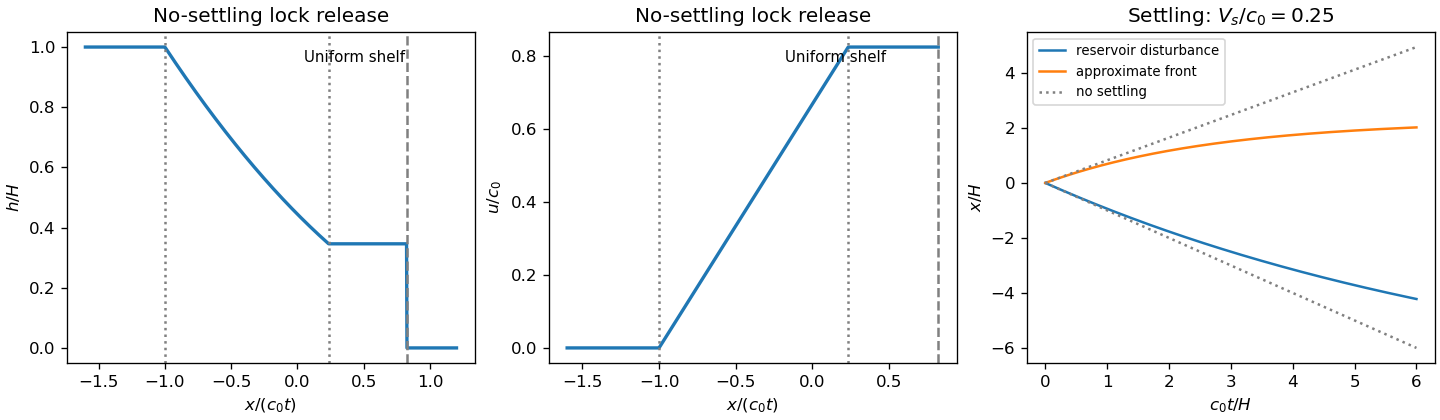
Lock-release depth and velocity profiles, with settling attenuation of the reservoir disturbance and approximate front
. Details. 
The undisturbed reservoir remains at , , while the particle budget gives . The edge of the rarefaction wave advancing into that reservoir travels with the local left-running characteristic speed, . ThusThis is the disturbance head into the initially resting reservoir, also called the leading edge of the rarefaction wave; it reduces to as . The rightmost fan/shelf junction is the rarefaction tail, not this reservoir edge. Its trajectory in the full sedimenting system cannot be obtained by retaining the constant-buoyancy Riemann invariants.
For the requested near-front approximation, hold fixed and take the shelf's concentration initially to be . The locally uniform shelf approximation gives , soThis tends to at small settling and predicts a finite limiting front location within the fixed-depth closure. It is not an exact solution of the spatially varying variable-buoyancy shallow water equations: different material histories and resulting buoyancy gradients eventually invalidate a perfectly uniform shelf. No exact finite-time stoppage is claimed.
Articles by others on the same topic
There are currently no matching articles.