Use incompressibility, negligible viscosity and surface tension, and an initially irrotational flow. Take the undisturbed free surface at and bed at . The velocity potential satisfies Laplace equation and . For a Fourier mode, writeThe linear kinematic boundary condition and linear Bernoulli equation at the free surface are and . Eliminating gives the surface gravity wave dispersion relationThe rightward phase velocity and group velocity areThe phase velocity transports a crest; the group velocity transports a narrow-band envelope and its leading-order energy. For , and : deep-water surface gravity waves are dispersive. For , and , the nondispersive shallow-water dispersion relation. The boundary velocity controls the excited amplitude; it does not change the linear dispersion relation.
Before surface-wave breaking or reflected waves return, the shallow water equations are and . Set and . Their Riemann invariants are along . An outgoing simple wave entering resting water has , so the imposed boundary velocity givesThis formula requires and an appropriate inflow/outflow characteristic curve count. In particular ensures that only the outgoing family enters the domain throughout the cycle; stronger forcing can change the boundary problem.
A characteristic curve emitted at time carries constant and and followsIncreasing boundary velocity produces faster following characteristic curves, steepening the advancing side of a crest; decreasing boundary velocity spreads the curves and produces a rarefaction wave. A trough has reduced depth and smaller propagation speed. Once the compressive curves intersect, the single-valued simple wave must be replaced by an admissible hydraulic bore, with mass conservation and momentum conservation across it and loss of mechanical energy. In a very weak or dispersive wavetrain an undular bore can replace the ideal discontinuity.
For a bore of speed entering undisturbed depth , the Rankine-Hugoniot condition gives and . If is its depth just behind, elimination of the behind-bore velocity yields and . Thus the newly formed front travels faster than , carries a depth jump, and dissipates energy; the behind-bore state must satisfy these balances rather than continuing intersecting smooth curves. The final sketch is schematic and does not claim a solved post-breaking boundary-value problem.
There is a numerical defect in the printed leading-edge claim. The first leading edge is the curve . The envelope condition givesAt the leading edge,This follows directly from the specified boundary acceleration and the exact Riemann invariant. The printed coefficient is incompatible with these data: at that distance the leading-edge characteristic curves have not yet intersected. For the first compression interval, , one has . Consequently , so the first envelope occurs at . This boundary-driven shallow-water wave steepening calculation also establishes that no later characteristic in the initial compression forms a bore earlier.
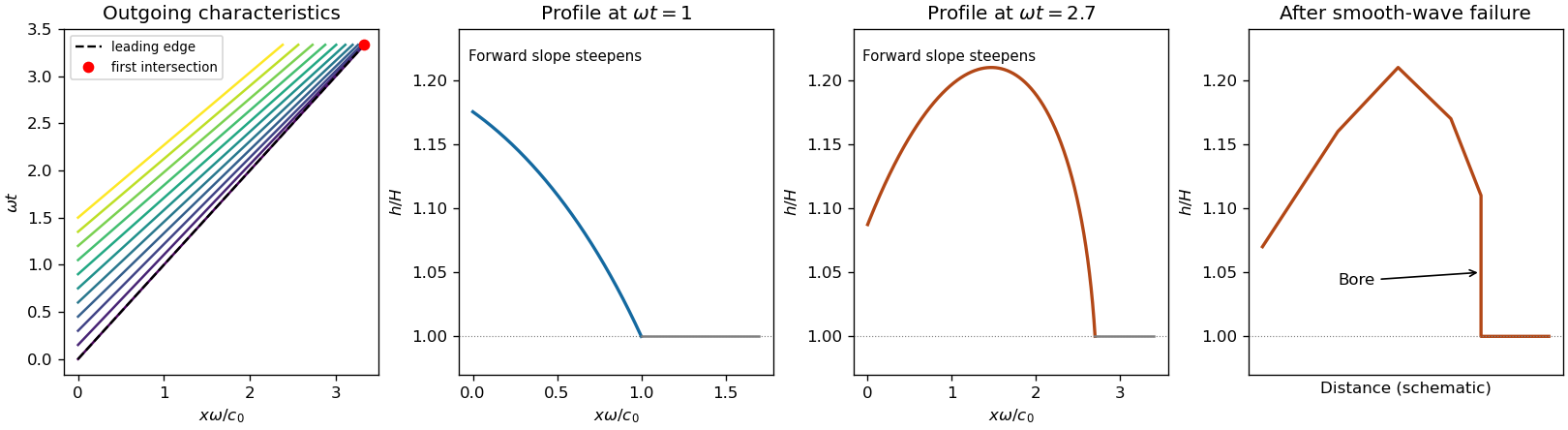
Outgoing shallow-water characteristics and profiles before the leading-edge bore
. Details. 
Write for the thermal expansion coefficient, for kinematic viscosity, for thermal diffusivity, and for thermal conductivity. For a temperature difference across depth ,The four-thirds convective heat-transfer law posits at high Rayleigh number, and thereforeThe layer depth cancels. A useful physical justification is a mixed interior with thin conductive boundary layers of thickness , each maintained near a fixed critical local Rayleigh number: and . Eliminating gives the exponent . Whether denotes the whole-layer contrast or the drop across one boundary layer changes the coefficient, not the exponent.
Assume Boussinesq approximation, constant material properties, a laterally extensive statistically turbulent Rayleigh-Bénard convection layer, negligible side-wall heat transfer, no rotation or imposed shear, approximately uniform bulk temperature, and the same specified Prandtl number regime when choosing . The closure is empirical and regime dependent; high Rayleigh number alone does not make it exact or extend it to the impulsive conductive initial transient.
Let , with . Apply the same one-boundary four-thirds convective heat-transfer law coefficient to both boundary layers. The lower inward heat flux is and the upper outward heat flux is . The layer's conservation of energy per unit area givesHere is the volumetric heat capacity. This uses a uniform bulk temperature, negligible boundary layer heat storage, constant depth and material properties, prescribed boundary temperatures, no lateral losses or internal heat generation, and identical upper and lower closure coefficients. It deliberately extrapolates the turbulent closure to , as the model requires; an actual impulsive start first has a conductive transient. This is the requested evolution equation, without solving it.
A linear, or “three-thirds”, boundary heat transfer closure needs its own dimensional conductance , so . One cannot simply keep the dimensions of the previous nonlinear coefficient . With equal conductances at both boundaries, the mean-temperature equation becomesIntegrating this linear ordinary differential equation givesThe relaxation time is . If the conductances differed, conservation of energy would instead select their weighted boundary temperature; the arithmetic mean follows from the assumed upper/lower symmetry.
Vertical turbulence carries particles upward as well as downward. Its mixing time should be short relative to the settling time ; hence is a useful well-mixed criterion, subject also to the eddy correlation time and particle response time. A more resolved description balances turbulent diffusion against downward settling velocity. A nearly uniform interior concentration does not eliminate the downward drift.
At an absorbing bed, particles crossing the boundary settle and do not return unless sediment resuspension is separately supplied. With well-mixed concentration , the particle volume deposition flux is per unit horizontal area. Thus stirring can preserve an almost uniform suspension while its total particle content decreases. The present model neglects sediment resuspension and any significant change of bulk fluid volume due to the dilute particles.
Put and , the reduced gravity. Use the Boussinesq approximation, hydrostatic pressure, uniform vertical velocity and concentration profiles, negligible fluid entrainment and drag, and a flat bed. Integrating volume conservation, momentum conservation and the particle budget over the layer givesThe hydrostatic pressure resultant is ; the last right-hand side is the deposition flux. With , these areThe quasilinear coefficient matrix in variables isIts eigenvalues are , where . Therefore the characteristic curves and their compatibility ordinary differential equations areFor the last equation the left eigenvectors are , and multiplying the quasilinear equations by them gives the displayed source terms. This is the sedimenting rectangular-channel characteristic compatibility relation; it supplies one differential relation on each wave family, rather than three independently closed scalar equations there. The contact eigenvector has and . For reference, an equivalent form isOnly for constant without settling do become genuine Riemann invariants. With settling, the spatial buoyancy gradient cannot be silently omitted.
Close the unresolved head of the gravity current byHere the speed is measured relative to the resting deep ambient, and are the depth and reduced gravity immediately behind the head. The Froude number expresses conversion of the head's hydrostatic pressure head into motion and depends on the ambient-depth ratio and head physics.
A front condition can be motivated by a steady control volume in the front frame: balance mass conservation, momentum conservation and the upstream/downstream Bernoulli equation, with a stagnation region and the appropriate ambient return flow. Assumptions include small density contrast, approximately hydrostatic far fields, negligible imposed ambient current, specified far-field depths, and a prescription for any mixing or energy loss. Viscous/turbulent head structure and finite-depth return flow change ; it is not fixed by the outer one-layer equations alone. A deep-ambient ideal head often motivates a constant order-one value, but no numerical choice is needed here.
The shallow-water approximation fails locally in the head because its vertical and horizontal dimensions are comparable and vertical accelerations are appreciable. The Froude number closure is a boundary condition for the outer shallow water equations, not a claim that they resolve the front itself.
Without settling, and . The left-running rarefaction wave has the unchanged Riemann invariant and similarity coordinate . HenceMatching to the Froude number condition givesThe full outer profiles are for ; the displayed fan for ; and for , whereAhead of there is only ambient fluid, so the particle-laden layer has zero depth. The shelf width is for every finite positive . It disappears only in the formal dry-front limit, where . For , the fan/shelf junction lies to the left of the initial barrier; the profiles remain consistent. This is the finite-Froude lock-release rarefaction, valid while the reservoir can be treated as semi-infinite.
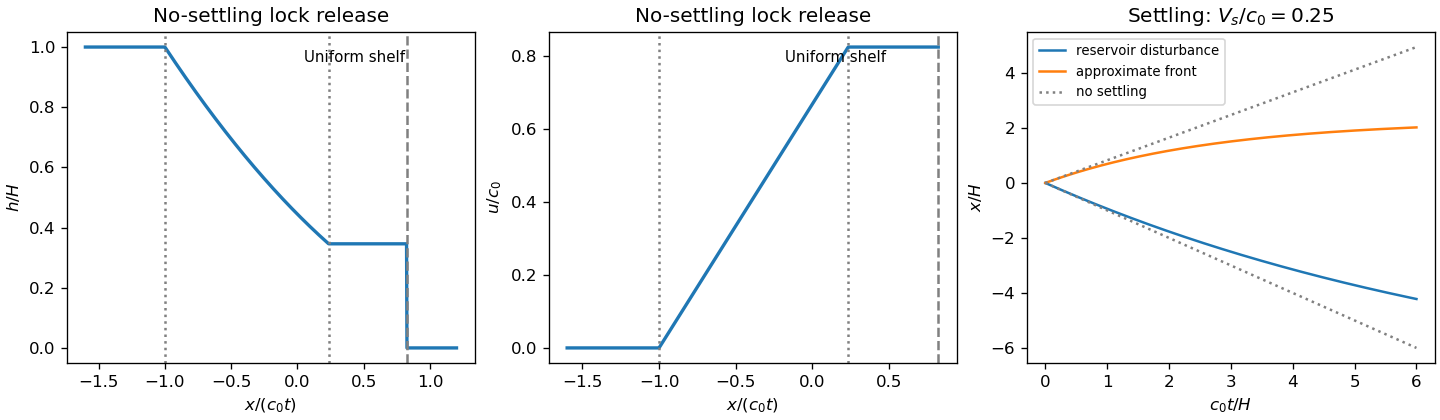
Lock-release depth and velocity profiles, with settling attenuation of the reservoir disturbance and approximate front
. Details. 
The undisturbed reservoir remains at , , while the particle budget gives . The edge of the rarefaction wave advancing into that reservoir travels with the local left-running characteristic speed, . ThusThis is the disturbance head into the initially resting reservoir, also called the leading edge of the rarefaction wave; it reduces to as . The rightmost fan/shelf junction is the rarefaction tail, not this reservoir edge. Its trajectory in the full sedimenting system cannot be obtained by retaining the constant-buoyancy Riemann invariants.
For the requested near-front approximation, hold fixed and take the shelf's concentration initially to be . The locally uniform shelf approximation gives , soThis tends to at small settling and predicts a finite limiting front location within the fixed-depth closure. It is not an exact solution of the spatially varying variable-buoyancy shallow water equations: different material histories and resulting buoyancy gradients eventually invalidate a perfectly uniform shelf. No exact finite-time stoppage is claimed.
Let and . The four balances describe, respectively, fluid entrainment through the spherical surface at normal speed , the increase of vertical momentum due to buoyancy, conservation of total buoyancy in a uniform ambient, and motion of the thermal centre. Entrained ambient fluid initially has no vertical momentum, so the momentum equation includes the inertia needed to accelerate it. This model neglects added mass and drag; these effects would alter the numerical similarity coefficients.
With , the Boussinesq approximation replaces inertial density by while retaining the density difference in buoyancy. Take to this accuracy. ThenFor a point source, and the initial integrated impulse is zero. Therefore and . Integrating yieldsThe mass density follows from conserved buoyancy:Thus the radius and rise height grow as , the rise speed decays as , and the density deficit decays as . In height coordinates, put and ; then and .
If a reference density different from the inertial ambient density is retained, : replace in the kinematic formulas by , while retaining the original in the density-deficit formula. This keeps reference-density normalization separate from the physical acceleration.
The point-source spherical thermal similarity is singular at and cannot satisfy the small-density-difference condition arbitrarily close to its formal origin. A finite-radius, zero-impulse regularization has and , with . This displays the required initial data rather than attributing the singularity to a physical infinite initial speed.
In stable density stratification, ambient density decreases with height. A rising buoyant thermal encounters progressively lighter surroundings and entrains denser fluid from below, so its net buoyancy decreases. It reaches neutral buoyancy, overshoots through its remaining momentum, and eventually stops rising, spreads as a buoyant intrusion or excites internal gravity waves. The finite rise is a consequence of this restoring effect, not just drag.
Total buoyancy has dimensions and buoyancy frequency has . For an ideal point release with no other dimensional source length or time, dimensional analysis therefore givesThe dimensionless coefficient depends on entrainment coefficient, shape and the momentum model. A finite source radius or impulse supplies additional dimensionless parameters; dimensional analysis cannot determine the coefficient by itself.
Within precisely the spherical model, and the evolving thermal buoyancy satisfies , so . Neutrality occurs at . For , the momentum equation and giveThe first nonzero-height stopping point is , so . This illustrates both the dimensional scale and the distinction between neutral height and maximum rise; the precise coefficients rely on the specified ideal fluid entrainment and impulse model.
Let and , and write for the mixed lower-layer density. PutUse the common Boussinesq reference/inertial density normalization from part (a). Here is the integrated negative buoyancy of the lower layer relative to the upper one. Assume negligible source volume, fixed enclosure volume, small density contrasts, identical thermals with total buoyancy , slow evolution during one rise, and deposition of their positive buoyancy in the lower layer until penetration begins. Entrainment of upper fluid carries zero density anomaly relative to , while thermal injection reduces the negative anomaly. The lower-layer conservation of mass or equivalent buoyancy budget is thereforeIt would be inconsistent to conserve while also depositing the nonzero source buoyancy .
Quasi-steady point-source spherical thermal similarity at the interface gives and . The Richardson number compares the potential-energy barrier associated with the density jump to the thermal's available kinetic energy:An entrainment coefficient must be positive for upward deepening. A positive exponent makes stronger stratification inhibit entrainment; removes this dependence and would perversely strengthen entrainment as the stabilizing barrier increases. The power law is intended for a suitable finite- regime: as , its divergence must be limited by available turbulent motion. Its constants and validity are closure information, not consequences of dimensions alone. An additional kinetic-energy constraint is useful: the interfacial lifting cost scales as , while the impinging turbulent power scales as . Hence must remain of order one or smaller. A law intended to hold at arbitrarily large with no extra power source therefore requires ; for , measures a bounded conversion efficiency up to geometric factors. The requested represents an ideal order-one efficiency in this normalization.
For , use the printed closure as a cycle-averaged interface law. ThenIntegrating from gives the thermal erosion of a two-layer interface resultThe thermal's density deficit relative to the lower layer at height is . Under the question's buoyancy-controlled penetration criterion, the threshold thermal is neutral relative to the upper layer. HenceThe time and height are determined implicitly by this threshold and the explicit law. Equivalently,Use its first admissible root, provided it occurs before the upper layer is exhausted. Impingement initially requires ; otherwise penetration is immediate in this criterion. Depending on parameters, can initially increase as entrainment deepens the layer, but it ultimately decreases to zero, so the first downward threshold crossing selects .
The printed must be an already averaged law to use it for separated thermal arrivals; if describes only an isolated impingement, an encounter duration/area averaging factor is missing and the same numerical formula cannot be asserted. The present answer uses the supplied averaged closure. It also uses the natural inherited per thermal; neglecting deposition of source buoyancy would instead give the different no-source-budget approximation . The two budgets are explicitly distinguished. Real inertial penetration can precede neutral buoyancy, but that requires an additional head/penetration model absent here.
For a nonrotating inviscid Boussinesq fluid, start from , andThe resting background has and . Write , and . Keeping first-order terms givesThe PDF has a genuine sign error: its momentum equation uses a minus sign before despite defining . A lighter parcel has and accelerates upward, so the plus sign is necessary. Retaining both printed signs would yield negative squared wave frequency and exponential growth in a supposedly stable fluid; no oscillatory stable-wave dispersion relation follows from that inconsistent system. Alternatively one can define a downward density variable , but then its density equation must have .
For the consistent system, take a plane internal gravity wave proportional to , with . Incompressibility gives . Project the momentum equation perpendicular to the wavevector, eliminating pressure: . Combining with givesOn a smooth signed-frequency branch, the phase velocity and group velocity areTheir scalar product is zero. Equivalently, the dispersion relation is homogeneous of degree zero in , so Euler homogeneous function theorem gives . The phase velocity moves crests normal to their phase lines; the group velocity moves wave packets and energy along those lines. Their perpendicularity explains why following individual crests does not reveal the direction of energy propagation.
Assume , , constant , negligible rotation, dissipation and reflection from infinity, small and , and no wave overturning. The terrain is stationary, so laboratory frequency is zero and intrinsic frequency is . Propagation requires . PutThe kinematic boundary condition at the linearized bed is . The upward radiation condition selects the positive branch because . ThusThe internal-wave polarization and every other perturbation follow from this vertical velocity and the linear equations.
In the frame moving with the fluid, , the phase is , andThe intrinsic energy ray slopes upward and upstream, , along a constant-phase line of an internal gravity wave. At fixed intrinsic frequency the spatial wave equation is hyperbolic, with the two characteristic curve line slopes ; the radiation condition selects the upward ray of the appropriate horizontal propagation branch.
In the terrain frame, phase lines remain fixed and the pattern phase velocity is zero. A transported packet hasIts energy path slopes upward and downstream, , and need not coincide with a stationary phase line. One should not add to the chosen normal intrinsic phase velocity and call that the normal ground-frame phase velocity: tangential motion along a phase line is arbitrary; zero laboratory frequency makes the entire crest pattern stationary. The sketch distinguishes stationary crests, intrinsic characteristics and transported energy.
If , is imaginary and the bounded field is an evanescent wave; at the vertical group velocity vanishes and an ordinary upward radiation interpretation degenerates.
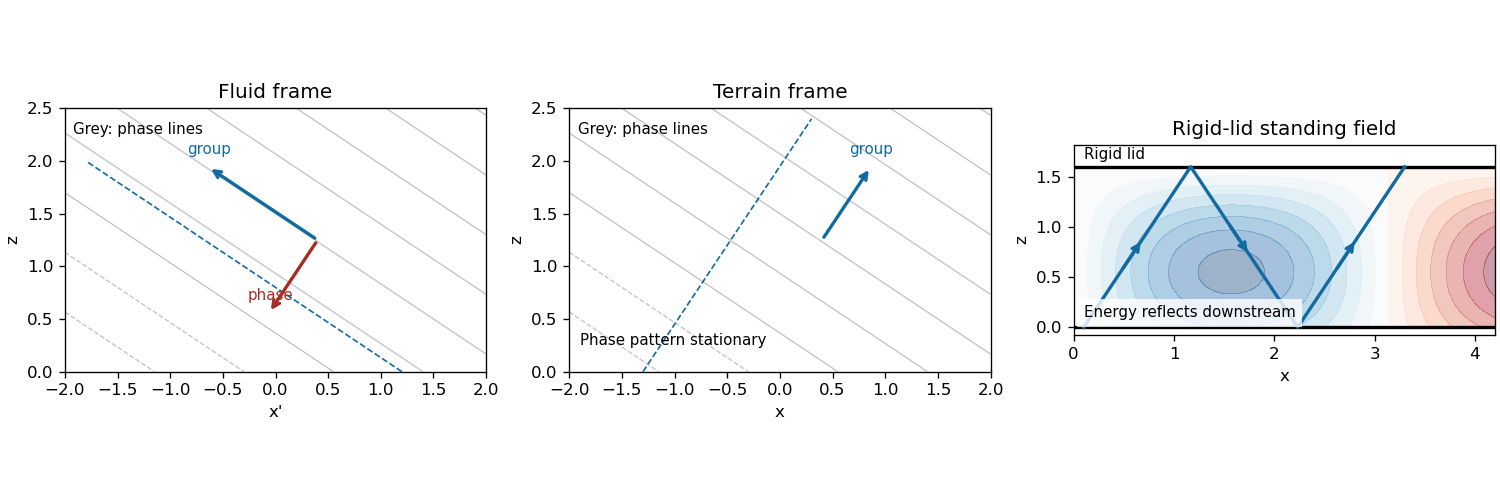
Phase lines and energy rays of topographic internal waves in fluid and terrain frames, with rigid-lid reflection
. Details. 
Let be the complex vertical velocity amplitude in . It satisfies , with and . Away from resonance, solve these two boundary conditions:The resulting field is a standing vertical superposition of equal-amplitude upward and downward internal gravity waves. Write . The rigid lid gives , and the bed givesThe upward vertical-velocity amplitude is . For real positive , its phase relative to the bed-height coefficient is if and if , modulo . Relative to the imposed bed-velocity coefficient , the phase is instead in the positive-sine case, with an additional when the sine changes sign. The complex coefficient gives the answer without convention ambiguity. The upward displacement coefficient, if desired, is , since for the stationary wave.
A reflecting lid reverses the vertical energy direction while retaining horizontal wavenumber and laboratory frequency. In the terrain frame the incident and reflected energy rays therefore travel downstream while zigzagging between the boundaries. The velocity field has nodes at the lid and a vertically standing pattern; the sketch marks this ray geometry, rather than falsely drawing the reflected ray as a specular optical ray.
The intrinsic group velocity makes an angle with vertical satisfying . Consequently the denominator vanishes whenThese are the rigid-lid resonance of stationary topographic internal waves. At such a nonzero vertical mode the homogeneous rigid-lid eigenfunction is also zero at the bed, so it cannot satisfy the nonzero prescribed bed velocity; a bounded stationary inviscid forced solution does not exist. Time-dependent forcing produces secular modal growth until dissipation or nonlinearity intervenes. The formal , limit is not this resonance: is finite. Propagating resonance also requires ; an evanescent field has no real standing-wave resonances of this kind.
The Batchelor entrainment hypothesis assumes that the mean ambient inflow normal to the edge of a turbulent turbulent plume is proportional to its representative axial velocity, . With top-hat plume model fields and circumference , the added volume per height is . It is an integral turbulent mixing closure; it does not assert that every instantaneous eddy has the same inward speed. Use constant positive , uniform resting ambient, Boussinesq approximation, negligible drag and no buoyancy loss.
Since , . Eliminate between the volume and momentum balances:The zero-source-flux condition gives , the pure plume balance. Substitution in and integration givesRecovering the top-hat fields from , and yieldsThe paper's ratio is thereforeThis is the constant inverse-normalized ratio used here, not the catalog's normalized plume balance parameter, which is one for a pure plume. The zero-flux point source is a limiting similarity origin: the speed and density anomaly diverge there, so a physically finite source must regularize the near field. The expressions are valid in the region where the Boussinesq approximation and turbulent closure apply.
Two source scales obtained from dimensional analysis areThe jet length measures how far source momentum remains important relative to buoyancy-generated momentum. The source-volume length of a turbulent plume measures how far imposed source volume remains important relative to entrained volume. Numerical constants and entrainment coefficient factors depend on the chosen normalization. From the equations here the useful exact volume-growth scale is ; the pure-similarity height whose flux equals is . A momentum crossover likewise contains a factor of order . The source radius is another useful geometrical combination, but it does not replace the two buoyancy/source crossover comparisons.
Integrate the differential relation from part (a) with finite source values:DefineThis plume flux-balance invariant rearranges toUse it to express , and substitute into . The coefficient satisfies , givingWith positive source fluxes, . For the source has excess momentum relative to pure plume balance, so it is a momentum-dominated forced plume. For it is already in pure plume balance, and the exact solution is the pure similarity translated to a finite plume virtual origin. For the source has deficient momentum relative to its buoyancy and volume fluxes, a lazy plume. Here “forced” in the broad sense merely means finite source fluxes; this sign classification distinguishes its jet-like and lazy branches. At large height, finite vanishes and every positive branch approaches pure plume balance.
Differentiate and use both balances:Substituting givesFor , the radius grows faster than the pure-plume slope and its growth rate decreases toward that slope as increases. For , it grows at that slope exactly. For , it grows more slowly, possibly initially contracting, and its slope increases toward . Since and , all branches satisfy as .
Initial necking requiresThus a sufficiently lazy plume initially narrows as buoyancy accelerates its fluid faster than fluid entrainment supplies additional volume. It still has increasing volume and momentum fluxes; shrinking radius does not imply volume loss. At equality the initial slope is zero, and for the slope later becomes positive once . This gives a finite minimum radius before the eventual pure plume regime.
Articles by others on the same topic
There are currently no matching articles.