Write and . The Euler equations and conservation of mass give and . The internal-energy density of the ideal gas is . The adiabatic pressure equation therefore givesMultiply the momentum equation by and use continuity to obtain the kinetic-energy balanceAdding the two equations moves into the flux. Thus the entire system is , whereThis derives the conservative energy flux of a polytropic ideal gas. In particular one-dimensional spatial dependence does not remove the transverse velocities from the total energy. The energy flux can equally be written with specific enthalpy .
Integrate any conservation equation from part (a) through a vanishingly thin control volume moving with shock speed . Its singular terms require . The stationary shock has , so all five fluxes are continuous. Substitution gives the Rankine-Hugoniot conditions for a perfect gas:Let the common mass flux be . Dividing the transverse conditions by proves and . Dividing the energy condition by shows that is unchanged. Thus tangential kinetic energies cancel when solving for the normal shock compression. No global equality of the entropy parameter across the shock has been assumed: physical dissipative shocks increase that parameter.
Set . Mass and normal momentum conservation implyAfter cancelling the unchanged tangential kinetic energies, the energy condition is . With and normal Mach number , rearrangement factors it asThe first root is the no-shock solution. The nontrivial perfect-gas shock jump conditions therefore giveIts density and pressure ratios arePhysical admissibility selects a compressive, entropy-increasing shock. This can be verified directly: with , define . The derivative of after inserting these ratios iswhere pressures are positive, and at . Thus the entropy increases precisely on the branch ; the positive-pressure expansion branch decreases entropy. Since the normal speed is positive,The endpoint one is the zero-strength limit, not a finite shock. The downstream normal Mach number obeys .
Let and , the strong-shock limit of the normal velocity ratio. In the plane containing the upstream direction and the shock normal, take and . The normal velocity is multiplied by while the tangential velocity is unchanged, henceEliminating gives the strong-shock polar for a perfect gas:Equivalently this is the circleBoth signs of the perpendicular component are possible by changing shock orientation. The endpoints lie on the upstream axis. An original sketch for illustrates the locus and a tangent ray:
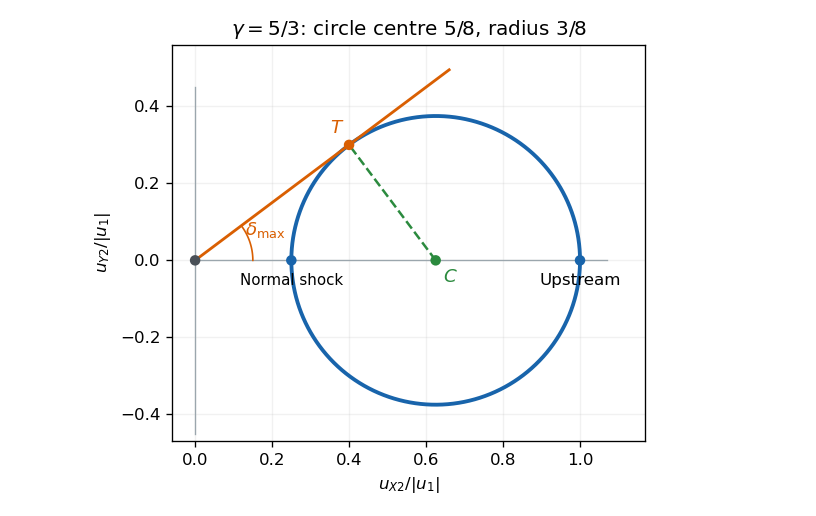

The deflection is the angle of the ray from the origin to the downstream velocity, rather than the shock-normal angle . Its maximum occurs where this ray is tangent to the circle. The circle's center is at distance and its radius is , so the tangent right triangle provesThis is the maximum deflection through a strong perfect-gas shock; for it is about degrees.
Articles by others on the same topic
There are currently no matching articles.