At a fixed point , the quadratic equation is . ConsequentlyThe Jacobian matrix is , and its Floquet multipliers solve . The Jury stability criterion requires and , . With , this becomes , . The lower branch never satisfies it; the upper branch is attracting precisely whenAt the lower boundary the two fixed points merge with Floquet multipliers , a saddle-node bifurcation for . At the upper boundary the upper point has Floquet multipliers , giving a generic period-doubling bifurcation for .
Its direction can be established explicitly. A distinct two-cycle alternates values satisfying , . Subtracting gives , and substitution givesIt exists beyond the fixed-point period-doubling bifurcation. The second-iterate Jacobian matrix has determinant and trace . Applying the same stability inequalities shows attraction for andThus the first period-doubling bifurcation is supercritical; the next upper boundary has a Floquet multiplier for the two-cycle. These are the fixed-point and two-cycle thresholds of the Hénon map.
At the map preserves phase-space area, so attraction is impossible. The fixed-point fold is at , with double Floquet multiplier , and is a conservative saddle-centre bifurcation. The upper branch is linearly elliptic for ; the lower branch is a saddle fixed point of a map. At , the upper branch has double Floquet multiplier and becomes a saddle fixed point of a map for larger . The two-cycle is elliptic for , then reaches double Floquet multiplier for the second iterate at . The partial sketch distinguishes elliptic, neutrally stable Floquet multipliers from attracting states. Resonances may require additional nonlinear analysis; unit Floquet multiplier moduli alone do not prove nonlinear Lyapunov stability.
The segment is a conservative Hénon stability boundary, not an ordinary nondegenerate dissipative Neimark–Sacker bifurcation. Indeed for constant phase-space area scaling is . A simple invariant closed curve would enclose a bounded invariant set of positive phase-space area, forcing . Thus no such closed invariant curve can bifurcate into within this constant-determinant family.
Generic folds and flips away from these degeneracies persist under sufficiently small smooth perturbations: their simple unit Floquet multiplier, transverse parameter crossing and nonzero leading nonlinear coefficient persist, while the other Floquet multiplier stays away from the unit circle. The implicit function theorem then continues the bifurcation curves and their criticality. The unqualified perturbation claim needs this restriction. Arbitrary perturbations need not preserve the conservative behavior. For example, in local complex coordinates at a nonresonant elliptic fixed point, the area-preserving map property gives a cubic normal form with zero cubic radial damping. Composing with the arbitrarily small radial perturbation introduces radial coefficient . Varying the modulus through one can now give a genuine Neimark–Sacker bifurcation. Conservative degeneracies and resonances are therefore not covered by a blanket structural-stability assertion.
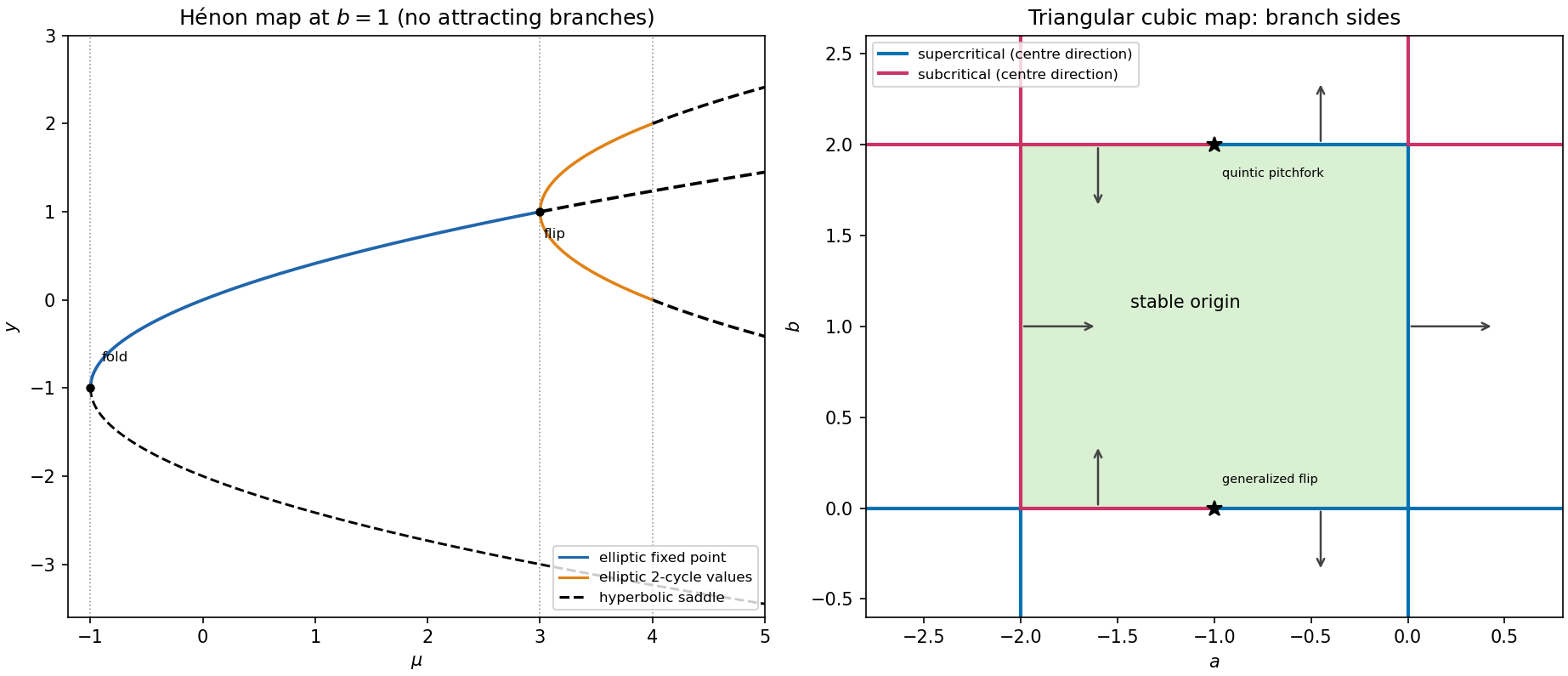
Hénon fixed points and two-cycles at unit area determinant, and local branches of the triangular cubic map
. Details. 
The origin's Jacobian matrix is triangular, , so its Floquet multipliers are , . It is attracting for , . The candidate codimension-one boundaries are , , , : respectively a or Floquet multiplier. No complex-pair crossing is possible at the origin.
The map is odd. To locate the nearby steady branches, write . The first fixed-point equation gives ; substituting into the second givesFor a symmetric two-cycle solve . Then andThese exact orbit equations for a triangular cubic map determine the amplitude and parameter side without confusing the original cubic coefficients with their centre manifold values.
On , with , steady states have and . The pitchfork bifurcation is supercritical for and subcritical for . Its centre manifold cubic coefficient is . In the stable-origin boundary segment , an attracting pair appears on .
On , with , the two-cycle has . The centre manifold map has cubic coefficient and Floquet multiplier . Since its unstable side is , the period-doubling bifurcation is supercritical for and subcritical for . In particular the boundary segment is subcritical: the nearby two-cycle lies on , where the origin is still attracting, and is unstable in the critical direction.
On , with , the steady branch hasIts scalar centre manifold map is . It is supercritical for , and subcritical for or . At the cubic vanishes: the exact equation gives , so this is a degenerate pitchfork bifurcation with destabilizing quintic coefficient and subcritical quartic amplitude scaling. It is not a generic point of the codimension-one curve.
On , with , put . The two-cycle satisfiesThe centre manifold map's cubic coefficient is . Thus the period-doubling bifurcation is subcritical for , and supercritical for or . In the stable-origin edge , a stable small two-cycle appears for . At the cubic vanishes, requiring the calculation below. All criticality labels concern the centre manifold direction; a bifurcating orbit is fully attracting only if the remaining Floquet multiplier is also stable. The sketch marks the small branches on the appropriate sides of each boundary of the stable-origin rectangle.
For clarity, these stability labels follow directly from one-dimensional derivatives. At a pitchfork bifurcation , the nonzero state has and Floquet multiplier to first order. At a period-doubling bifurcation , the symmetric cycle has and one-step derivative ; its two-step Floquet multiplier is . A supercritical branch lies on and is attracting in the centre manifold direction; a subcritical branch lies on and is repelling there.
At the Floquet multipliers are , so the degeneracy is not two simultaneous unit Floquet multipliers. On its centre manifold, and direct substitution gives . With small, the unfolding to leading weighted order isThis is a generalized flip bifurcation: one parameter crosses , and the other changes the cubic sign. Writing , its two-cycles obey . For a stable smaller two-cycle and an unstable larger two-cycle collide atThe intervening range contains both. For the period-doubling bifurcation is subcritical. At , the exact orbit equation is , so the unstable two-cycle exists for with . This proves both the codimension and the required quintic effect.
Articles by others on the same topic
There are currently no matching articles.