Write . The equilibrium points are a stable node and a saddle equilibrium , whose unstable and stable eigenvalues are and . The saddle equilibrium's local stable manifold is . When the right-going unstable separatrix returns at with , it lands exactly on that stable manifold, producing a homoclinic orbit of the saddle. Crossing this condition changes whether the returning trajectory is captured by the node or lies on the outgoing side of the saddle equilibrium.
Use an incoming section and outgoing section . For entry with , integrate the local flow:so the outgoing height isThe global excursion is smooth and transverse. Its return coordinate has expansion , with in these section orientations. Thus the local passage map near a dissipative saddle-node givesFor small , , hence and . If is small, the graph starts above the diagonal and, with slope less than one nearby, crosses it close to . More explicitly, , giving a unique small fixed point with Floquet multiplier . It corresponds to an attracting periodic orbit. For no such local crossing exists on ; the unstable branch returns to the node's side instead. The Poincaré return map panel shows this geometric fixed-point test.
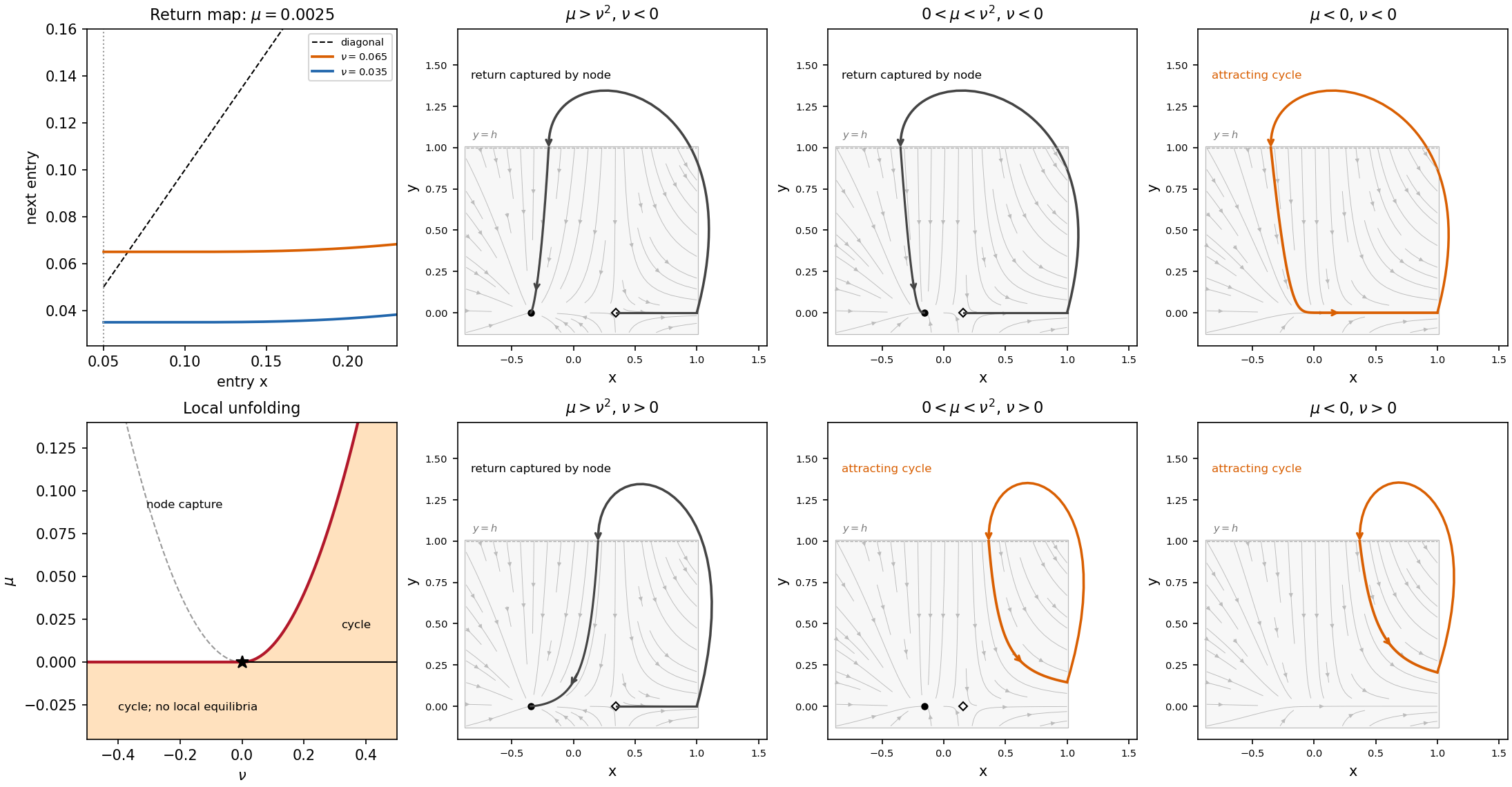
Local return map and six local phase portraits near a saddle-node separatrix-loop point; outer return arcs are schematic
. Details. 
For , put . There are no local equilibrium points and , so every incoming point passes through the local region. The same sections giveand again . The global return supplied by the problem closes the passage into a periodic orbit if this map has a fixed point.
Its derivative is strongly contracting: . To see the smallness uniformly near the codimension-two point, put and assume . The passage includes , on which , so . ConsequentlyFor a sufficiently small entry interval and all sufficiently small of either sign, maps the interval into itself and has derivative bounded strictly below one. The mean value theorem bounds differences by a factor strictly below one, while the endpoint signs of give existence of a fixed point. ThusHere “all ” means all return parameters in the neighborhood where the stated local/global construction applies, not arbitrarily distant global return geometries.
With and small negative , the returning trajectory enters to the left of the bottleneck, crosses the region around slowly, and exits to the right. Its height contracts towards throughout because . The local horizontal arrows point right everywhere. There is no equilibrium point; the schematic global excursion then returns the trajectory to the incoming section, giving the stable limit cycle shown in the negative-, negative- panel.
For fixed , the complete local bottleneck crossing takesThe actual entry coordinate is near a fixed negative . Replacing by that entry removes only a bounded time as , and the global excursion also takes bounded time. ThereforeThis is the inverse-square-root period law near a saddle-node bottleneck. The coefficient assumes fixed negative , or more generally . In a joint approach to the codimension-two point, the actual local time is , . If , the coefficient is instead; at entry it is . The fixed-negative- law is not uniform over all joint parameter paths.
For , the left equilibrium point is a stable node, the right equilibrium point a saddle equilibrium, and the saddle equilibrium's left unstable branch flows directly towards the node. The right branch takes the prescribed global excursion. Its landing relative to the two equilibrium points gives the six local portraits in the figure.
If , then for either sign of . The global branch lands between the equilibrium points and flows left into the node. There is no nearby Poincaré return map cycle, and the landing approaches the node from its right.
If and , the branch lands to the right of the saddle equilibrium. The contracting Poincaré return map has an attracting fixed point, giving a stable periodic orbit; the node also remains as a separate attractor with its own basin. If instead , the branch lands to the left of the node and approaches it from the left. There is no nearby periodic orbit in that case.
If , the two equilibrium points have vanished and a stable returning cycle exists for either sign of . For negative the cycle traverses the full bottleneck and has the divergent period in part (c). For fixed positive it enters to the right of the bottleneck; its local period approaches , so it need not diverge when . The outer arcs in the figure encode only the given return; the local equations do not specify the full vector field away from the origin.
The boundaries explain the codimension-two organization. On the saddle equilibrium has a homoclinic orbit. On , , the return passes through the semistable equilibrium point at a saddle-node bifurcation, producing a saddle-node bifurcation on an invariant circle. On , , the node and saddle equilibrium instead collide away from the persistent cycle. At , the returning separatrix hits the equilibrium point's strong stable manifold at the saddle-node bifurcation: this is the saddle-node separatrix-loop bifurcation. The curve changes which side of the node receives the returning orbit; unlike the positive branch, it is not a global bifurcation through a saddle homoclinic orbit.
Articles by others on the same topic
There are currently no matching articles.