For a normalized state driven by the admissible control , maximizeHere is the specified Hermitian operator, the final time, and the dependence on is through the Schrödinger equation. The objective is real and is exactly the desired expectation value, so increasing it increases the requested observable. A control-resource penalty may be included when the admissible set does not already constrain field strength or fluence.
For target unitary operator and actual propagator on an -dimensional space, minimize the phase-insensitive unitary gate errorThe Cauchy-Schwarz inequality for the Hilbert-Schmidt inner product gives a value in , because both unitary matrices have squared norm . The error is zero exactly when the matrices are proportional, namely . It therefore tests the full process, not just its action on one state, and ignores a physically irrelevant common phase. If the gate phase itself must be fixed, instead minimize , which vanishes only at exact equality.
For actual final density operator and target , minimizeThis Hilbert-Schmidt distance is nonnegative and is zero exactly at the target, for pure or mixed states. The subscript denotes evolution under the chosen control; is fixed. A simple overlap need not have its maximum at a general mixed target, whereas this distance has the required equality condition. For purely Quantum Hamiltonian dynamics, the target must lie on the initial state's unitary orbit of a density operator to attain zero error; otherwise the constrained optimization finds the closest accessible state instead.
In adaptive experimental quantum control, parametrize a reproducible pulse by a finite real vector , for example in a calibrated waveform basis. Prepare the same initial state for each trial, apply that pulse without feedback during the run, and estimate the objective from repeated measurements. No accurate dynamical model is required if the laboratory can evaluate the objective.
One concrete algorithm is experimental finite-difference gradient ascent. For every parameter, run trials at and estimateUpdate to an admissible projection of , test the new pulse, and reduce the step size if performance deteriorates. Averaging many shots controls statistical noise; choose large enough for the difference to exceed the measurement uncertainty but small enough to approximate a derivative. Repeat until no statistically significant improvement remains. Multiple starting pulses help explore distinct basins, but this does not guarantee a global optimum. Resource penalties and hardware restrictions belong in the objective or the admissible parameter set.
The feedback is across experimental runs: a measured objective chooses the next pulse. Each individual trial is open-loop control. This distinction matters because the algorithm does not require an instantaneous nondestructive state measurement on the system being controlled.
For a concrete variational method, maximize the terminal-observable objective with a fluence penalty,where weights the control cost. Enforce the dynamics with a complex costate and the real augmented functionalVariation of restores the state equation. Integrate the variation by parts; because , the terminal coefficient gives , and the interior coefficient givesThis equation has final data, so it is integrated backward. Variation of the real control gives the variational costate gradient for Hamiltonian quantum controlIn particular an unconstrained stationary pulse satisfies . The state, adjoint and control equations form a coupled two-boundary-value problem, so the stationarity formula is not an independent explicit solution for .
Use direct-adjoint looping: start from an admissible pulse, propagate the state forward, set the terminal costate, propagate it backward, compute the gradient on the time grid, and update the pulse with an ascent step and line search. Project amplitude bounds and impose bandwidth constraints within the parametrization or update. Repeat until the projected gradient is small. For gate objectives the forward variable is the propagator and the costate is matrix-valued; for mixed-state objectives it is the density operator. Gradient ascent pulse engineering applies the same efficient forward/backward differentiation to time-slice amplitudes. The variational conditions identify local stationary controls and require numerical convergence checks; they do not prove global optimality of a nonconvex control landscape.
A 4f pulse shaper supplies an experimental realization of spectral pulse shaping. A first diffraction grating separates the frequencies of a broadband coherent pulse; a lens maps them to distinct transverse positions in its back focal plane. Place an amplitude-and-phase mask, or calibrated spatial light modulator with appropriate polarization optics, in that Fourier plane. A second lens and grating recombine the shaped spectrum into one output beam. The original schematic below shows the frequency channels and the four focal-length separations.
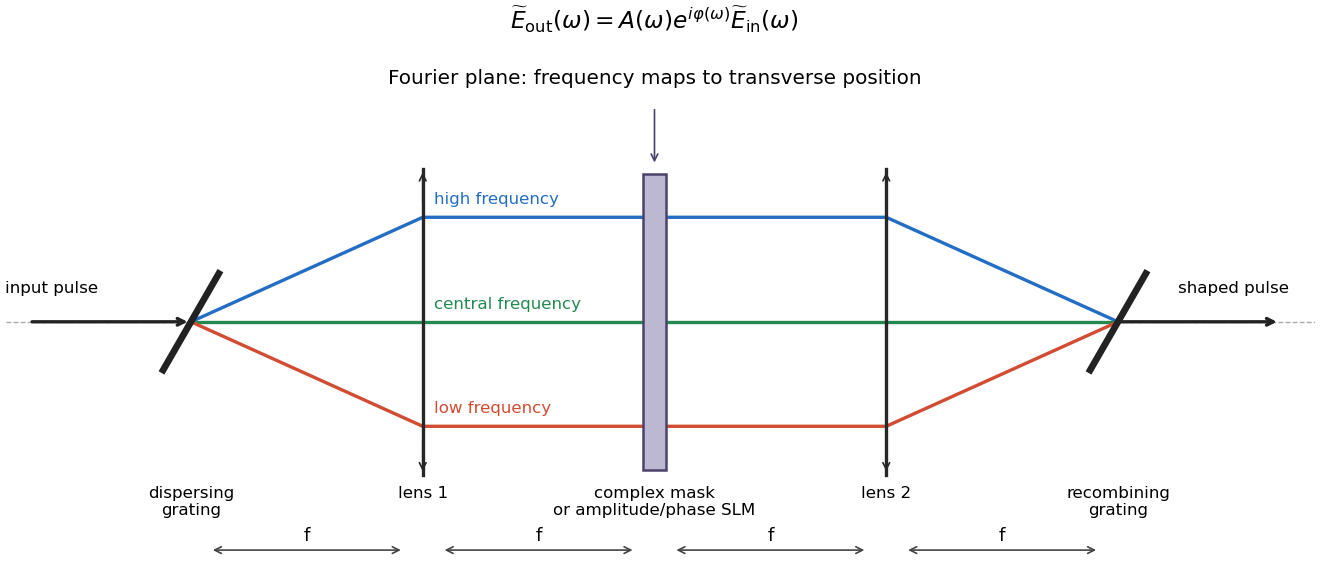
Original 4f spectral pulse-shaping schematic showing dispersing and recombining gratings, two lenses, and a frequency-resolved complex mask
. Details. 
If the mask is , then . In principle choose wherever the input spectrum is nonzero and recover the temporal waveform by inverse Fourier transform. Set the desired real physical field by conjugate symmetry of its positive and negative frequency components; its envelope and carrier phase implement the optimized control in the appropriate interaction frame.
A passive mask cannot amplify spectral components or create frequencies absent from the input, so the desired waveform must respect available bandwidth and may need overall rescaling or amplification elsewhere. Finite spectral resolution limits the useful temporal window, while total bandwidth limits the shortest temporal features. A phase-only modulator cannot in general implement independent amplitude and phase shaping without extra optics. These are hardware admissibility constraints, not corrections supplied by the variational calculation after the fact.
Articles by others on the same topic
There are currently no matching articles.