Put . The planar autonomous differential equation isIts equilibria have , . There are none for , one at , and two for . At an equilibrium the stability matrix isWriting , is always a saddle equilibrium. At , the determinant is and the trace is : it is attracting for and repelling for .
At and , the eigenvalues are ; the nonzero quadratic term and parameter unfolding give a saddle-node bifurcation. At , the trace crosses zero at , with eigenvalues , giving a Hopf bifurcation. It is nondegenerate: around the equation is . At , a small oscillatory expansion of leading amplitude has , so the first nonlinear damping is positive and nonzero. For example, its second-order oscillatory expansion is with . Thus the small attracting limit cycle is on the side. At the matrix has a double zero eigenvalue and a nontrivial Jordan block, the Bogdanov–Takens bifurcation organizing the two curves. The local bifurcation curves areA change between node and focus away from these curves is not itself a local bifurcation.
For the requested global exclusion, suppose were periodic with period . Integrate the original equation over a period. The integrals of , , and vanish. ThereforeThe left side is nonnegative and the right side is negative when . This contradiction proves there are no periodic orbits for , independently of .
With the stated time rescaling, and , where primes refer to . Dividing by givesAt , put and define the HamiltonianIts orbital derivative is , so this is a conserved quantity. The Hamiltonian system has , .
For , set . The potential has a minimum at and a maximum at . The corresponding center equilibrium and saddle equilibrium have energies and . Levels contain closed ovals around , as well as separate unbounded components on the right. At , the center's ovals limit to a homoclinic orbit to the saddle, turning at . Its equation isThe same energy also has external unbounded saddle separatrices for . Levels above pass over the potential barrier and are open. Along the upper halves , so the closed loops are traversed clockwise. If , the two critical points coalesce into a degenerate equilibrium; if , the potential is strictly decreasing and there is no center or homoclinic loop.
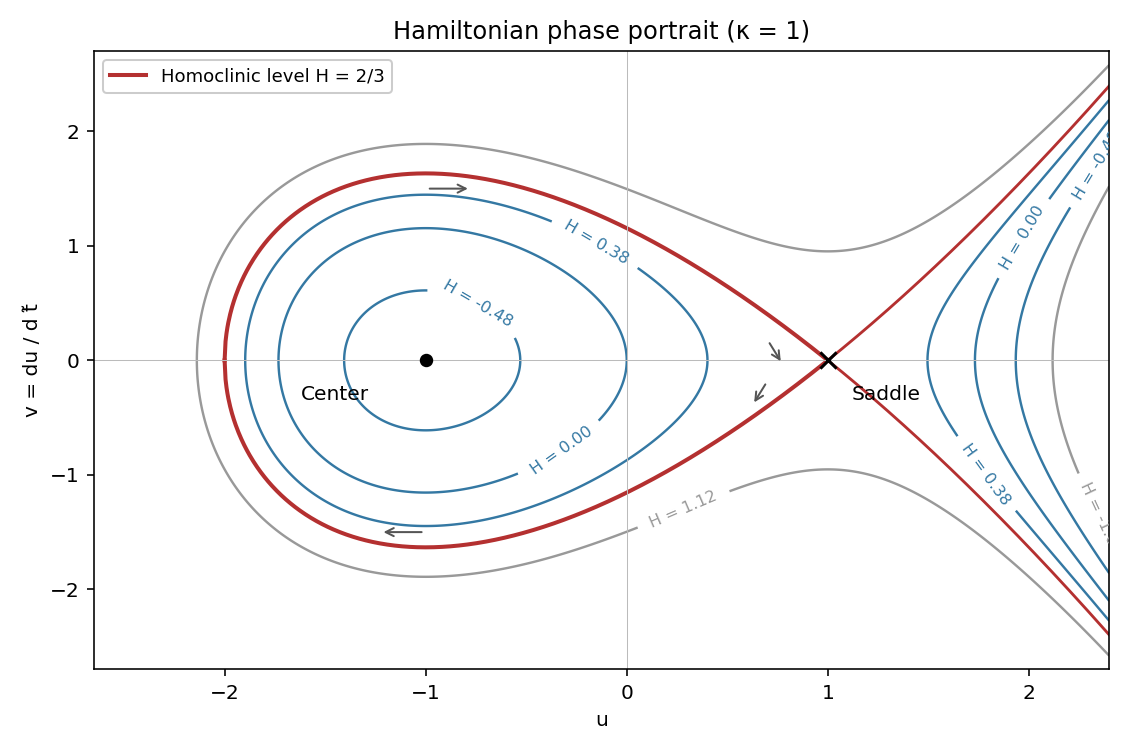
Hamiltonian level curves for kappa equal to one, showing the center, saddle and homoclinic loop
. Details. 
For small , the conserved quantity from part (b) instead obeys . The Melnikov energy-balance method evaluates the first-order net change along the unperturbed homoclinic orbit:Using the homoclinic curve , these are integrals of on its two halves. Their weighted mean is . Thus the first-order splitting vanishes at . Since its derivative with respect to is , the implicit function theorem gives a nearby curve where the stable and unstable saddle separatrices reconnect. This is the homoclinic balance for a quadratic-force oscillator and therefore a global, rather than local, bifurcation.
Returning to the original parameters, and . With fixed positive and , the homoclinic bifurcation curve has leading formThe energy integral locates the leading curve; the perturbed orbit itself is no longer a constant- curve.
With , the feedback system isFor , is an equilibrium. Its stability matrix and characteristic polynomial areThus there is always a zero eigenvalue, with eigenvector , so it is a nonhyperbolic equilibrium. If , the other two eigenvalues are off the imaginary axis: for their real parts are negative, while for their product is negative. At , all three eigenvalues are zero, explaining the exclusion in the next part.
Adjoin and use an extended centre manifold with local coordinates . Count as order , as appropriate to a steady-state fold, and writeThe centre-manifold invariance equation differentiates these graphs along . The derivatives and first contribute at weighted order three. Comparing the coefficients of and in the right sides therefore givesSince , their solution isHence the reduced normal form isBoth the quadratic and unfolding coefficients are nonzero, so the steady-state bifurcation is a saddle-node, with equilibria on the side. The exact steady equations confirm this: , , and , giving two nearby equilibria for and none for .
For the transverse modes are attracting; the negative- branch is locally attracting and the positive- branch has one unstable direction. For , one transverse eigenvalue is already positive, so neither full equilibrium is asymptotically stable, although the reduced fold is still present with reversed flow orientation. The parameter requires a higher-dimensional degeneracy analysis and is outside the stated assumption.
Articles by others on the same topic
There are currently no matching articles.