Use natural units and the Minkowski metric . The canonical momentum is , and the Legendre transform in mechanics givesFor canonical quantization of a real scalar field, impose the equal-time canonical commutation relationsThe Heisenberg picture equation then gives . For the other equation, the momentum term commutes with ; commuting the gradient term past and integrating the derivative of the Dirac delta function by parts gives . ConsequentlyThe Fourier transform reduces this Klein-Gordon equation to oscillators of frequency . Hermiticity of the real scalar field pairs their positive- and negative-frequency coefficients, so its general mode expansion can be normalized asTo verify its normalization rather than guess the oscillator algebra, use scalar field oscillator inversion at :Its adjoint has the conjugate phase and the opposite sign in front of . The two mixed field-momentum commutators giveThe Fourier representation of the Dirac delta function sets the energies equal in the last step. Similarly, has a factor multiplying and vanishes; the two-creator commutator vanishes as well.
Substituting the expansion in and integrating the spatial phases, the two-annihilator and two-creator coefficients cancel by . The free real scalar Hamiltonian in oscillator variables isIt differs from by its constant vacuum energy; normal ordering removes that constant. Using the oscillator commutators, for either Hamiltonian,Choose the Fock vacuum annihilated by every . Each creation operator adds a particle of energy and momentum ; its annihilation operator removes one. Their mutual commutativity gives bosonic Fock space and symmetric many-particle states. Thus the scalar mass-shell frequency has a particle interpretation, rather than merely describing a classical oscillation.
For and , vacuum contraction and time ordering give the Feynman propagatorIn the scalar Feynman propagator pole prescription, the integral of has poles at and . Close clockwise below for and counterclockwise above for . The residue theorem gives exactly the corresponding term above, provingAs a direct check of the distributional source, is continuous, but . The derivative jump of a free scalar time-ordered two-point function therefore gives . Spatial Fourier inversion yields
The supplied matrices are the chiral gamma-matrix representation. The Pauli matrix multiplication law implies . Block multiplication gives , , and . Hence their Clifford algebra relation isSince partial derivatives commute, multiplying the Dirac equation by givesThus every component of the Dirac spinor satisfies , the Klein-Gordon equation with the same mass.
For a Lorentz transformation , set . The derivative transforms as . With the given spinor-matrix identity,This proves the Lorentz covariance of the Dirac operator explicitly.
For parity, let and . Spatial differentiation brings a minus sign, which is canceled by . ThereforeSince is Hermitian and squares to one, the Dirac adjoint transforms asThe chirality matrix anticommutes with . The parity transformation of a Dirac bilinear consequently givesThe first bilinear is a Lorentz scalar even under parity, and the second is a pseudoscalar.
In this representation, . Its square is one, so the chiral projectors are idempotent, mutually orthogonal and sum to the identity. They select and , the two Weyl spinors. Because , a solution of the massless Dirac equation has each chiral component solving that equation separately. In two-component form,The two chirality sectors are thus independent under massless propagation and proper Lorentz transformations. A nonzero Dirac mass term couples them, while parity exchanges them. This explains why the projectors are particularly useful in the massless theory.
The interaction contains no time derivatives, so . The Legendre transform in mechanics givesThusHere is the free Hamiltonian operator of mass , and is the interaction Hamiltonian.
In the interaction picture, operators evolve with and the states with . With , the state evolution satisfies . Integrating once and iterating gives the Dyson seriesEquivalently it is the time ordering of the exponential. Taking the infinite-time scattering limit, with adiabatic switching understood, gives the scattering matrixThe field in the interaction is the free interaction-picture field, which is essential for applying the free-field contractions.
Use relativistic normalization of a one-particle state, , so each external scalar contraction contributes its plane-wave phase without an extra factor. For the connected on-shell two-to-two scattering amplitude, the first Dyson series term is . The Wick theorem gives ways to attach the two incoming and two outgoing external particles to the four fields, canceling the denominator. ConsequentlywhereThe delta function expresses four-momentum conservation. The connected scattering convention removes spectator, vacuum and external self-energy contributions; equivalently at this order one can normal-order the interaction and keep the physical external mass fixed. These contributions should not be mistaken for additional connected four-point diagrams.
Take incoming electron momentum and positron momentum , with outgoing photon momenta , so . The leading electron-positron annihilation into two photons has two tree-level Feynman diagrams, differing by the order in which the two outgoing photons attach to the charged-fermion line.
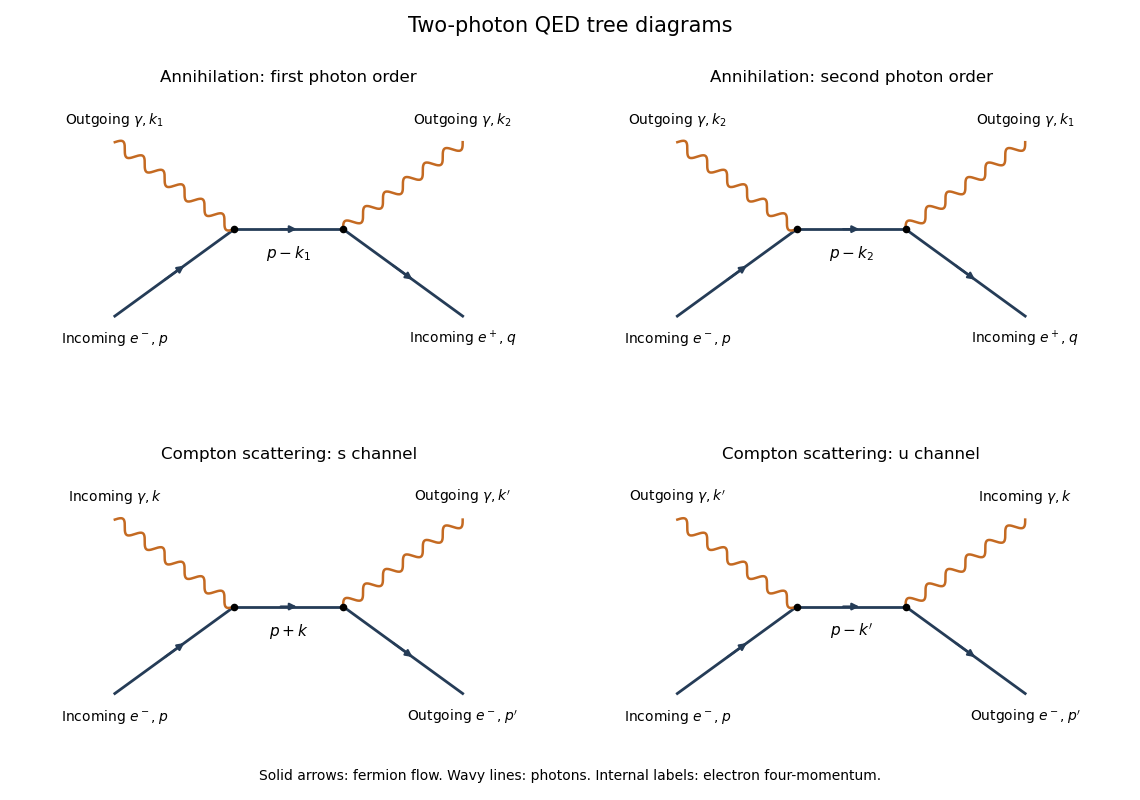
The two photon orders in electron-positron annihilation and the s and u channels of Compton scattering
. Details. 
The arrows indicate fermion flow. An incoming positron has the opposite flow direction to its physical momentum; the lower row uses an outgoing electron instead.
The required QED Feynman rules, with interaction , are a vertex , a Dirac propagator , an incoming electron spinor , an incoming positron adjoint , and an outgoing photon polarization . Here Feynman slash notation means , and the external Dirac equations are and .
Put , omitting only the propagator's overall factor . Multiplying the two vertices and the propagator givesThe diagrammatic expression is . The relative sign is plus because the two photons are bosons; exchanging their attachments does not exchange external fermions. The amplitude is of order .
A physical photon polarization vector obeys and , with the gauge equivalence . One can choose a transverse representative with and normalize . There are two physical transverse polarizations.
To prove the requested two-photon fermion Ward identity, replace by . Away from an internal pole, is the inverse of , with the boundary prescription understood. The first term simplifies becauseFor the second term, four-momentum conservation gives , soThe two contributions are therefore and , which cancel. Interchanging the photon labels proves the other contraction vanishes. By linearity, adding a multiple of either photon momentum to its polarization leaves the summed amplitude unchanged. This is gauge invariance: longitudinal gauge representatives do not describe an additional physical photon state. An individual diagram does not generally have this property.
For Compton scattering, let be incoming electron and photon momenta and the outgoing ones. The diagrams in the lower row have intermediate electron momenta and respectively. The same QED Feynman rules giveTheir denominators are and , the - and -channel denominators. In annihilation the two exchanged-electron channels instead carry and . Crossing symmetry relates the two expressions by moving the positron to an outgoing electron and one outgoing photon to an incoming photon, with the corresponding momentum and polarization replacements. There is no two-photon contact vertex for the minimally coupled Dirac electron. Both processes require the sum of the two photon orders to satisfy the Ward identity.
Articles by others on the same topic
There are currently no matching articles.