The strong equivalence principle asserts universality of free fall even for bodies with gravitational self-binding, together with independence of local experimental outcomes, including gravitational experiments, from the location and velocity of a freely falling laboratory. “Local” means that external tidal variation across the apparatus can be neglected. It does not mean that all curvature, or a laboratory's own gravitational field, can be removed. The weak principle concerns freely falling test bodies without appreciable self-gravity; laboratory composition tests alone therefore do not establish the strong version.
Lunar laser ranging supplies evidence specifically sensitive to the strong version. The Earth and Moon have different fractions of gravitational self-energy. If those fractions affected gravitational and inertial mass differently, their accelerations toward the Sun would differ and the lunar orbit would acquire a periodically varying polarization, the Nordtvedt effect. Combining lunar ranging with laboratory bounds on composition-dependent differential acceleration separates this self-energy effect. A determination available before this examination found the self-energy contribution to the Earth–Moon difference in to be , consistent with zero; see the 2004 experimental analysis. Universality-of-free-fall experiments, gravitational redshift measurements and tests of local Lorentz invariance support the weaker constituent principles, but should not be confused with a direct self-gravity test.
In general relativity, all matter couples to one metric tensor, and freely falling test particles follow its geodesics. At any event, Riemann normal coordinates give and . Nongravitational local equations reduce to their special-relativistic forms in that frame. Gravitational binding is governed by the same metric field equations rather than a separate composition-dependent force, and the local gravitational coupling is universal. These features implement the strong equivalence principle. Curvature still governs geodesic deviation, so this construction removes uniform acceleration, not tidal gravity.
To geometrize Newtonian mechanics, use a four-dimensional manifold with coordinates , absolute time and a degenerate spatial inverse metric , . For a gravitational potential define the torsion-free Newton–Cartan gravitational connection byIt satisfies and . An affine geodesic has ; choosing makes its spatial equationsThis is Newton's free-fall law. The geometry is Newton–Cartan theory, with an affine connection and degenerate metric data, rather than a nondegenerate four-dimensional Lorentzian metric. The spatial slices themselves remain Euclidean.
Use the curvature conventionIn these coordinates the quadratic connection terms vanish, and the only nonzero curvature components, apart from antisymmetry in , areIn particular and all other components of the Ricci tensor vanish. This Newtonian tidal curvature gives relative acceleration . Spatially constant gravitational acceleration can be removed by an accelerating frame because its Hessian vanishes. The Poisson equation for Newtonian gravity becomes . Fluid mechanics is compatible with the same connection: the covariant continuity equation is the usual mass-conservation equation, and the spatial Euler equation is , which includes the gravitational force through the connection.
Now replace this absolute-time geometry by the Lorentzian metric of general relativity, with signature . A perfect fluid haswhere is rest-frame energy density. In units , for a nonrelativistic fluid. The Newtonian equation suggests a covariant curvature equation sourced by . However alone conflicts with generic stress-energy conservation, because the contracted Bianchi identity gives . Among expressions linear in Ricci curvature, conservation therefore selectsA constant multiple of the metric is also divergence-free, giving the possible cosmological constant term. This is a heuristic selection using locality, universal metric coupling and second-order metric equations; Newtonian matching by itself does not prove uniqueness among every possible gravity theory.
To fix the coefficient, first set the cosmological constant to zero. The trace-reversed equation would read . In the fluid rest frame, , so . In the weak static Newtonian limit, and . For negligible pressure the Poisson equation for Newtonian gravity then requires . Restoring uses , and , giving . ThusPressure contributes to relativistic active gravity, while the low-pressure weak-field limit recovers Newton's Poisson equation. The comparison fixes the Newtonian normalization but does not fix , which is an independent parameter.
Use metric compatibility and a torsion-free connection. The coordinate formula for the Lie derivative of the metric tensor isSubstituting and collecting connection terms gives . Thus a Killing vector obeys , and conversely this Killing equation makes its flow preserve the metric. Its contraction gives .
With the curvature convention fixed in Q1, contract the vector Ricci identity to obtainThe second term vanishes because the Killing divergence is zero. Metric compatibility converts the first term to , and the Killing equation changes this to . Therefore the second covariant derivative of a Killing vector satisfiesThis derivation fixes the sign by the stated Ricci identity rather than by an unspecified convention for curvature.
For the axial Killing vector set . It is antisymmetric and its divergence is . Work in geometrized units and with zero cosmological constant, as required by the asymptotically flat setting. If a spatial shell has oriented boundary , the given form of Stokes theorem applied to the Komar angular momentum givesThe vacuum Einstein field equations give everywhere in the shell outside the matter source. The shell can still contain gravitational waves, since those have nonzero Weyl curvature rather than a nonzero Ricci tensor. HenceThis is angular momentum conservation in an axisymmetric vacuum region. Moving the outer surface through the radiative region adds no angular momentum. In an exactly axisymmetric spacetime there is no outward transport of the axial angular momentum by the waves. Axisymmetry does not imply stationarity, so this conclusion does not exclude radiation of energy.
For completeness the Einstein equations express the bulk current asOn an axisymmetric spacelike slice, is tangent to the slice and its contraction with vanishes; there the trace contribution to the angular-momentum volume integral drops out. One must retain any inner surface charges if the integration region has inner boundaries. The vacuum shell argument itself does not require a matter-only representation of the total charge.
The current is conserved on arbitrary slices, not just those to which is tangent. Indeed symmetry of the Ricci tensor and antisymmetry of giveThe last equality follows because a metric-preserving Killing flow also preserves the scalar curvature. Equivalently, the stress-energy conservation law and invariance of the stress trace give the same conserved current.
Let two spacelike hypersurfaces terminate on large enclosing spheres at the same asymptotic end. Join the spheres by a timelike tube lying wholly in the vacuum exterior. On this tube , so Stokes theorem gives zero difference of their Komar surface integrals, independently of the tube's shape. Alternatively, use the given Gauss theorem on a spacetime volume between the slices: , and the lateral flux is zero because in the exterior vacuum tube. Taking the enclosing spheres to infinity with the usual asymptotic falloff therefore provesAll surface orientations in these equations use the same convention as the stated Komar integral. The argument concerns enclosing surfaces at the same asymptotic end, so it does not discard additional charges from other ends or inner boundaries.
Let , with , and let a dot denote differentiation with respect to an affine parameter . The geodesic Lagrangian is one half the squared tangent norm. Its Euler–Lagrange equations givewhere in these formulas only. The constants from time translation and axial rotation areThey are the Killing energy and axial angular momentum per chosen affine normalization. A rescaling of rescales both, while their ratio is invariant. More generally the rotational Killing fields conserve the full angular-momentum vector: differentiating any Killing contraction along an affine geodesic gives . Thus its direction can be chosen as the polar axis.
Equivalently rotate the initial position and angular tangent into one plane through the centre. The angular geodesic equation then has initial data , , for which solves the equation identically. Uniqueness keeps the geodesic in that plane. A radial geodesic has no distinguished orbital plane but can be placed in any equatorial plane. Hence no physical restriction is imposed by setting .
Write in that plane. For a null geodesic the tangent norm vanishes, givingThe full radial equation also gives . These equations are used away from the coordinate singularity ; the geodesics themselves extend across the horizon in regular coordinates. For radial rays , and azimuth is not an orbit parameter.
For the nonradial case , set and now use a prime for . Since , the null first integral becomesHere is the signed impact parameter; its magnitude is the ordinary positive impact parameter for an exterior future-directed ray. The second-order orbit equation is . It follows from the radial geodesic equation and therefore holds even where ; differentiation of the squared first integral alone would not establish a circular solution at a turning point.
A finite circular photon orbit has and nonzero . Hence , while the first integral fixes :The null radial potential has second derivative there, so the photon sphere is unstable. The formal root lies at infinite radius, not a finite orbit. Radial null generators of the event horizon have fixed angles and are not circular photon orbits.
At the critical impact parameter the first integral factors asChoose the oriented branch . Put ; then . The functionsatisfies by direct differentiation. Integrating givesThis establishes the displayed family as actual critical-impact-parameter geodesics. Reversing the azimuthal orientation gives the complementary parametrization.
To expose the geometry, put . Solving for the positive square root givesFor physical this branch uses , with the upper endpoint corresponding to infinite radius. As ,Thus the critical photon orbits of Schwarzschild spacetime wind around the photon circle infinitely many times with an exponentially shrinking radial displacement. For the approach is from outside ; for it is from inside; for the orbit is the circle itself. Increasing along the chosen orientation sends the positive branch outward toward infinity and the negative branch inward, through the horizon toward the singularity. The limiting description at concerns the asymptotic photon sphere rather than a finite-angle radial turning point.
Use the original PDF's spatial Ricci component ; the converted TeX's is a transcription defect. Continue with and signature . Tracing the vacuum Einstein field equations with a cosmological constant gives , and hence . The time component therefore gives . Substituting this into the spatial component givesThe left side is strictly positive, so is necessary for a real positive closed scale factor. Define . The acceleration equation has solution , and the first integral fixes . Taking the positive scale-factor branch and shifting the origin to the minimum givesThe universe contracts for , has its nonzero minimum at , and expands for . The minimum is a smooth bounce, not a curvature singularity.
Introduce the dimensionless time . Then the closed slicing of de Sitter spacetime isOne can identify it explicitly: in five-dimensional Minkowski space, set and , where . These coordinates satisfy , and their induced metric is the one above. Thus the solution is global de Sitter spacetime, with spherical spatial topology and both contracting and expanding parts.
The time entering the printed compactification formula is this rescaled time. WriteDirect differentiation and elementary trigonometry give , and . ThereforeMultiplying by gives the metric of a finite-time slab of the Einstein static universe, often called the Einstein cylinder. This is a conformal transformation of the metric and does not assert that the transformed matter content remains vacuum. The coordinate ranges areThe angular-coordinate degeneracies at the poles are the usual regular spherical ones.
Radial null lines satisfy , so the Penrose diagram is the square displayed below. Every interior point represents an angular two-sphere. Its top and bottom are the spacelike conformal infinities and at and ; they are excluded from the physical spacetime and are not curvature singularities. The vertical sides and represent the regular north and south poles of the three-sphere, not spatial edges of the universe.
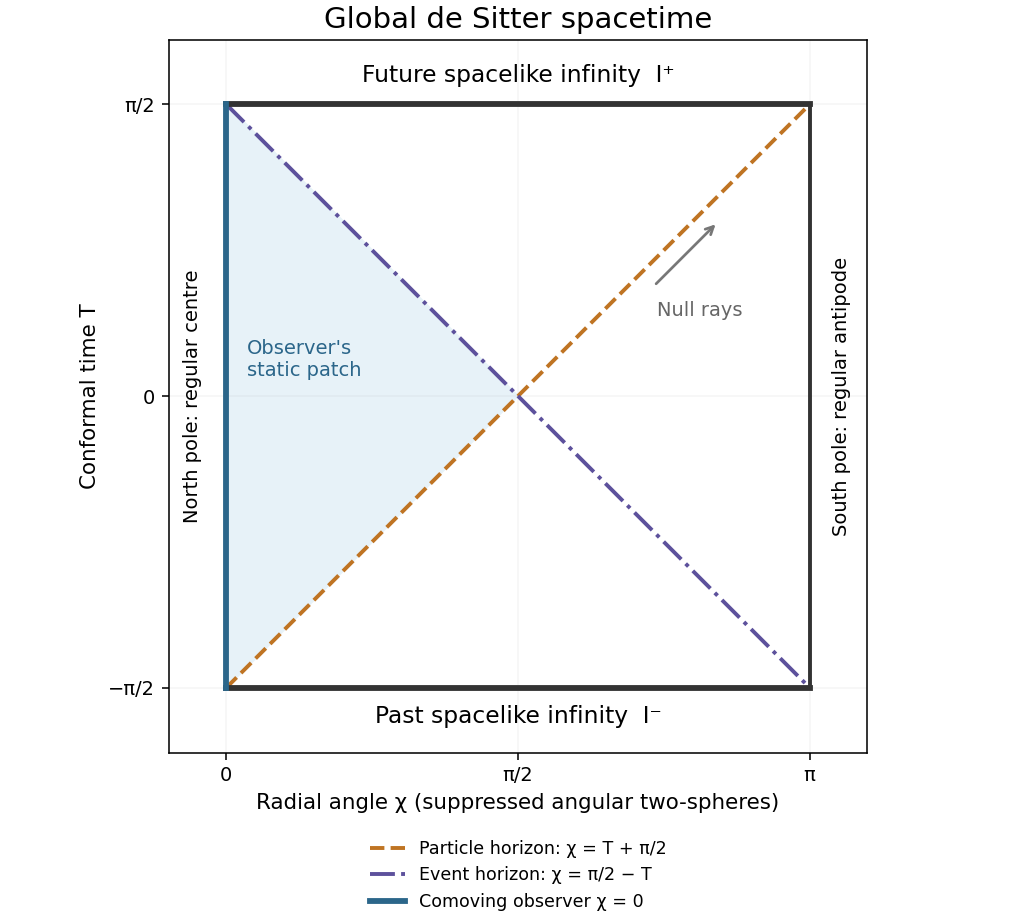
Global de Sitter Penrose diagram with spacelike conformal infinities and a comoving observer's particle and event horizons
. Details. 
A particle horizon at an observer's current time bounds the comoving sources whose light could have reached that observer over the available past conformal interval. Here the cosmological past extends to , but its conformal duration is finite. For a comoving observer at ,Since at every finite time, a particle horizon exists. The corresponding null boundary in the diagram is , emerging from the observer's past endpoint at . The antipodal point never has enough time to send a signal received at a finite proper time.
An observer event horizon bounds the events that can ever send a signal to the observer's future-inextendible worldline. The remaining conformal time fixes its distance:This too lies strictly between zero and at finite time, so the observer has a cosmological event horizon. Its null line ends at the observer's future endpoint on . Both horizon spheres have areal radius , though their comoving angular positions differ except at . These are the cosmological horizons in global de Sitter spacetime; changing the comoving observer relocates them by an isometry.
A Cauchy horizon is the boundary of the domain determined by data on a chosen partial Cauchy hypersurface; beyond it an inextendible causal curve can avoid that initial surface. Each complete constant- three-sphere here is a Cauchy hypersurface. To see this directly, a causal curve in the conformal metric has spatial speed at most one when parameterized by . On any finite interior time interval its path therefore has a limit in the complete compact three-sphere. If an inextendible curve stopped at an interior time, that limit would allow its continuation, a contradiction. Its time range consequently extends between both conformal ends, and monotonicity makes it cross any complete constant- sphere exactly once. Its domain of dependence is the entire physical spacetime.
Thus particle and cosmological event horizons exist for every comoving observer, while the complete global Cauchy slices have no Cauchy horizons. Horizons of a restricted static patch or a deliberately partial initial surface are relative to that restriction; they do not alter the global Cauchy conclusion.
Articles by others on the same topic
There are currently no matching articles.