Assume an axisymmetric thin disc rotating in the fixed potential of a dominant central mass, with independent of time and height. Neglect vertical mass loss and vertical angular-momentum flux at the two faces, as well as self-gravity and radial pressure corrections to the rotation law. Define the surface density and density-weighted kinematic viscosity byand let . These assumptions give the vertically averaged viscous disk equationswhere is specific angular momentum. Subtract times conservation of mass from conservation of angular momentum. Since is fixed in time,Substitution into conservation of mass proves the Keplerian viscous diffusion equationNo assumption of height-independent kinematic viscosity is needed; its density-weighted average is the one appearing in the integrated stress. A wind or surface magnetic stress would add terms and must not be silently discarded.
Put . In steady state, is constant, soThe inward mass accretion rate and outward viscous torque in an accretion disk are
For a zero-torque inner boundary condition at finite ,With positive finite inner kinematic viscosity, tends to zero there. At fixed nonzero inward mass flux, the corresponding becomes large, signaling the breakdown of the nearly circular thin disc approximation in the inner transition region.
For no central accretion, andThis nonaccreting constant-torque disk has a finite inner stress and normally a nonzero inner surface density. An external inner torque supplies the angular momentum transported to an outer sink, although mass does not flow. If both this zero-mass-flux condition and a zero inner torque are imposed, ; there is no nontrivial positive-viscosity steady disk satisfying both.
The instantaneous kinematic viscosity law is , with no explicit constitutive memory. Expand its transported quantity at the possibly evolving background:The viscous transport response exponent satisfies . Subtract the background equation and retain only linear terms to obtainThis remains a linear equation with space- and time-dependent background coefficients; neither a steady background nor constant is required for this step. The sign of the response coefficient is the negative-diffusion criterion for viscous disk instability.
For , the response is . A nonaccreting background has , while , soConsequently . On this steady background, introduce the square-root-radius diffusion transformSince is constant and , the linear equation becomesThus , and the required choice isFor a Fourier mode , . Positive kinematic viscosity makes have the sign of , so gives growing modes whose rate increases with . The formal equation is a backward heat equation and predicts arbitrarily rapid small-scale amplification. Physically the thin disc diffusion closure applies only to wavelengths sufficiently larger than the thickness and stress-relaxation scales; this formal limit identifies the need for a cutoff, rather than a finite fastest wavelength absent from the model. The boundary case has vanishing linear transport response.
For a razor-thin disk, integrate the delta function in height to getThe corresponding horizontal force kernel is proportional to . It removes the short-distance point-force singularity and smooths forces on separations of order . This is height-evaluation gravitational softening.
To represent finite vertical thickness, choose of order the disc disk scale height . There is no universal exact numerical choice: a true vertical mass density profile produces the Fourier reduction factor , which is not generally . Matching the long-wave term gives , the vertical-profile softening match. For an exponential vertical profile this mean is , while its full reduction factor is .
Use the horizontal Fourier convention . For each nonzero , the Poisson equation becomesDecay away from the sheet and continuity at it give . Its derivative jump is , hence the off-plane razor-thin Poisson kernel isThe spatially uniform mode has a different vertical solution and an arbitrary additive potential reference; it is not obtained by substituting into this decaying-mode formula.
Let , and . Linearize the barotropic closure of a razor-thin disk and shearing sheet about the given state. Write the radial and azimuthal velocity perturbations as and . Axisymmetry removes advection by the background shear, givingThe softened potential is . Eliminating the velocity components for the compressive branch gives the softened Toomre dispersion relationThe Coriolis/shear combination supplies the radial epicyclic restoring term, pressure supplies the short-wave term, and self-gravity lowers the squared frequency. The full three-variable determinant also has a stationary axisymmetric geostrophic mode, with and azimuthal flow balancing the pressure-plus-gravity gradient. The displayed relation describes the density-wave pair; eliminating by division by must not silently deny that stationary mode.
Assume , and use the positive Toomre parameter. The dimensionless dispersion relation isAt fixed dimensionless gravitational softening , maximum growth corresponds to maximizing . Differentiating gives the most unstable softened disk wavenumberFor , the right side is strictly decreasing on , while the left side increases; there is exactly one positive solution. The equation implies and , soInstability occurs precisely when . Thus the critical Toomre parameter with exponential softening isThe printed description of a minimum for instability reverses the threshold: is the upper boundary of unstable values and the lower boundary of stable ones. Because and increases on ,Both strict comparisons become equality in the unsoftened limit : then and . Gravitational softening suppresses short-wave gravity, shifts the most dangerous mode to a longer wavelength and requires stronger self-gravity, or smaller , for instability.
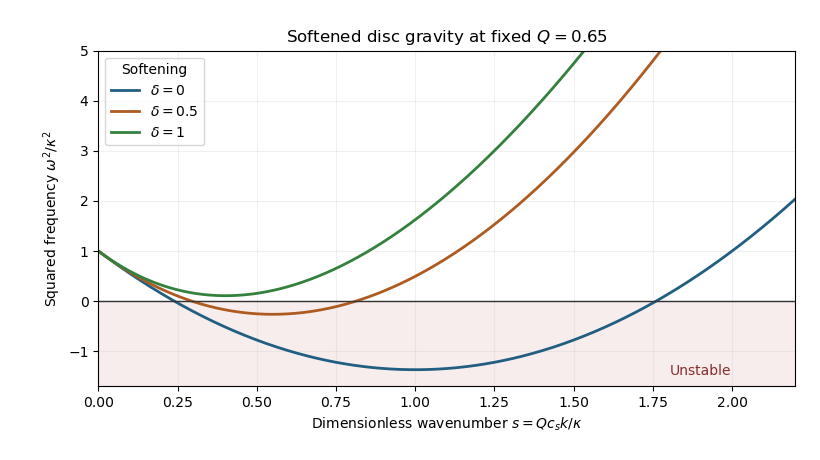

The plot holds fixed and changes gravitational softening. If is varied physically at fixed , remember : the marginal curve must be evaluated at its corresponding , rather than treating these two dimensionless parameters as independently fixed along that physical variation.
The conventional complete-flyby impulse approximation uses a straight incoming path , , with . Integrate the satellite's transverse acceleration over the whole encounter. For ,The hint's integral is one over a half encounter, and two over the full encounter. The leading longitudinal impulse vanishes by oddness. In weak elastic scattering, conservation of the relative speed gives the next-order change along the original velocity as . With the original outer flow along negative , this meansThe same signed expression holds for inner particles and has the opposite sign there. This is the complete-flyby gravitational impulse. Its weak-deflection requirement is . Rotation and tidal dynamics retained throughout the encounter give a more detailed response; this impulse model does not claim to solve the full Hill scattering problem exactly.
The printed coefficient is four times smaller than this complete-flyby value. It is obtained if the single-sided transverse impulse is inserted into the same quadratic longitudinal estimate, leaving out the other half. Thus the scaling and sign agree, but that numerical coefficient is not derived by the usual full-encounter prescription. To keep the subsequent requested formulas unambiguous, write the satellite impulse normalizationThe following parts are derived for general and specialize to the supplied value. The complete-flyby one-sided torque coefficient is also the normalization used in the primary coplanar impulse calculation summarized by Chametla and collaborators.
A strip at passes the satellite at relative speed , so its encounter mass flux is . Each unit mass gains specific angular momentum . Therefore the one-sided impulse torque on a disk isPutting gives exactly the requested expression. Inner strips have the opposite signed impulse but the same positive encounter flux. The net disc torque is consequentlyAn even surface density makes the integrand vanish pointwise, so the total torque is zero although each one-sided torque can be nonzero. The cutoff must keep the encounters in the weak-deflection regime; an appropriate physical value is at least of order the thickness or the relevant strong-scattering radius. The infinite-sheet integral also assumes convergence or a specified outer truncation.
The odd mass density difference is . Integrating from to infinity givesFor Keplerian shear, and . Thus the density-slope satellite torque isUsing the complete-flyby normalization multiplies this supplied-model result by four. The linear mass density law is a local Taylor approximation, not a nonnegative mass density on the entire infinite real line. With an outer local cutoff , the same calculation replaces by ; the extension to infinity is the leading local result. Small keeps the mass density perturbation small in the dominant encounter region.
Outer particles gain angular momentum and inner particles lose it. The satellite transmits angular momentum from inner to outer material. If , the denser outer side receives the larger torque: the disc gains net angular momentum and the satellite loses it. If , the net transfer reverses. At zero slope these exchanges cancel in the satellite's total torque.
For a fixed satellite mass on an adiabatically changing circular orbit, . The satellite torque is minus the disc torque. HenceThe circular-orbit migration rate from disk torque, in the normalization supplied by the question, isIt is inward for a positive mass density slope and outward for a negative one. The complete-flyby normalization makes its magnitude four times larger, with the same direction. This is a local torque estimate; the hypothesis of a nearly circular slowly migrating orbit is needed when using the derivative of the circular angular momentum.
Articles by others on the same topic
There are currently no matching articles.