Let and define the cosmological density power spectrum by . The contribution per logarithmic wave-number interval is the dimensionless cosmological power spectrum . The linear cosmological mass variance on mass scale iswith a comoving smoothing radius and the top-hat filter in Fourier space. On halo scales the observed spectrum is consistent with greater variance at smaller masses. Growth therefore brings smaller objects to the collapse threshold earlier, statistically; larger structures assemble by accretion and dark-matter halo mergers. This statistical growth from smaller bound systems to larger ones is hierarchical galaxy formation. It is an ordering of dark-matter assembly, not a rule that every small visible galaxy must precede every large visible galaxy.
For linear modes the linear growth factor gives . During matter domination , so and the characteristic nonlinear mass increases. Once modes become nonlinear, coupling between scales and halo formation change the shape, so the same multiplication cannot be used for the entire late-time spectrum. At low redshift accelerated expansion suppresses linear growth. Galaxy clustering traces the matter spectrum with galaxy bias; it should not be equated directly with an unbiased matter measurement.
The broad linear shape was set by the cosmological transfer function before and around matter-radiation equality, with baryonic acoustic structure also imprinted before recombination. A nearly scale-invariant primordial curvature spectrum has , with close to one. After converting curvature perturbations to matter-density perturbations,Thus nearly scale-invariant primordial curvature does not mean a constant density . Modes with enter the horizon after equality and have . Modes with enter during radiation domination, when radiation controls the expansion and cold-matter perturbations grow only slowly. The cold-dark-matter transfer function behaves approximately as at large . Hence the density spectrum turns over near :The turnover records the equality horizon, while the late nonlinear excess records gravitational clustering. On galactic scales the effective slope is greater than , giving the growing small-scale variance needed for hierarchical galaxy formation.
Cold dark matter has negligible primordial thermal velocities and a very short collisionless free streaming length on galactic scales. Warm dark matter has appreciable residual velocities while structure is being seeded; particles stream across small fluctuations and reduce their contrast. Its cosmological transfer function is consequently cut off below a characteristic length, suppressing low-mass halos and delaying their formation. Above that cutoff its assembly can still be hierarchical. The important distinction is the free-streaming scale, rather than the present temperature or an arbitrary particle-mass label.
Linear evolution assumes . When becomes of order unity, overdense regions depart strongly from the Hubble flow and can turn around and collapse. Collisionless dark matter develops multistream motion after trajectories cross; gravitational mixing redistributes energy and produces a bound dark matter halo. The formal infinite-density collapse of an ideal spherical pressureless solution is not the physical endpoint. A roughly virialized halo has and a characteristic virial velocity . Its gas virial temperature is conventionallyIt measures the thermal energy associated with the gravitational potential; the numerical factor depends on the velocity-dispersion convention. It does not imply that the collisionless dark matter has a thermodynamic gas temperature.
The unheaded request about baryon conversion efficiency of a halo is also answered here. Define using the cosmic baryon fraction . In small halos, shallow potentials let stellar feedback drive outflows or repeatedly heat star-forming gas; supernova energy per stellar mass is roughly fixed while binding energy per gas mass scales as . Photoheating during reionization also prevents very small halos from retaining or accreting cool gas. Molecular/atomic cooling thresholds further reduce star formation in the smallest systems. These effects make fall toward low mass.
Near , gas can cool efficiently and the potential is deep enough to retain more of it, while a long-lived hot atmosphere and maintenance heating are less effective than in larger systems. At high mass, higher virial temperature and lower cooling efficiency let a substantial hot atmosphere persist. Active-galactic-nucleus feedback can prevent that atmosphere from supplying cold gas and can expel some gas; the cooling-time bottleneck alone is not an adequate explanation for the low stellar fractions of massive groups and clusters. The peak reflects a competition between gas supply/cooling and feedback, rather than complete conversion of all baryons at a sharply universal mass. Its exact location and height depend on epoch, metallicity, gas history and the stellar population included.
If gas cannot radiate enough energy to fall below the virial temperature, infall converts gravitational energy into heat through shocks and compression. Thermal pressure can support an extended atmosphere in the dark matter halo. It need not have the same density profile as the collisionless dark matter, because its entropy and pressure matter.
A useful quantitative comparison is the radiative gas cooling time against the halo dynamical time . If cooling remains slow or a heating source balances it, the gas stays predominantly hot and diffuse, rather than forming a compact, cold, self-gravitating stellar system. Without sufficient cooling, most baryons remain pressure-supported halo gas. Very slow cooling can still feed gradual central condensation; the condition is about energy loss relative to the evolution time, not an absolute prohibition on any inward motion.
If the gas can cool appreciably below the virial temperature, radiative cooling removes thermal energy and pressure support. In a dark matter halo the gas then contracts, dissipating more energy as it falls. Efficient condensation requires the radiative gas cooling time to be short enough compared with the relevant dynamical or assembly time; merely having an available low-temperature transition does not guarantee that the gas reaches it quickly.
The collisionless dark matter cannot lose comparable energy through radiation and remains extended. Gas with appreciable conserved angular momentum stops radial collapse when rotation supports it, often forming a disk; lower-angular-momentum gas reaches a more compact central region. Cold dense gas can fragment into self-gravitating clouds and form stars if its gravitational instability overcomes remaining support. Stellar feedback subsequently reheats or expels gas and regulates the conversion. Efficient cooling enables central baryonic condensation and star formation; angular momentum and feedback determine the resulting galaxy.
Below about , neutral hydrogen electronic excitation becomes inefficient because the lowest relevant excitation energies greatly exceed the typical particle thermal energy. Primordial gas therefore needs molecular hydrogen cooling through rotational and vibrational transitions; HD can cool still colder gas where it is sufficiently abundant. Without molecules or metals, cooling can stall near the atomic threshold.
In enriched gas, metal-line cooling from low-energy fine-structure transitions, notably singly ionized carbon and neutral oxygen, remains effective below that threshold. At higher densities, molecular rotational lines such as CO and energy transfer from gas to dust followed by dust infrared emission are important. Cold-gas cooling is primarily molecular, fine-structure, or dust-mediated, according to composition and density. Molecule formation, dissociating radiation and the cosmic microwave background temperature floor constrain how far cooling proceeds.
In the intermediate-temperature interval, atomic line cooling is generally efficient. Collisional excitation of hydrogen and helium followed by photon emission removes thermal energy; collisional ionization and subsequent recombination also contribute. As the gas becomes more ionized, different transitions enter and leave the cooling budget.
For enriched gas, metal-line cooling is often dominant over substantial parts of this interval, because heavy ions provide many ultraviolet and optical transitions. The cooling curve consequently has pronounced peaks rather than one smooth universal power law. Hydrogen/helium atomic processes and metal lines provide the main cooling channels here. Their relative strengths depend on metallicity, ionization state, density and the incident radiation field; these temperature bands describe typical gas, not composition-independent boundaries.
In sufficiently hot ionized gas, electrons radiate when accelerated in ion Coulomb fields: thermal bremsstrahlung is the main continuum cooling process. In the optically thin nonrelativistic limit its emission rate scales approximately asFor hot metal-poor gas this is the principal high-temperature channel. Metal ions still give important metal-line cooling near , and in enriched gas can remain important up to several million kelvin; one should not infer that crossing instantly eliminates all lines. At sufficiently high temperatures most ions are stripped and free-free emission dominates. Inverse Compton cooling can also matter for ionized, diffuse gas in a strong radiation field, especially the high-redshift cosmic microwave background. The high-temperature asymptote is bremsstrahlung cooling, with metal-line and Compton qualifications where appropriate.
For a pressureless spherical mass shell with fixed enclosed mass and no shell crossing, the shell theorem gives . A cosmological constant is absent in the Einstein-de Sitter universe. Parametric differentiation givesSince , the equation of motion holds providedThe expanding branch runs from to the turnaround of spherical collapse ; the recollapsing branch runs from to . HenceThe common bang-time origin selects the growing overdensity, without an extra arbitrary shift in the time parameter.
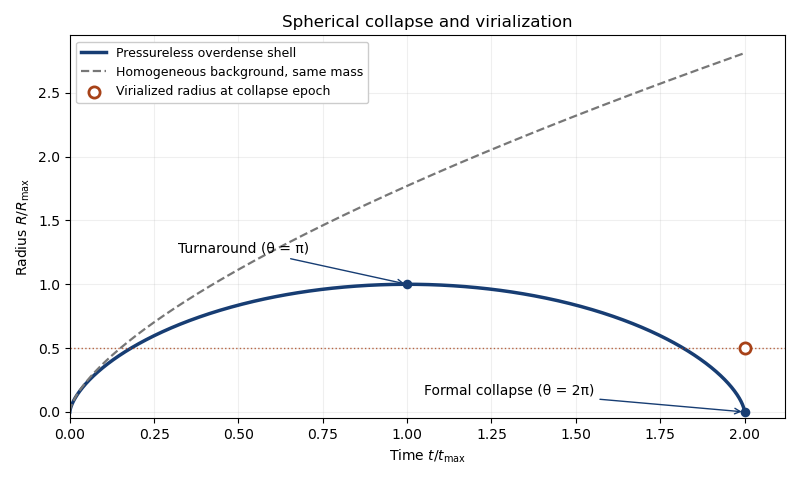

In the Einstein-de Sitter universe, and . An unperturbed homogeneous sphere containing the same mass thus has . Comparing its volume with the perturbed sphere givesAt maximum expansion,For the non-dissipative, homologous spherical-collapse model, the potential energy of a uniform sphere is . At turnaround the bulk kinetic energy is zero, so . At virial equilibrium, gives . Conservation of energy implies , and therefore . This comparison assumes the same potential-energy structure coefficient; it is the usual top-hat model rather than an exact claim about every halo profile.
Halving the radius multiplies the density by eight. During the interval to , the background density falls by four. ThusThe formal pressureless trajectory reaches zero radius; the physical virialized object instead has a finite radius. Its density is evaluated at the same collapse epoch, not at the instantaneous singular solution's density.
For a physical estimated virial radius and enclosed mass, . Equating this to gives a halo density estimate of formation redshift:In the pure Einstein-de Sitter universe, equals the present critical density. The inference assumes the measured density retains the collapse-epoch normalization. Later accretion, mergers and a changing virial-radius convention can change it, so it is a model-dependent formation estimate rather than a unique historical date.
For fully ionized hydrogen, the outward radiation force on a coupled proton-electron pair at radius is , while its inward gravitational force is approximately . Equating them yields the Eddington luminosity,This uses isotropic radiation, Thomson scattering and efficient momentum coupling between electrons and ions. Composition or other opacity sources alter the corresponding limit.
With radiative efficiency , a rest-mass supply rate gives . In the approximation that supplied mass is added to the hole, continuous accretion at the Eddington luminosity givesHere is the elapsed time since seed formation. If the radiated rest mass is counted exactly, and the Salpeter time becomes . The displayed approximation in the question neglects this correction; retaining it lengthens the growth time.
The required growth factor is , corresponding to e-folds. With the supplied efficiency,At , the expansion is overwhelmingly matter-dominated. Using total and givesThe baryon density is part of the total matter density, so it is not added to in this age calculation. Dark-energy and radiation corrections are small for this estimate. Even starting at the earliest possible time, the approximate growth time exceeds the age, and a real stellar seed forms later. A seed cannot reach the stated mass through uninterrupted Eddington-limited growth with the stated efficiency. Exactly retaining the radiated mass gives about and strengthens this conclusion. A heavier seed, lower radiative efficiency or super-Eddington episodes can relieve the time constraint; interruptions make it harder.
Use the supplied cosmological cosmic baryon fraction , and assume the halo initially has that fraction. Its total baryon mass is then . The selected baryons are the lowest-angular-momentum fractionHere the given cumulative specific angular momentum distribution must be normalized separately for the baryon component: equal baryon and dark-matter distributions mean equal normalized fractions, not equal absolute masses.
The virial velocity and the largest specific angular momentum in the selected inner baryon population areEstimate the outer radius of the settled low-angular-momentum component using circular rotational support and an enclosed-mass approximation to its self-gravity. With negligible dark matter inside the component, and , soThe given rounded gravitational constant produces the same estimate. The very small radius follows from selecting a small low- fraction, rather than assigning all central baryons the halo-edge angular momentum.
These estimates assume that gas radiates energy, preserves each parcel's specific angular momentum, and settles with negligible pressure support and no strong redistribution or cancellation of its angular-momentum vectors. They also assume that the phrase “innermost baryons” selects the lowest- material, the original cosmic baryon supply is retained, and the central gas supplies the dominant gravity. A possible central black hole or an exact flattened disk potential changes the numerical coefficient; the stated baryonic mass is used for this estimate.
The low-angular-momentum baryonic disk estimate uses a cumulative distribution uniform in from zero to , so its mean is . The quoted is the outer radius based on the cutoff angular momentum, not a one-zone radius based on the mean. Within the same enclosed-mass approximation, and circular balance give : the rotation curve is approximately flat and the half-mass radius is . Treating every baryon as one shell with the mean would instead give and twice the velocity, a different radius convention rather than the outer edge of the supplied distribution.
Let . The present-extrapolated spherical-collapse barrier is , where is the linear contrast extrapolated to spherical collapse in a matter-dominated universe. It is not the nonlinear interior overdensity . The cosmological mass variance is the variance of the present-extrapolated linear density contrast smoothed over a mass . It is not the variance of already virialized halo densities.
For a fixed-shape smoothing filter and , rescale the variance integral with :Thus , with and a normalization carrying the appropriate mass units. For a real-space top-hat filter, convergence requires ; a spectrum outside this interval needs physical cutoffs and does not have this unrestricted scale-free result.
If counts halos per comoving volume, the Press-Schechter halo mass function follows by differentiating the cumulative mass fraction and converting mass fraction to number:The minus sign is needed because the cumulative fraction decreases with . To match the printed exponential coefficient exactly, define byThis peak-height calibration from an exponential mass-function cutoff differs from the also-common convention . Here , and consequentlyEquivalently . The scale-free halo cutoff normalization therefore evolves with ; the displayed is not a redshift-independent universal constant. For physical number density, replace by instead. Since , it grows as ; in matter domination it is proportional to . At the collapse epoch itself, .
The prescribed photon budget requires a collapsed mass fraction , assuming baryons trace the collapsed mass fraction and using the supplied effective photon yield. No extra photon-escape or recombination correction should be counted on top of this stipulated budget.
For spectral slope , . The mass-scale measurement givesBoth relevant epochs are matter-dominated, so the linear growth factor ratio is , independent of any present-day normalization convention. Thus . The Press-Schechter formalism givesUsing the supplied inverse value,This is the photon-budget reionization threshold in the specified toy model, not a measurement of the full astrophysical reionization history.
To estimate the characteristic mass, use the non-dissipative spherical-collapse model result . At this high redshift the background matter density is practically the critical density. Circular virial velocity then obeysConsequentlyFor , this gives and , with physical virial radius about .
At the threshold mass the halo peak height is , soThe present mean matter density is . Hence the differential abundance per logarithmic mass interval is about andRounded inputs and the supplied approximate factor justify quoting about . The corresponding physical separation is about at this epoch. The requested halo spacing from a differential mass function uses a logarithmic mass bin of order unity; it is not obtained by identifying with that differential abundance. A cumulative number density above the threshold requires a separate mass integral.
Articles by others on the same topic
There are currently no matching articles.