Let increase outward and define the inward optical depth by . With constant outward internal radiative flux , radiative diffusion givesThe constant is a boundary condition; diffusion alone does not determine it. For an unirradiated grey atmosphere with the Eddington closure approximation and Eddington surface boundary condition, , soThe internal effective temperature of a planet is defined by its intrinsic cooling flux, not by its incident stellar heating. Since and , temperature decreases outward. Towards the thin upper layers, ; if the density and optical-depth gradient vanish there, . This is the upper nearly isothermal atmosphere. The diffusion approximation itself fails at small optical depth: the grey boundary closure supplies the approximate continuation. Small irradiation perturbs this intrinsic-flux solution.
Young, self-luminous gas giants at wide orbital separations can have intrinsic cooling dominate their photospheric budget. They are favorable for exoplanet direct imaging, especially in the infrared, where their own thermal radiation is easier to separate from the host light. A strongly irradiated hot Jupiter instead has a large stable outer radiative region set mainly by stellar heating; it can be nearly isothermal over a broad pressure range or develop an atmospheric thermal inversion if stellar light is absorbed sufficiently high. Inversion is not inevitable for every strongly irradiated planet. Deep convection begins below its radiative-convective boundary.
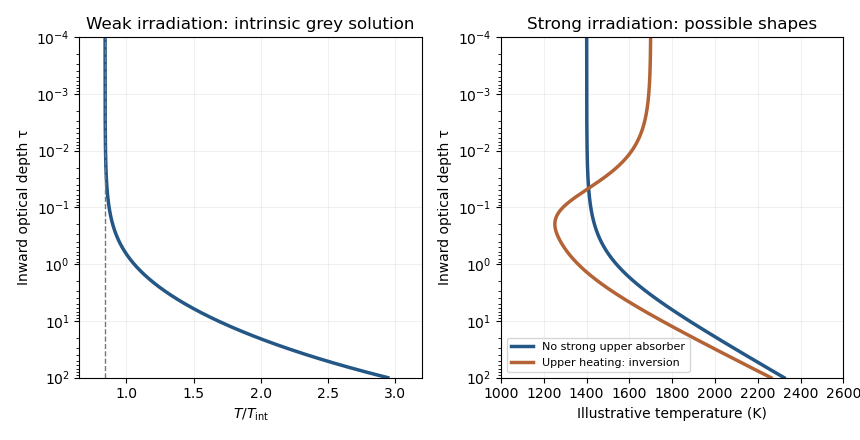
Intrinsic grey-atmosphere cooling profile compared with illustrative irradiated hot-Jupiter profiles
. Details. 
The intrinsic curve follows the grey formula. The irradiated curves illustrate possible shapes only; they are not solutions for a specified opacity model. Smaller optical depth corresponds to greater altitude.
Use a dry ideal gas of fixed composition with specific gas constant and constant specific heat capacity at constant pressure . For a fixed-mass parcel, constant and implyAlong a hydrostatic adiabat, ; hence the dry adiabatic lapse rate isFor an actual pressure-balanced parcel rising in an ambient atmosphere, instead gives . The usual lapse-rate expression is exact for a hydrostatic adiabatic column and is the local first-order result at the launch point where , as needed in a linear stability test. Treating an already much hotter parcel as an exact copy of the ambient hydrostatic column would be an extra approximation.
After a small upward displacement from temperature equilibrium, its temperature excess isAt equal pressure, warmer gas is less dense and continues to rise. Thus the Schwarzschild criterion in altitude form isThe supplied non-strict inequality includes the marginal case; strict growth requires the strict inequality. A downward displacement gives the same stability conclusion. Efficient convection normally adjusts an initially superadiabatic gradient to a nearly adiabatic one.
Deep envelopes of gas giants and ice giants commonly transport intrinsic heat by convection, as do the planetary tropospheres of many weakly irradiated atmospheres. Earth's dry troposphere provides another approximate example, with moisture changing the lapse rate. Strongly irradiated hot Jupiters can still have deep convective interiors, while their upper radiative regions need not be convective. Composition gradients can modify the homogeneous-gas criterion and inhibit overturning even in an interior.
In local thermodynamic equilibrium, thermal intensity samples the Planck function near an optical depth of order unity. The Eddington-Barbier relation makes this explicit: . A molecular band has greater opacity than its adjacent continuum and therefore samples a higher layer. A band in emission relative to the continuum implies that this higher layer is hotter: the line-forming region has an atmospheric thermal inversion under the assumed LTE, thermal interpretation.
The continuum is thermal radiation from an optically thick, deeper photosphere, with comparatively smooth opacity. In an H/He hot Jupiter, collision-induced absorption by H2-H2 and H2-He collisions supplies an important continuum; weak overlapping molecular lines and opaque exoplanet clouds can contribute too. It is not a separate blackbody emitter floating above the gas. A strongly isothermal layer would erase LTE molecular contrast rather than generate emission peaks.
In the emitting inversion, , whereas the dry adiabatic lapse rate has . Thereforewhich lies on the stable side of the Schwarzschild criterion. An upward-displaced parcel cools and becomes denser than the ambient hot upper gas. The region can thus carry and redistribute thermal energy by radiative transfer, not by unstable thermal convection. Winds may transport energy horizontally; stability rules out the specified buoyant vertical convection, not every possible motion.
An atmospheric thermal inversion is an altitude interval with . Absorption of incoming stellar radiation above the usual thermal-emitting layers can heat the upper gas faster than it cools, producing an inversion. In a semi-grey irradiated atmosphere, a large shortwave-to-infrared opacity ratio favors such high-altitude energy deposition; local infrared emitters and the intrinsic flux also matter.
In the Solar system, Earth and all four giant planets have well-known stratospheric inversions. The ozone layer absorbs ultraviolet sunlight on Earth; methane and photochemical hydrocarbons absorb solar radiation in the giant planets, with aerosols contributing. The giant planets are Jupiter, Saturn, Uranus and Neptune. This refers to their stratospheric temperature rise, not to the gradient at every atmospheric level.
For hot Jupiters, influential factors include the stellar flux and spectrum; the abundances of high-altitude absorbers such as titanium monoxide and vanadium monoxide; atmospheric metallicity of a giant planet and atmospheric carbon-to-oxygen ratio; thermal dissociation, atmospheric photochemistry and condensation; a atmospheric cold trap or atmospheric condensate rainout that removes absorbers; replenishment by vertical mixing; exoplanet clouds and atmospheric hazes; and heat redistribution by circulation. The ratio of visible heating to infrared cooling, rather than a single chemical species in isolation, determines whether an inversion persists.
Articles by others on the same topic
There are currently no matching articles.