In the linear complex Ginzburg-Landau equation, take real. gives advection, carrying the envelope downstream at speed . gives wave dispersion: the imaginary part of the second-derivative coefficient changes wave phase without directly dissipating a real-wavenumber Fourier mode. gives local linear production or damping: a spatially uniform perturbation grows for and decays for .
The real part of the diffusion coefficient is the scaled value one. It smooths the envelope and damps a real-wavenumber Fourier mode at rate . Thus the linear complex Ginzburg-Landau equation models competing advection, smoothing through a diffusion equation, wave dispersion and local growth, rather than nonlinear saturation.
For a normal mode, , , and . Substitution into the linear complex Ginzburg-Landau equation givesTherefore the dispersion relation isFor real , its temporal growth rate is , with unique maximum at . Its real angular frequency is , displaying the separate advection and wave dispersion terms.
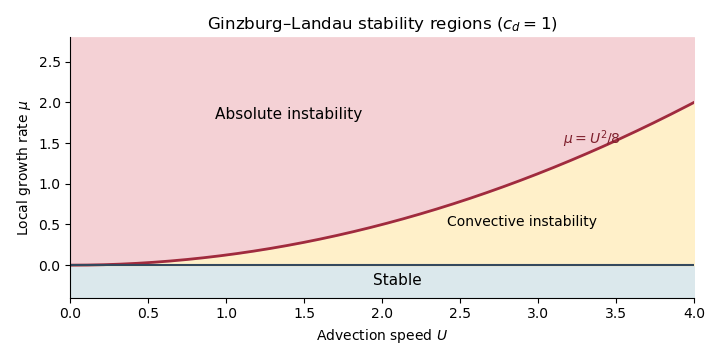
The dispersion relation gives the zero-group velocity saddleThus the absolute growth rate is . More generally the saddle growth rate along a ray isso a frame travelling at sees the maximal rate .
For , the three open regions areThe line is the temporal marginal boundary; the parabola is the convective-to-absolute boundary. The Green function of the linear complex Ginzburg-Landau equation has the prefactor , so zero exponential rate on the latter boundary still allows algebraic decay of the impulse response. This is the stability diagram of the linear complex Ginzburg-Landau equation.

Articles by others on the same topic
There are currently no matching articles.