Under the convention , a mode's amplitude grows as . The linear stability analysis of real-wavenumber disturbances is therefore summarized byAt there is marginal or neutral hydrodynamic stability: no normal mode grows exponentially, but some may fail to decay. If “linearly stable” includes neutral modes, its condition is . These modal statements do not rule out transient growth from non-normal modes or algebraic growth.
The fixed observer is the ray . The physically selected zero-group velocity saddle defines the absolute wavenumber and absolute frequency :For a smooth frequency branch with , the saddle condition is equivalently . The absolute growth rate isHere and can be complex. A physical saddle point is selected by the localized impulse response and deformation of its Fourier transform contour; an arbitrary algebraic stationary point need not determine absolute hydrodynamic instability.
For a temporally unstable base flow, the relevant saddle growth rate along a ray distinguishes two cases in the chosen observation frame:A convective hydrodynamic instability amplifies a travelling wave packet but lets a localized disturbance decay at any fixed point. An absolute hydrodynamic instability grows at a fixed point. The separating case is marginal in exponential rate and can have an algebraic prefactor. In a frame moving with , replace by : this distinction depends on the observation frame.
In the linear complex Ginzburg-Landau equation, take real. gives advection, carrying the envelope downstream at speed . gives wave dispersion: the imaginary part of the second-derivative coefficient changes wave phase without directly dissipating a real-wavenumber Fourier mode. gives local linear production or damping: a spatially uniform perturbation grows for and decays for .
The real part of the diffusion coefficient is the scaled value one. It smooths the envelope and damps a real-wavenumber Fourier mode at rate . Thus the linear complex Ginzburg-Landau equation models competing advection, smoothing through a diffusion equation, wave dispersion and local growth, rather than nonlinear saturation.
For a normal mode, , , and . Substitution into the linear complex Ginzburg-Landau equation givesTherefore the dispersion relation isFor real , its temporal growth rate is , with unique maximum at . Its real angular frequency is , displaying the separate advection and wave dispersion terms.
The dispersion relation gives the zero-group velocity saddleThus the absolute growth rate is . More generally the saddle growth rate along a ray isso a frame travelling at sees the maximal rate .
For , the three open regions areThe line is the temporal marginal boundary; the parabola is the convective-to-absolute boundary. The Green function of the linear complex Ginzburg-Landau equation has the prefactor , so zero exponential rate on the latter boundary still allows algebraic decay of the impulse response. This is the stability diagram of the linear complex Ginzburg-Landau equation.
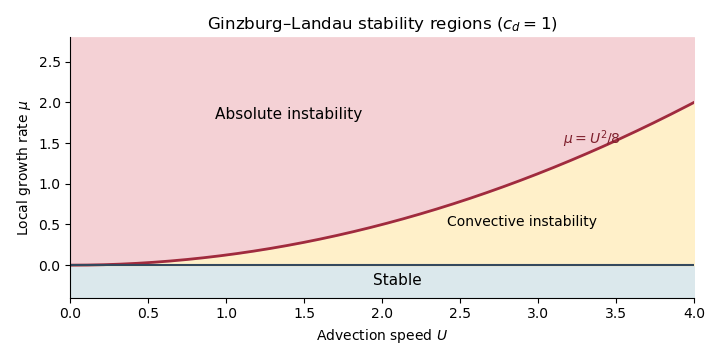
Temporal, convective and absolute stability regions for the linear complex Ginzburg-Landau equation with c_d=1
. Details. 
Impermeability requires . Let with real , and set . If is nonreal, or real outside the channel, the Rayleigh equation for inviscid shear flow gives everywhere. The two wall conditions then force . In fact there is no nonzero globally smooth eigenfunction for any : the complete family is the inviscid Couette continuous spectrum.
For each , permit a localized vorticity sheet. Let be the Dirichlet Green function satisfying . An explicit generalized eigenfunction iswhere and . It vanishes at both walls, is continuous at , and has derivative jump . Consequentlyusing the Dirac delta multiplication identity. These are vorticity-sheet eigenfunctions of inviscid Couette flow, understood as generalized eigenfunctions, not as a discrete smooth Sturm-Liouville eigenfunction expansion.
To see completeness, define the vorticity variable . Its evolution is , so for any admissible initial vorticity ,The homogeneous Dirichlet problem for has only the zero solution, so this inversion reconstructs every initial vertical-velocity field in its usual function space. The generalized frequencies fill the interval with endpoints ; the endpoint values are understood as the closure of the continuous spectrum.
Every generalized frequency in the inviscid Couette continuous spectrum is real: for real . Thus every time factor has unit modulus and there is no exponentially growing normal mode:The vorticity equation also gives , preserving its norm. For fixed nonzero , the bounded Dirichlet Green function inversion therefore gives a uniform bound on the reconstructed velocity in terms of the initial vorticity norm. Superpositions can still rearrange their velocity energy and display transient growth from non-normal modes; neutral hydrodynamic stability does not require every velocity component to decrease monotonically. Treating only smooth discrete modes would miss this continuous neutral family.
Articles by others on the same topic
There are currently no matching articles.