A family of compact H-hulls is non-decreasing whenThis permits equal hulls at different times. A Loewner chain with strictly increasing half-plane capacity has strict inclusion for . Usually its initial compact H-hull is .
Write and let be the relatively closed hull obtained by mapping the increment through . For a bounded compact H-hull , defineThe Loewner local growth property isOne can equivalently use diameter: for a nonempty compact H-hull, , using a point of its closure on for the second inequality. The condition concerns the mapped increment, not the original difference , which can be large when a narrow opening closes. It makes growth occur near one continuous Loewner driving function rather than by a sudden addition at separated boundary points.
With the normalization used in the Chordal Loewner equation, half-plane-capacity parameterization meansThus is empty and the half-plane-capacity composition rule gives . The factor two produces . A convention using half-plane capacity instead changes that coefficient to one and rescales time; the convention must be kept consistent.
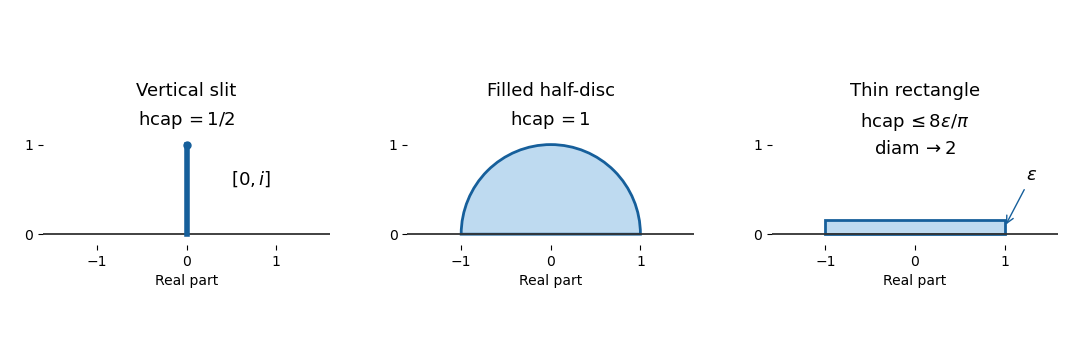
The implication is false. Take the thin rectanglesEach is a compact H-hull, and . We verify that its half-plane capacity nevertheless tends to zero.
Let , which contains all these rectangles. At the Brownian exit time from , the exit height is at most , and a positive exit height requires hitting before . ThereforeFor , conformal invariance of planar Brownian motion and identify the probability on the right with the harmonic measure of from in . Integrating the Poisson kernel for the upper half-plane givesThe Brownian representation of half-plane capacity now proves the explicit estimateChoose to obtain the required sequence. This is an instance of half-plane capacity of a low rectangle: shrinking height can make half-plane capacity small while horizontal extent stays fixed.

For real smooth functions of compact support in a planar domain , use the Dirichlet inner productChanging the positive normalization factor does not change orthogonality. For complex functions, insert complex conjugation in the second factor to obtain the corresponding Hermitian form.
Let be a conformal bijection, and let be smooth functions of compact support on . Its real Jacobian matrix is , where is a rotation. By the chain rule,The change of variables formula has Jacobian determinant , so this factor cancels:This proves conformal invariance of the planar Dirichlet inner product. By completion it is also an isometry between the corresponding Dirichlet energy spaces. It asserts invariance of the energy form, not of the inhomogeneous Sobolev norm, whose term has a different transformation rule.
Using the usual zero-boundary Sobolev space convention,where weak derivatives define and is the space of test functions. In the Gaussian free field convention, the same notation often denotes the Dirichlet energy space, the completion in the gradient norm alone. On bounded domains the Poincaré inequality makes the two definitions equivalent; on unbounded domains one must distinguish them. The following gradient-pairing argument applies in either setting whenever the energy completion is realized as weak functions.
Identify with a vector subspace of by zero extension of H01. Approximating by test functions in shows that this is an isometric embedding in the inhomogeneous Sobolev norm and also in the Dirichlet inner product norm. In particular, arbitrary irregularity of causes no additional boundary term.
DefineThese are weakly harmonic Sobolev functions. For , integration by parts in the weak sense gives . If , choose converging to in , or in energy for the homogeneous convention. The Cauchy-Schwarz inequality givesHence the orthogonality of supported and harmonic Dirichlet functions isBoth are linear vector subspaces. In the inhomogeneous convention they are closed: the first is the isometric image of a complete space, and the second is the intersection of the kernels of the linear functionals . No spanning assertion is needed. The PDF contains this orthogonality statement; the TeX has badly corrupted it into an assertion about openness.
Articles by others on the same topic
There are currently no matching articles.