Write . A compact H-hull is a bounded, relatively closed set for which is a simply connected domain. “Compact” refers to its compact closure in ; boundary points on can be adjoined without changing the remaining domain.
The Riemann mapping theorem and normalization at infinity give a unique mapping-out function of a compact H-hull with hydrodynamic normalization at infinity. By the Schwarz reflection principle outside a large disc, it has the Laurent seriesThe half-plane capacity is the coefficientThe empty compact H-hull has and half-plane capacity zero. Nonnegativity follows from the Brownian representation of half-plane capacity proved next.
Put on . This is a harmonic function, tends to zero at infinity, and is bounded. To justify the boundary behavior without requiring a locally connected space as its boundary, let . Its expansion at infinity implies that bounded cannot have . If approaches a finite point of and had a subsequential limit inside , continuity of would force that point to lie inside , a contradiction. Thus boundary degeneration under a mapping-out function gives . Consequently extends continuously to the finite boundary with value .
Let be planar Brownian motion started at , and its Brownian exit time from . This time is finite almost surely: it is at most the first time the imaginary coordinate, a one-dimensional Brownian motion, hits zero. By the Itô formula, is a bounded martingale. The optional stopping theorem and dominated convergence theorem therefore giveBoundedness is important here: directly stopping the unbounded imaginary-coordinate martingale would require an unjustified uniform integrability assertion.
At , the Laurent series gives . HenceThe sign follows because the exit point lies on . This proves the Brownian representation of half-plane capacity.
For , the conformal mapmaps onto and has hydrodynamic normalization at infinity. Its Laurent series is . Uniqueness of the mapping-out function of a compact H-hull therefore givesThis is the translation part of scaling and translation of half-plane capacity.
For , the conformal map maps onto and has Laurent series . The uniqueness in hydrodynamic normalization at infinity givesAt the scaled closure is contained in , so the interior compact H-hull is empty and both sides are zero. This is the scaling part of scaling and translation of half-plane capacity.
Suppose . Map out and let be the relatively closed image hull corresponding to , with bounded complementary components filled if needed. Then maps onto . Uniqueness of the mapping-out function of a compact H-hull gives . Comparing their Laurent series yields the half-plane-capacity composition ruleThe Brownian representation of half-plane capacity makes the last term nonnegative, proving monotonicity of half-plane capacity:
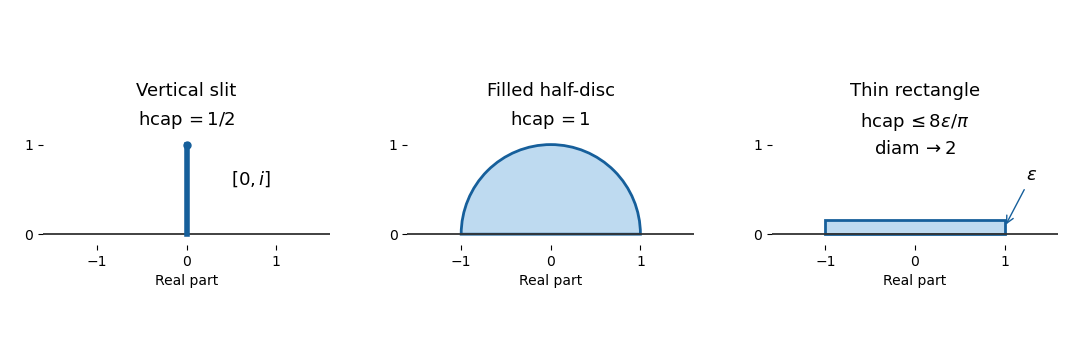
For the vertical slit, choose the branch of asymptotic to at infinity. It is the mapping-out function of a compact H-hull for , andThus half-plane capacity of a vertical slit givesThe endpoint is merely part of the boundary closure convention.
For the filled upper half-disc , the conformal map maps the exterior half-disc onto . Indeed, it sends the semicircle to , the remaining real boundary to the complementary intervals, and its inverse is the branch of asymptotic to . Hence half-plane capacity of a half-disc givesIf denotes the open unit disc, the printed is not relatively closed and is literally not a compact H-hull. The intended value is the one for its filled relative closure . With a closed-disc convention the displayed notation already represents that hull.
For a nonempty compact H-hull , its closure meets : otherwise a nonempty compact set strictly inside would be separated from the lower half-plane in the complement, contradicting the simply connected domain condition for . Choose and put . Taking limits in the definition of diameter shows for every . Thus lies in the filled half-disc of radius centered at . Its half-plane capacity is by scaling and translation of half-plane capacity. Using monotonicity of half-plane capacity,For the empty compact H-hull, use diameter zero. This proves the unit-constant version of half-plane capacity is bounded by squared diameter; no claim of optimality of the constant is needed.
A family of compact H-hulls is non-decreasing whenThis permits equal hulls at different times. A Loewner chain with strictly increasing half-plane capacity has strict inclusion for . Usually its initial compact H-hull is .
Write and let be the relatively closed hull obtained by mapping the increment through . For a bounded compact H-hull , defineThe Loewner local growth property isOne can equivalently use diameter: for a nonempty compact H-hull, , using a point of its closure on for the second inequality. The condition concerns the mapped increment, not the original difference , which can be large when a narrow opening closes. It makes growth occur near one continuous Loewner driving function rather than by a sudden addition at separated boundary points.
With the normalization used in the Chordal Loewner equation, half-plane-capacity parameterization meansThus is empty and the half-plane-capacity composition rule gives . The factor two produces . A convention using half-plane capacity instead changes that coefficient to one and rescales time; the convention must be kept consistent.
The implication is false. Take the thin rectanglesEach is a compact H-hull, and . We verify that its half-plane capacity nevertheless tends to zero.
Let , which contains all these rectangles. At the Brownian exit time from , the exit height is at most , and a positive exit height requires hitting before . ThereforeFor , conformal invariance of planar Brownian motion and identify the probability on the right with the harmonic measure of from in . Integrating the Poisson kernel for the upper half-plane givesThe Brownian representation of half-plane capacity now proves the explicit estimateChoose to obtain the required sequence. This is an instance of half-plane capacity of a low rectangle: shrinking height can make half-plane capacity small while horizontal extent stays fixed.

For real smooth functions of compact support in a planar domain , use the Dirichlet inner productChanging the positive normalization factor does not change orthogonality. For complex functions, insert complex conjugation in the second factor to obtain the corresponding Hermitian form.
Let be a conformal bijection, and let be smooth functions of compact support on . Its real Jacobian matrix is , where is a rotation. By the chain rule,The change of variables formula has Jacobian determinant , so this factor cancels:This proves conformal invariance of the planar Dirichlet inner product. By completion it is also an isometry between the corresponding Dirichlet energy spaces. It asserts invariance of the energy form, not of the inhomogeneous Sobolev norm, whose term has a different transformation rule.
Using the usual zero-boundary Sobolev space convention,where weak derivatives define and is the space of test functions. In the Gaussian free field convention, the same notation often denotes the Dirichlet energy space, the completion in the gradient norm alone. On bounded domains the Poincaré inequality makes the two definitions equivalent; on unbounded domains one must distinguish them. The following gradient-pairing argument applies in either setting whenever the energy completion is realized as weak functions.
Identify with a vector subspace of by zero extension of H01. Approximating by test functions in shows that this is an isometric embedding in the inhomogeneous Sobolev norm and also in the Dirichlet inner product norm. In particular, arbitrary irregularity of causes no additional boundary term.
DefineThese are weakly harmonic Sobolev functions. For , integration by parts in the weak sense gives . If , choose converging to in , or in energy for the homogeneous convention. The Cauchy-Schwarz inequality givesHence the orthogonality of supported and harmonic Dirichlet functions isBoth are linear vector subspaces. In the inhomogeneous convention they are closed: the first is the isometric image of a complete space, and the second is the intersection of the kernels of the linear functionals . No spanning assertion is needed. The PDF contains this orthogonality statement; the TeX has badly corrupted it into an assertion about openness.
The Koebe quarter theorem says that if is a univalent function with and , thenEquivalently, an arbitrary univalent function on the unit disc has . The constant cannot be increased: the Koebe function omits the ray .
Assume the domains are proper, so and are finite and positive, and interpret the conformal transformation as a bijection. Apply the Koebe quarter theorem toThe open ball lies in , so is a normalized univalent function. Its image inclusion shows that . Therefore , or .
Apply the same argument to the inverse conformal map, whose derivative at is . It gives . Thus the boundary-distance derivative bound for a conformal bijection isThe full domains need not be simply connected domains: only the two interior discs are used. If the whole plane is allowed as a domain, a conformal bijection onto another plane domain is affine and both domains are the whole plane. For example, and make both boundary distances infinite and the printed ratios undefined. This is a necessary proper-domain convention. Bijectivity also matters: the injective conformal map from the unit disc into itself has at zero but . Thus an interpretation allowing a map into, rather than onto, the second domain makes the lower bound false.
Use the Chordal Loewner equation with . For a fixed , let be its Loewner swallowing time, and write and before that time. The Loewner conformal radius is , half of the conformal radius of at . The Koebe quarter theorem bounds the conformal radius above by four times the distance to the boundary. For the reverse comparison, if maps zero to , apply the Schwarz lemma to on the unit disc, where ; it gives . ThusWe use the basic trace theorems that, for , the Loewner trace is continuous and Transience of chordal SLE gives . These facts make its image relatively closed in ; they do not assume the space-filling conclusion. The continuity and transience statements are available in Rohde and Schramm's basic trace theorems.
Take in the supplied SLE interior-point martingale. The derivative exponent vanishes, leavingA nonnegative local martingale is a supermartingale. Applying the optional stopping theorem after localization at its first hit of a level gives the maximal inequality for a nonnegative supermartingaleThus almost surely.
Suppose the Loewner trace avoids some open ball whose closure is inside . Before , the whole open ball is in : a connected open ball disjoint from the trace cannot be partly in the unbounded connected component. Hence . The bound on forces throughout this interval, for a positive random constant .
The Chordal Loewner equation and its derivative yieldThe first identity forces , since otherwise becomes negative. At a finite maximal lifetime, ; otherwise the continuous Loewner driving function and the ordinary differential equation continue past that time. Integrating the last identity, using , givescontradicting . Thus every fixed rational ball inside is hit almost surely. A countable intersection makes the trace a dense subset almost surely, and its relatively closed image, established by continuity and transience, then contains all of :This proves space-filling SLE above parameter eight. It rules out unvisited open regions, rather than inferring visits merely from membership in the filled compact H-hulls. The choice does not address the critical value eight.
The chordal restriction property concerns the unparameterized trace law. Let be a compact H-hull with , and put . This conformal map takes onto , fixes and infinity, and has derivative one at infinity. On the event that the curve avoids , its image is a curve from to infinity in . Restriction requires positive avoidance probability for every admissible , and the conditional identityup to increasing changes of the curve parameter. Equivalently, conditioning an SLE in a marked simply connected domain to stay in an admissible simply connected domain gives the same SLE law in that subdomain. The property does not assert that the original half-plane-capacity parameterization survives an arbitrary conformal map.
Let , and take another admissible compact H-hull in the image complex upper half-plane. Form the hull , including its relative closure and filling bounded complementary components if needed. Its mapping-out function of a compact H-hull isIndeed, this composition maps the correct remaining domain onto , and its constant term at infinity is zero. Since , the chain rule givesBoth derivatives are positive by local Schwarz reflection principle and boundary orientation. Therefore the assumed avoidance formula givesThe conditioning event has positive probability because .
It remains to justify that these equalities determine the law. For a proper simple curve from to infinity, its complement has two sides, each connected to an interval of the real boundary. Any point off the curve lies in a thin polygonal tube attached to that boundary which avoids both the curve and zero; its closure, with an end cap, is an admissible compact H-hull. A countable collection of tubes with rational geometry therefore reconstructs the complement as the union of the tubes avoided by the curve.
The joint distribution of their avoidance indicators is also determined. Avoiding finitely many tubes is equivalent to avoiding the filled union when that union is admissible. If the union separates from infinity, avoidance is impossible and the joint probability is zero. Otherwise a simple curve cannot enter the bounded complementary pockets without crossing the union, so filling does not change the avoidance event. Finite joint avoidance probabilities consequently come from the same single-hull formulas; inclusion-exclusion principle supplies every finite indicator pattern. These patterns determine the random complement and hence the unparameterized simple trace.
Thus avoidance probabilities determine a simple chordal curve law, and the conditional image law above equals the original law. This proves the derivative avoidance criterion for chordal restriction, giving the chordal restriction property. Simplicity is essential to this reconstruction argument; it should not be replaced by a claim that arbitrary random closed sets are determined by these hull-avoidance tests.
The boundary assertion is interpreted at positive finite times: a chordal SLE already starts on the domain boundary, and its marked target is another boundary point. The precise conclusion in the complex upper half-plane is almost surely.
For and a fixed real , the centered Boundary-point Bessel flow for SLE solvesThus is a Bessel process driven by of dimensionThe Hitting-zero classification for a Bessel process says that, started positively, it never hits zero when . For , reflect the equation and apply the same result. Therefore every fixed nonzero boundary point has infinite swallowing time. A countable intersection gives this simultaneously for all nonzero rational boundary points.
To extend this countable conclusion to every real , choose rational with . The difference of two centered boundary solutions satisfiesso it remains positive while both flows exist. On any finite time interval, is bounded away from zero, hence so is . Moreover remains bounded there, so the differential equation continues for the whole interval. Its uniform separation from the Loewner driving function also allows each flow map to continue as a holomorphic function on a complex neighborhood of . Thus is outside and cannot be visited by the Loewner trace. Reflection gives the negative real axis. This uses countably many Bessel processes followed by deterministic flow comparison, rather than an uncountable union of probability-zero events.
To exclude a return to the starting point, use the boundary extension of the inverse map for a continuous Loewner trace: is continuous on the closed complex upper half-plane and maps to . This follows from the continuous trace theorem and the Caratheodory boundary extension theorem; it does not assume simplicity. At each deterministic rational time , the Conformal Markov property of SLE makes the mapped future a fresh SLE, so its trace lies in by the preceding argument. Mapping back with therefore showsIf a point were revisited at , choose rational with . Such an exists because continuity and strictly increasing half-plane capacity forbid a constant trace on an interval. But , contradicting the displayed inclusion. This excludes all self-contacts, including returns to zero, and proves the simple curve property needed when discussing later swallowing times.
For , the deterministic Loewner trace is , so the conclusion follows directly. Hence the boundary-intersection threshold for SLE givesMapping to another marked simply connected domain carries positive-time points into its interior. The literal statement including the starting point is false, since is prescribed to be on the domain boundary.
Before the Loewner swallowing time , put and . The Itô formula applied to the holomorphic logarithm in the complex upper half-plane givesTaking imaginary parts yields the SLE angle processFor the drift vanishes, sois a continuous local martingale. Since , every localized stopped version is a bounded true martingale. After resolving the lifetime issue below, the dominated convergence theorem applied to conditional expectations removes localization and gives a true bounded martingale.
For completeness, there is no finite lifetime ambiguity for a fixed interior in this parameter range. The preceding Bessel process and Conformal Markov property of SLE argument gives a simple trace staying in the interior, so no point is swallowed in a disconnected pocket. If were finite, the trace would have to reach , forcing the Loewner conformal radius to tend to zero by the Koebe quarter theorem. ButThe Dambis-Dubins-Schwarz theorem says that a bounded continuous local martingale cannot have infinite quadratic variation before a finite terminal time: that would require a Brownian motion to stay in a bounded interval for all clock times. Therefore cannot tend to zero at a finite , a contradiction. Thus almost surely for each fixed . This proves the SLE4 angle martingale assertion: the angle is a bounded continuous martingale. In particular . The upper-half-plane branch of the argument is used throughout.
Articles by others on the same topic
There are currently no matching articles.