First supply the introductory scaling and geometry. The leading tangential Stokes equation in a thin gap balances against . The shear stress scale is , so lubrication pressure dominates shear stress:The outer circle, viewed along a ray from the inner centre, satisfies . Expanding its positive root to first order in gives , hence .
Take positive to mean increasing , and put , , . With no-slip boundary conditions at , lubrication theory givesSteady mass conservation makes independent of . Single-valued pressure requires . Write and . It follows thatThe tangential fluid tractions on the inner and outer solids, measured in the same increasing- direction, are respectivelyThis sign convention distinguishes the traction on a wall from the corresponding stress component in the fluid.
To leading order the holding force balances the pressure traction on the inner circle. Integration by parts givesUse and , with the continuous limit at . Substituting the boxed flux yieldsThe zero vertical component also follows from reflection in mathematics in the vertical line: this leaves the geometry and vertical force unchanged, reverses , and Linearity of Stokes flow then requires .
Pressure gives no moment about either circular wall's own centre. Integrating the viscous shear torque with lever arm to leading order gives the fluid couplesIndeed and at this order. Applied holding or driving couples are the negatives of these fluid couples. They need not cancel because they are moments about different axes. The fluid force on the outer solid equals the holding force on the inner one. Transferring its moment to the inner axis adds , so angular momentum balance about a common axis isFor the usual equal and opposite concentric couples are recovered. All these formulas are leading thin-gap expressions at fixed ; taking the contact limit requires maintaining the local slender-gap assumptions.
This is a squeezing motion, not the rotational motion of the previous part. The gap changes at rate . The Reynolds lubrication equation therefore givesThe outer wall also has tangential speed , but its local Couette flow flux is compared with the squeezing flux and does not affect the leading force. Thus at leading order. Periodic pressure gives , because the integral of vanishes over a full circle. Balancing pressure traction on the fixed inner cylinder and using integration by parts,The supplied integral gives the squeeze resistance of an eccentric journal bearing:The fluid tends to pull the inner cylinder upwards with the moving outer wall, so a downward holding force is required when . At concentricity the translation resistance is . The omitted wall-tangential flux and shear traction give smaller thin-gap contributions.
Put the fixed outer centre at the origin, and let the moving inner centre be . This reverses the sign of the vertical offset used in the previous parts: now . At concentricity rotation produces no force and translation has isotropic resistance . Balancing the external load givesThere is no inertial acceleration in this Stokes flow model; velocity is determined instantaneously by force balance.
For the subsequent motion, the full-film journal bearing assumption matters: pressure is single-valued around the whole annulus, with no specified cavitation boundary. Let , , , and be its radial and tangential unit vectors. The squeeze resistance of an eccentric journal bearing has radial and tangential coefficientsFor completeness, rotate coordinates until points along , so . Radial translation gives squeezing flux and resistance proportional to . Tangential translation gives ; the constant enforces periodic pressure. Its resistance usesThese expressions supply both translation directions; retaining only the vertical squeezing formula would miss the moving axle's horizontal dynamics.
The rotational fluid force from the earlier calculation points along , with magnitude . Superposing rotation and translation by Linearity of Stokes flow, and resolving the load, givesFor positive the axle initially moves down, then to the right because the rotation-generated force is perpendicular to the downward eccentricity. The equilibrium is displaced horizontally to the right, at the same height as the outer axis. Its eccentricity is the unique solutionThe rotational force then points upwards and balances the load. For negative the displacement is to the left, using in the magnitude equation. Uniqueness follows because the logarithmic derivative of has positive numerator after a common positive denominator. If and , no separated static equilibrium exists in this ideal model. If , concentricity remains a solution.
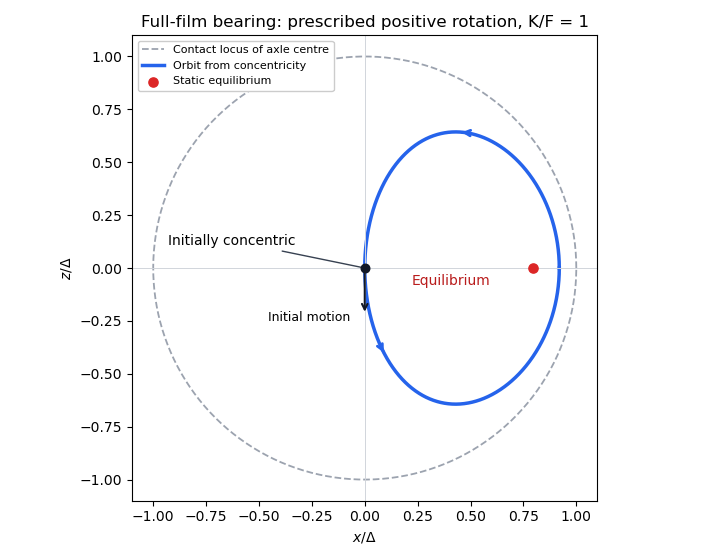
One should not assert that this full-film model necessarily settles to the equilibrium. It predicts full-film journal-bearing whirl. For , eliminate time from the two boxed evolution equations and put . The orbit starting at concentricity obeysso, with its zero initial horizontal displacement,The orbit begins on the lower branch, turns at before contact, and returns along the upper branch, forming a closed orbit through concentricity. The ratio of the right-hand side to increases from zero to infinity, giving a unique turning eccentricity below one. Linearizing at equilibrium likewise gives and with : the eigenvalues are imaginary, not damped. Thus the equilibrium position exists, but the initially concentric axle circulates around it in the stated ideal full-film approximation. Cavitation or additional mechanical constraints would change the model; none were specified.
The normalized centre trajectory below illustrates the full-film prediction for . The dashed circle is the contact locus of the axle centre, not either cylinder wall.
Journal-bearing geometry and whirl
. Details. 
Articles by others on the same topic
There are currently no matching articles.