The optical telescope focuses the sky onto an optical slit; the collimator turns the selected light into a beam incident on the reflection diffraction grating; the optical camera images each diffracted direction onto the photodetector. The drawing also shows the monochromatic optical slit image for uniform optical slit illumination in the geometric, slit-limited approximation.
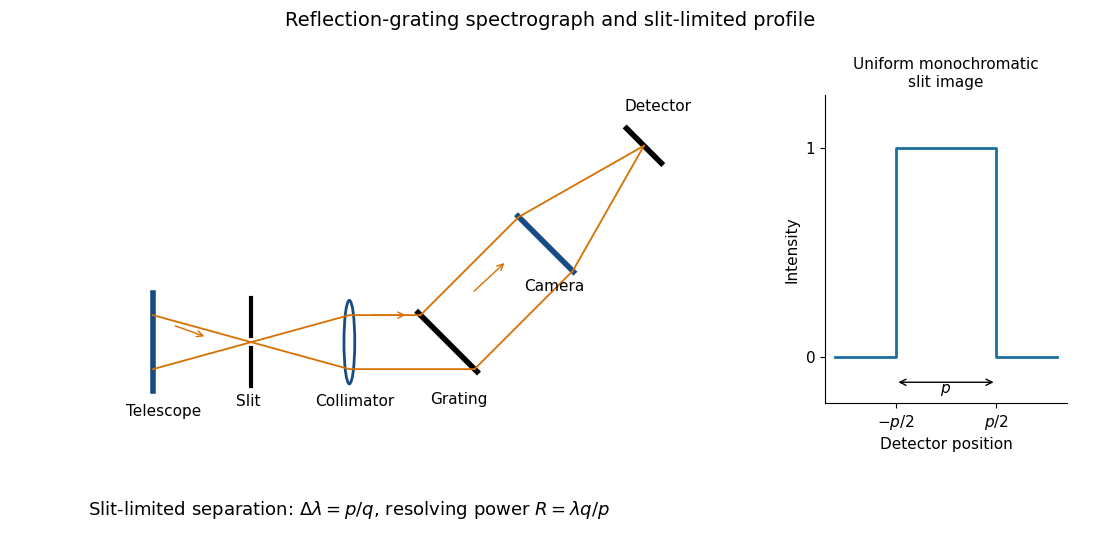
Reflection-grating spectrograph and slit-limited line profile
. Details. 
Near the chosen wavelength , a small wavelength increment moves the image by , where is the magnitude of the linear spectral dispersion. An optical slit image of physical width therefore has an apparent spectral width . With one optical slit width as the adopted separation criterion,Uniform illumination gives a top-hat monochromatic profile of width ; an unresolved stellar image need not illuminate the optical slit uniformly, so its profile follows the actual illumination convolved with the instrument response. Negligible optical slit diffraction and optical camera optical aberrations do not remove the finite diffraction grating diffraction width. The formula is the slit-limited result when that width is small compared with , rather than a universal exact line-profile criterion.
Let be the optical telescope focal length, the physical optical slit width, the collimator focal length, and the incident collimated beam diameter. For the grating equation , differentiation at fixed wavelength gives . Thus the monochromatic optical slit image width isThe incident and emergent optical pupil widths are and . Multiplying cancels the anamorphic magnification of a grating:This is conservation of the Lagrange optical invariant in the dispersion plane. It uses paraxial optical slit angles, an unvignetted optical pupil and matching full-width conventions for .
Insert the slit-limited spectral resolving power into the invariant expression:Here is a magnitude; a signed linear spectral dispersion would require the corresponding absolute value. Since has units of photodetector length per unit wavelength, has units of length.
Differentiate the grating equation with incidence fixed:The second formula is local to a spectrum centered on the optical camera optical axis, where to first order. Since the illuminated surface width projects to optical camera beam width ,The expression takes positive diffraction order and width magnitudes. Off-axis, a photodetector mapping also has a factor; the exam's compact formula uses the local paraxial mapping.
Substitution of givesThe incident and outgoing optical path length contributions between the two ends of the illuminated diffraction grating add. Their total is , so is the edge-to-edge optical path difference in the selected diffracted direction. This is a length, not a dimensionless resolving power. With illuminated grooves, and the ideal diffraction grating diffraction-limited spectral resolving power is . A wide optical slit generally gives a smaller slit-limited ; this distinction limits how far the slit-width scaling may be extrapolated. All of these formulae assume the stated reflection-grating sign convention.
Articles by others on the same topic
There are currently no matching articles.