Let denote the fluid pressure perturbation divided by the reference mass density, and let be the buoyancy perturbation. The buoyancy frequency satisfies . Linearization requires small boundary slope , small displacements compared with the vertical scales of the disturbance and background, and advection small compared with the oscillatory acceleration. For a propagating internal gravity wave this includes ; boundary slope alone is insufficient when . The Boussinesq approximation also requires small relative mass density differences over the region of interest. These conditions must hold for the resulting disturbance, including any amplification by resonance.
The inviscid Linearized Boussinesq equations and linear kinematic boundary condition areWrite the velocity field as . Incompressibility and horizontal momentum balance giveThe vertical momentum balance therefore yieldsFor a real vertical wavenumber , this gives the dispersion relationWhen , define . The radiation condition selects , because energy must leave the boundary upward. The boundary-forced internal gravity wave isIts wavevector is , its phase velocity is , and its group velocity isThus the phase velocity points down and right, while the group velocity points up and right. They are perpendicular. Internal-wave polarization makes the particle motion an oscillation along the group velocity direction, with zero first-order mean transport. The constant-phase lines of an internal gravity wave are also parallel to the group velocity. Their inclination above the horizontal satisfies .
When , set . Boundedness at infinity selects the evanescent waveThe horizontal and vertical velocity components are in quadrature: fluid particles describe small ellipses, and the response decays over . There is no upward time-averaged energy flux, because and are in quadrature. A real vertical group velocity is not defined for this evanescent wave. The pattern travels horizontally with phase velocity .
For the response is the evanescent wave with ; the ratios should not be used. At the cutoff , the bounded harmonic solution has , : it neither decays nor has nonzero upward group velocity. It is the limiting cutoff response, rather than a localized radiating disturbance. A uniform nonzero buoyancy frequency in an infinitely deep Boussinesq approximation is itself a local idealization of the background mass density.
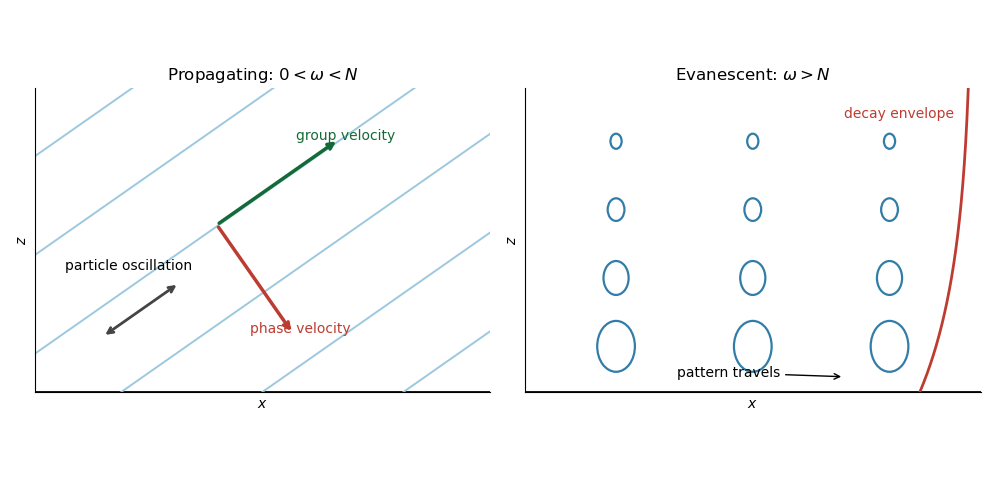

The arrows distinguish the phase velocity, group velocity, and oscillatory particle motion of the internal gravity wave. The right panel shows the decay envelope and particle ellipses of the evanescent wave.
At the change in buoyancy frequency, continuity of vertical velocity and fluid pressure givesThe background mass density is continuous, so there is no interfacial density jump or separate surface restoring force. Since , these internal-wave transmission across a stratification step conditions are continuity of and . The buoyancy perturbation need not be continuous, because the background density gradient jumps.
Let and . The lower unstratified layer obeys and the upper radiation condition givesPropagating these matching data downward givesThe kinematic boundary condition at the moving lower boundary therefore givesThe upper vertical-displacement complex amplitude at isIn particular, . The unstratified layer attenuates and phase-shifts the transmitted internal gravity wave. The matching height is in the original PDF; the TeX transcription's is a typo.
The central stratified layer supports upward and downward internal gravity waves, whose counterpropagating components form a standing wave. The unstratified regions support evanescent waves, and the upper disturbance decays as . Consequently the central layer is a stratified internal-wave guide, rather than a source of propagating energy at infinity.
The largest response occurs at its trapped normal mode frequencies. They can be specified without solving the forced problem. Set the boundary forcing to zero to find a free normal mode. The lower solution is proportional to , so continuity of fluid pressure and vertical velocity givesIn the central layer writeThe upper Robin boundary condition then gives the exact trapped-mode conditionThe left side increases strictly from zero to infinity, so there is one positive root for each ; the frequencies accumulate at zero. This is constructive phase matching after reflection at both ends. The phase shifts from the evanescent waves matter: simply imposing integer half-wavelengths across the stratified layer is generally incorrect.
In the ideal inviscid model, exact resonant forcing has no bounded steady harmonic solution. The undamped normal mode grows secularly under sustained forcing. Weak viscosity or other losses would produce large finite peaks near the displayed frequencies; the linear approximation eventually fails if the disturbance becomes too large.
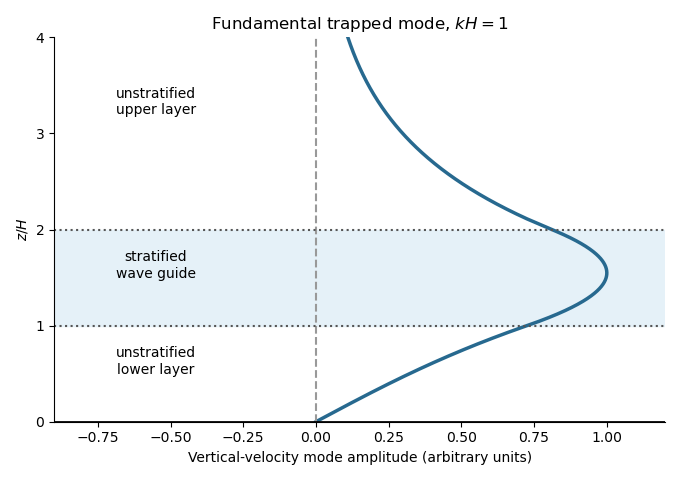
A trapped internal-wave mode
. Details. 
The illustrated free normal mode has an oscillatory central region and evanescent wave tails. Its lower tail reaches the fixed zero-displacement boundary; its upper tail decays to infinity.
Articles by others on the same topic
There are currently no matching articles.